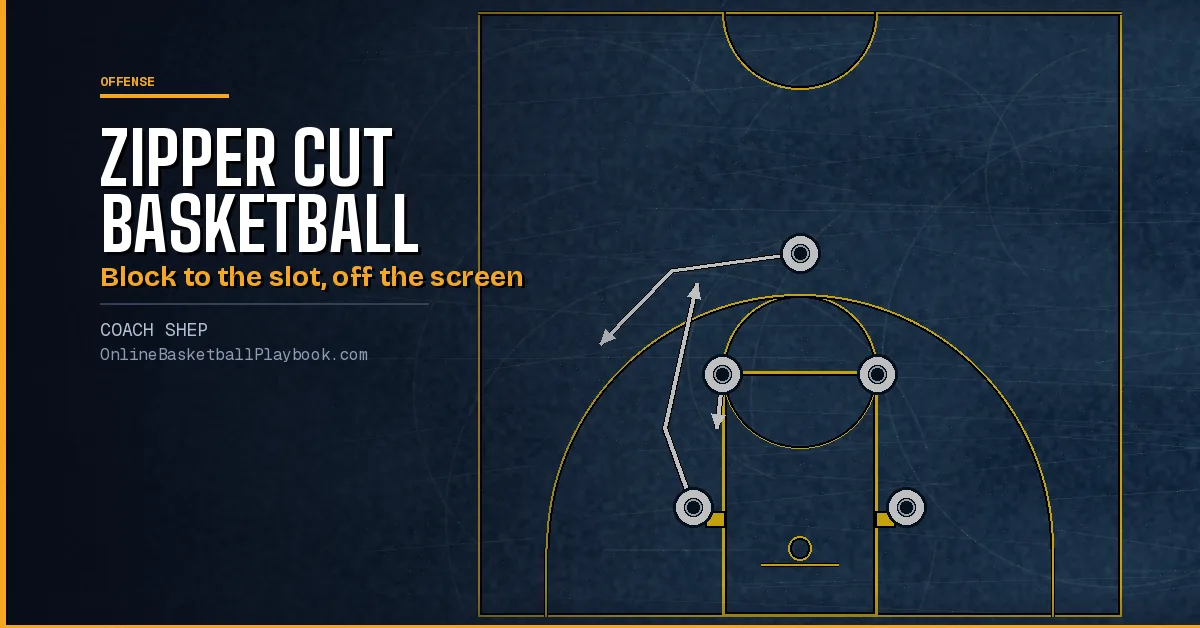
Zipper cut basketball starts with a down screen near the lane. A player on the block runs straight up past the screener, usually a big who steps down from the elbow, and catches at the slot or the top of the key with the offense already moving. Coaches call the cut the zipper, the screen the zipper screen, and the cut plus whatever follows it zipper action.
The zipper is an entry. FIBA lists the zipper cut among the common ways a play begins, and the word zipper often comes first in a play call, with a tag for what follows the catch. The screen itself is covered on down screen basketball.
The Zipper Cut in Basketball
FIBA's glossary defines the zipper as a down screen set for a low-block player, on the strong side or the weak side, who then cuts up to the slot for the ball. Other versions start the cutter on the block or in the corner, send him around the low post or straight up past an elbow screen, and end with a catch at the slot or the top of the key.
Two names sound close and mean something else. The zipper stack is a separate continuity built on two stacks at the free-throw line. The Iverson cut runs across the floor over two screeners at the elbows.
Write your version next to the word on the call sheet.
The Base Zipper Action
The clearest picture starts from a box. 4 and 5 stand at the elbows, 2 and 3 on the blocks, and 1 brings the ball to the top of the key.

- The dribble entry. 1 dribbles to a wing, which lets a team flow out of transition into the set without stopping.
- The screen. The big on that side steps down from the elbow and screens for the player on the block.
- The cut. The cutter jab-steps to put his defender between himself and the screen, waits for the screener to be set, then runs up past him and opens to the ball.
- The catch. He catches above the elbow, at the slot or the top of the key, facing the basket.
The ball handler on the wing can drive when he beats his man, pass to the cutter, or feed the screener posting up low. With the screen on the ball side, the defense has to guard an outside and an inside threat at once.
Set the screen first, cut second, and catch facing the rim on every rep.
Where the Zipper Screen Goes
The cut always runs low to high. The spot of the screen changes from set to set.
- At the elbow. A two-elbow version screens at both elbows. One cutter comes up the lane to the top of the key while another comes up to the left slot.
- At the mid-post. The big steps down from the elbow to the mid-post, and the cutter runs straight up the lane line past him.
- On the block. The post on the block is the screen, and the cutter curls tight around him.
- Near the corner. A big crosses the lane to screen low for a corner player.
The screener is usually a big. One sideline play also has a guard screen down for a big.
Pick one spot and use it every time, so the cutter and the screener meet in the same place.
What the Catch Leads To
The zipper gets a player the ball on the move. What happens next is the second word in the call.

- Ball screen from the zipper screener. The screener follows the cutter up and sets a high ball screen.
- Ball screen from the other big. The far big comes up to screen, and the cutter attacks the side the first actions emptied, as in the zipper into a pick and roll from the box. The corner zipper into a ball screen adds a high-low pass if the drive is stopped.
- Handoff. The ball is reversed to the cutter, who dribbles at the far wing for a handoff, covered on dribble handoff basketball.
- Spain. The catcher goes straight into a ball screen with a back screen on the roller's defender, covered on Spain pick and roll. A Miami tag sometimes goes in between, and Miami means different jobs in different offenses.
- Flex. The zipper screener clears to the corner. The other big cuts to the low block, sets a flex screen for the player in the corner, then pops back to the ball.
- Lob. A big flashes to the high post and the zipper screener back screens for the far player, who cuts high first to set up his defender.
- Post feed. The screener seals his man and posts once the cutter is by.
Teach one follow-up until it is automatic, then add the next tag.
Reads Against a Chase, a Top-Lock and a Switch
A defender can guard the cut in a few ways, and each opens its own counter.
- The jab. If the defender ignores the jab, the cutter comes up to the top of the key on the inside, nearest the passer. If he bites, the cutter comes straight up the middle.
- Chase. X2 trails over the screen. The cutter comes off it toward the free-throw line area for the jumper, with a step of room on his man.
- Top-lock. X2 sits on the high side to take away the catch. The cutter takes him high and back cuts to the rim as the screener steps out to the short corner. The passer hits the cutter, or the short corner, who can pass on to the cutter.
- Switch, big on the cutter. The cutter pump fakes the closeout and drives, dropping it off to a post or kicking to a wing when help comes.
- Switch, small on the screener. The screener posts the smaller man and the cutter feeds him. When the post is fronted, the ball goes to the cutter first for a better angle.
- Show and recover. When the screener's defender steps out to show, or waits to switch, the cutter steps up and back screens him. The screener rolls for a lob or posts a smaller defender, and the cutter pops out.


Team defenses use two answers. In a show and recover, the screeners' defenders show and force the cutters wide while the cutters' defenders chase to deny, and the back screen for the screener answers it. A pressure defense instead traps the guard on the wing, who is left alone by the ball-side screen, and switches to front the post.
Give the cutter one answer for each coverage, and let the defense choose which one he uses.
Versions of Zipper Action
The cut stays the same in every version.
- Double zipper. Both block players come up at once, each off his own big. A late-game version has two bigs set a double zipper for the point guard, who attacks, with a flare for a shooter as the second option.
- The zipper offense. A full system on the ball-side down screen. It runs the dribble entry, the down screen and a post-up, then reverses into the far down screen, with two offensive rebounders kept on the weak side. When it stalls it flows into motion, flex, a triangle post or a side ball screen.
- A one-entry series. Five sets share one start, a dribble entry to the right wing and the 4 screening down for the 2, and end in a clear-out for the post, a lob, a backdoor for 2, a flex screen or a handoff.
- Against a zone. A box set uses the zipper cut up the lane to build an overload, drawn on set plays vs zone.
Zipper is also a family name. Some teams use it as the name for a whole group of sets.
Choose the version that fits your system, and keep the cut identical in all of them.
Zipper Out of Bounds
On a sideline inbound the zipper is a way to free the catcher. The down screen lifts a guard up toward the inbounder.

- Pass or post. The inbounder hits the cutter or feeds the screener posting up low.
- Into a pick and roll. Two players screen down for two teammates and clear to the corners. One screened player catches, and the other comes up to ball-screen for him. The full play is on basketball inbound plays.
- Handoff back. The receiver hands back to the inbounder, who gets a pick and roll at the top while a shooter turns out on the far side. Put your best decision maker at the 1.
For the end of a game, the zipper is one of the single screens that can get a shot with two to five seconds left. More sideline sets are on sideline out of bounds plays.
Run the same zipper from the sideline that you run in the half court, so the special situation needs no new reads.
How to Teach the Zipper Cut
Every off-ball screen has three jobs. The cutter runs his man into the screen and changes speed. The passer delivers on time, because a late pass or an extra dribble lets the defender recover. The screener sets a solid screen with contact, holds still, then looks for the ball.
- Zipper shooting. A line behind the baseline with two or three balls and a coach on the wing. The player passes to the coach, zipper cuts to the top of the arc, catches, rips through and drives to finish. Add a jab, a one-dribble pull-up and a spin finish. Get 10 to 15 makes a side.
- Zipper drive and kick. The same start with a shooter in the opposite corner. The cutter drives and kicks for the corner three, and the passer becomes the shooter.
- Screener and cutter. The zipper shooting drill puts a big at the mid-post and a coach in the slot. Swap the two players, run both sides, then add a defender who chases.
- Small-sided. Walk the elbow screen in groups of three, then play it 3-on-3 live until a score or a stop.
- Chain the screens. Once the zipper is clean, follow it with a pin-down, a back screen and a baseline exit, reading each defender until a good shot or a good post touch.
Keep the weak side moving, and if the defense cheats into the key, stay spaced instead of running into a screen that clogs the lane. More screen drills are on drills to teach off-ball screens.
Drill the cut alone first, then add one defender, then the full team.
Questions Coaches Ask
What is a zipper cut in basketball?
A cut from the block straight up past a down screen to the slot or the top of the key. FIBA's glossary calls it a down screen set for a low-block player, who cuts up to the slot for the ball.
What is the difference between a zipper cut, a zipper screen and zipper action?
The zipper cut is the cutter's path, and the zipper screen is the down screen he runs off. Zipper action is the cut together with what follows the catch, such as a ball screen, a handoff or Spain.
How do you beat a defender who top-locks the zipper?
Back cut. The cutter takes the defender high and goes to the rim while the screener steps out to the short corner.
Is a zipper the same as an Iverson cut?
No. The Iverson cut runs across the floor over two screeners at the elbows. The zipper runs up from the block off a down screen.
Can you run a zipper out of bounds?
Yes. From the sideline a big screens down for the receiver, and the play goes on into a pick and roll or a handoff back.
Every diagram on this page uses the symbols on how to read a basketball play diagram. Related actions are on zoom action and Chicago action, more short sets are on quick hitters, and the ball-screen reads after the catch are on pick and roll.
Get the next coaching guide in your inbox
One email when a new guide or diagram set goes up. Free.
Want the printable playbook packs?
Playbook packs: zone attack, press break, press defense, out of bounds, quick hitters, practice plans and the youth turnover cure, each a printable PDF. Or draw your own version free in PlayDraw.
See the playbook packsRelated Guides
- Floppy Action Basketball: Setup, Reads and Counters
- Step Up Screen Basketball: The Step-Up Ball Screen Explained
Back to Basketball Plays and every Offense page.
Keep Building
Related breakdowns
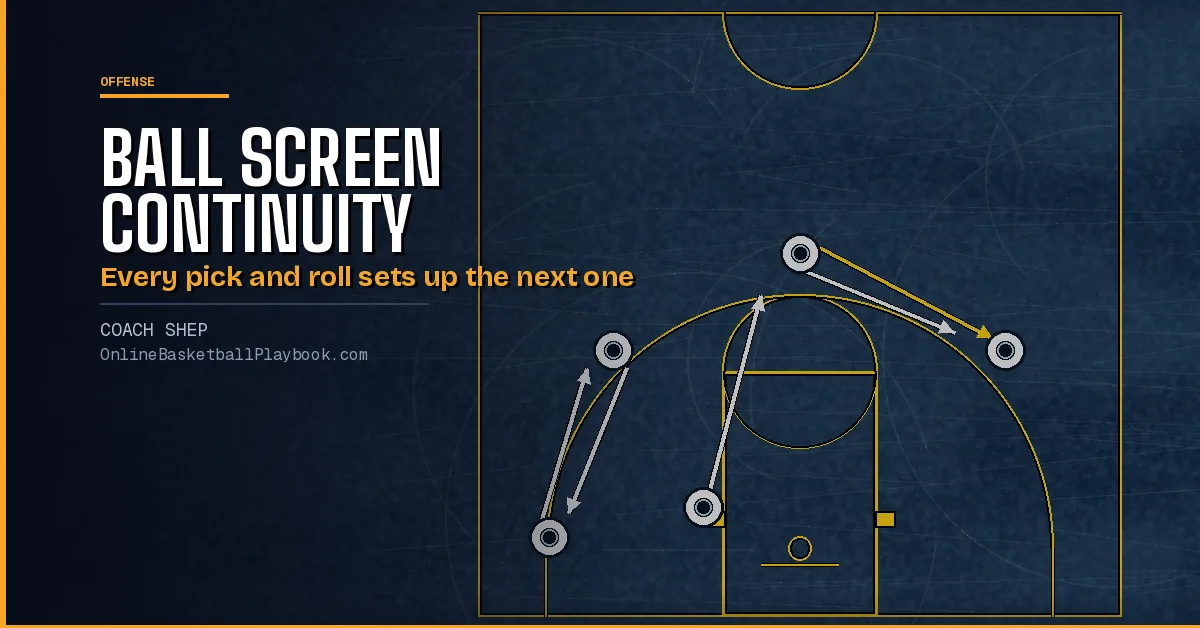
Ball Screen Continuity Offense: Pick and Roll Rules and Reads
Ball screen continuity offense in full: the 4-out and two-big engines, reload rules, spacing, angles, reads, counters, Spain, Ram, double drag and zone sets.
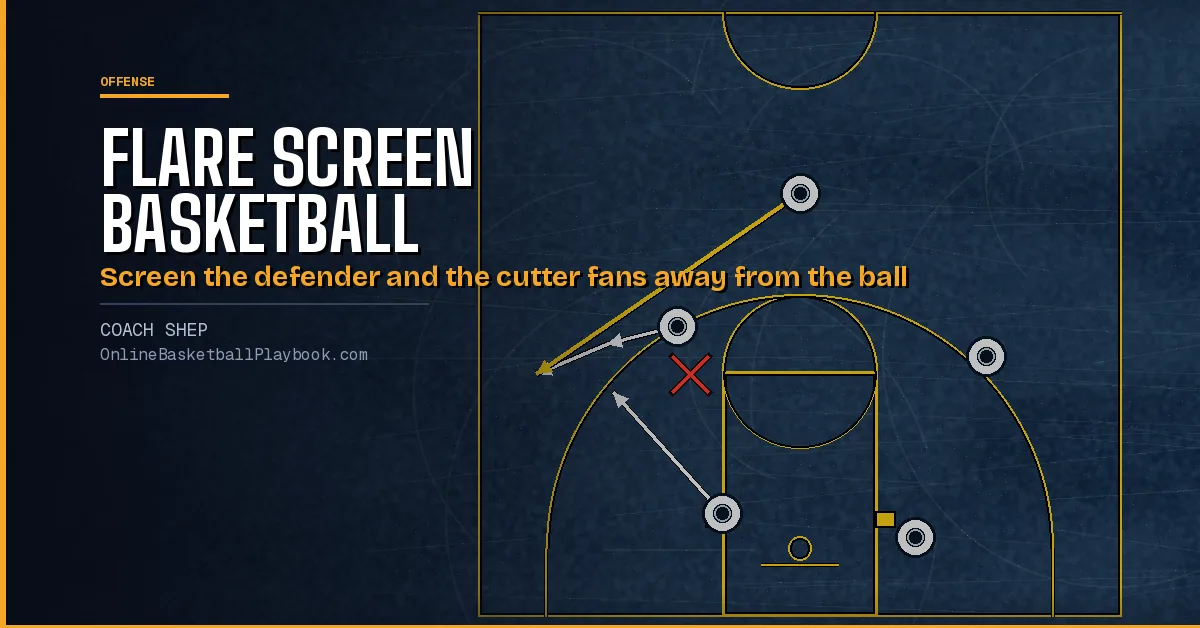
Flare Screen Basketball: How It Works, Reads and Counters
Flare screen basketball explained for coaches, with the screen, the cut, the pass, the three reads, where teams use it and how coaches teach and defend it.
Princeton Offense: Cuts, Reads and Sets
How the Princeton offense works: the Chin set, backdoor cuts, the high-post reads, the players it needs, how to install it and what defenses do to stop it.