
This glossary covers every essential basketball term — offense, defense, positions, and plays — defined clearly for players, coaches, and fans at every level of the game.
Offensive Terms
Basketball offense is built on spacing, movement, and decision-making. Understanding the language of offense helps every player read the floor and react without hesitation.
Pick and Roll: One of the most common actions in basketball. The ball-handler dribbles toward a teammate who sets a screen (the pick). As the defender fights through or switches, the screener rolls to the basket looking for a pass. The pick and roll creates two problems at once — a defender who fights the screen leaves the roller open, and a defender who drops off the screen leaves the ball-handler open for a pull-up jumper. For a deeper breakdown of stopping this action, see our guide on defending the pick and roll.
Backdoor Cut: When a perimeter player is being overplayed by a defender, they cut hard to the basket behind the defender's back. The passer must deliver the ball quickly to the cutting player's inside hand. The backdoor cut is a staple of motion offense because it punishes aggressive on-ball defense.
Curl Cut: A cut where an offensive player loops around a screen and curls toward the basket or the elbow, typically to receive a catch-and-shoot or catch-and-drive opportunity. The curl is most effective when the defender trails the cutter around the screen.
Dribble Penetration: Attacking the basket off the dribble to collapse the defense. When a ball-handler beats their defender and draws help, teammates on the perimeter must be ready to catch and shoot, attack closeouts, or feed the post. Good dribble penetration breaks down zones and man-to-man defenses alike.
Spacing: The positioning of offensive players to stretch the defense across the entire court. When five players are spread to the corners, wings, and top, the defense cannot double-team without leaving someone wide open. Spacing is the foundation of every effective offense, from sets to free-flowing systems. The 5-out motion offense maximizes spacing by keeping all five players on the perimeter.
Drive and Kick: When a ball-handler attacks the lane and passes to an open shooter on the perimeter as the defense collapses. The "kick" is the pass back out to a catch-and-shoot player. This action is the primary way to generate open three-point looks against aggressive help defenses.
Post Entry: A pass from the perimeter into a post player positioned in the lane or on the block. Effective post entries are low and firm, thrown to the player's inside hand away from the defender. Once the ball enters the post, the perimeter must lift and create skip-pass angles.
Transition Offense: The period immediately after a defensive rebound or turnover when the offense pushes the ball upcourt before the defense is set. Running the fast break effectively means making quick decisions — either finish with a numbers advantage or set up your half-court offense before the defense gets organized.
Defensive Terms
Defense wins championships — and it starts with every player knowing exactly what they're responsible for. Shared language on defense means fewer breakdowns and faster communication.
Help Defense: When a defender leaves their assigned player to stop a ball-handler who has beaten their primary defender. Good help defense requires anticipation, positioning, and the discipline to rotate back to your original assignment. Our full guide on help defense principles covers positioning, rotations, and the five-second rule for recovery.
Closeout: The sprint and controlled stop a defender makes when their assigned player catches the ball on the perimeter. A proper closeout is high hands, short choppy steps at the finish, and a low athletic stance — never a flat-footed stumble that gives the offensive player a straight-line drive. Technique matters; see basketball closeout technique for the mechanics.
Denial Defense: Guarding a player who does not have the ball by taking a position that makes it difficult for them to receive a pass. The defender positions their body between the ball and the offensive player, with one arm in the passing lane. Denial defense is used on dangerous scorers and shooters who want to catch the ball in rhythm.
Zone Defense: A defensive scheme where each player guards an area of the court rather than a specific opponent. The most common zone is the 2-3 zone, which places two defenders at the top and three near the baseline. Zones can disrupt timing offenses, protect foul-prone players, and create confusion for unprepared opponents.
Trap: A two-defender pressure tactic designed to force a turnover. Traps are most effective on the sideline, in corners, or after a ball-handler picks up their dribble. The two defenders converge simultaneously, forcing a pass or a held-ball. The remaining three defenders must anticipate the pass and intercept it. The full-court press uses trapping as its primary mechanism.
Switch: When two defenders trade their assignments after a screen is set. Switching is most effective when the two players are similar in size and athleticism. Mismatches occur when a smaller guard switches onto a post player or a forward switches onto a quick guard.
Box Out: Establishing body position between an opponent and the basket after a shot is taken. The goal is to prevent the offensive player from getting position for an offensive rebound. Proper boxing out requires making contact first, then pivoting to seal the opponent before pursuing the ball.
Transition Defense: Sprinting back after a turnover or made basket to get between the ball and the basket before the opposing offense can score in the open court. Good transition defense requires effort, communication, and a willingness to take a charge when necessary.
Positions and Roles
Modern basketball has blurred traditional positional lines, but players still need to understand the responsibilities that come with each spot on the floor.
Point Guard (1): The primary ball-handler and floor general. The point guard initiates the offense, calls plays, and sets the pace. At the highest level, point guards must be elite decision-makers who make everyone else better — not just individual scorers. They must be able to create for themselves and for others off the pick and roll, and they must take care of the ball.
Shooting Guard (2): Typically the team's best perimeter shooter and a secondary ball-handler. The shooting guard must be capable of creating their own shot off the dribble, catching and shooting, and defending the opponent's best perimeter scorer. In many modern systems, the 1 and 2 are interchangeable.
Small Forward (3): A versatile player who can score from multiple spots, defend multiple positions, and contribute in the open court. The small forward is often the team's best wing defender and must be able to guard bigger players in the post and quicker players on the perimeter. Versatility is the defining trait of an effective three.
Power Forward (4): Traditionally a physical post player who rebounds, defends in the paint, and scores close to the basket. In the modern game, many power forwards are stretch fours who can knock down the three-point shot from the perimeter while still defending in the paint. The stretch four creates spacing problems that traditional big-man defenses struggle to solve.
Center (5): The anchor of the defense and the team's primary post player. The center is responsible for protecting the rim, defending the pick and roll (either by switching or dropping), and establishing post position on offense. Rim protection — the ability to contest shots in the lane and alter the opponent's approach — is the most valuable trait a center can bring to a team.
Plays and Sets
Plays and sets give teams a structured starting point — a choreographed action designed to create a specific advantage. Every player must understand the purpose of each action, not just the footwork.
Horns: A formation where two players set screens at the elbows while the point guard brings the ball up the middle. The ball-handler can go to either elbow, triggering a pick and roll to one side. Horns gives teams multiple options from a simple formation — pick and roll, dribble handoff, corner action — and is difficult to scout because the reads are interchangeable.
Floppy: A set play that begins with a baseline runner using a series of screens to get open. The runner can curl, fade, or cut straight — reading the defense to determine the best option. Floppy is designed to free up a shooter coming off multiple screens in sequence.
Elevator Doors: A set where two screeners set side-by-side screens on the lane line and then close together (like elevator doors closing) as the shooter cuts between them. This action generates a clean catch-and-shoot look for the shooter by pinning the trailing defender.
Spain Pick and Roll: An advanced action where the ball-handler runs a standard pick and roll, but a third player sets a back-screen on the big's defender as the big rolls to the basket. The third screen creates a free roll-man catch for a layup or dunk. Spain pick and roll requires precise timing and is one of the most difficult actions to defend in contemporary basketball.
Inbounds Plays: Set plays used to get the ball inbounds from the sideline or baseline. Well-designed basketball inbounds plays create open shots out of timeouts and late-game situations. Every team should have a baseline inbounds play that can be run for a layup or a three-point shot depending on what the defense gives.
Motion Offense: A system built on principles rather than set plays. Players move with purpose — filling spots, cutting, screening — based on where the ball is and what the defense is doing. Motion offense develops basketball IQ because players must read the defense and make decisions in real time rather than executing memorized footwork.
Rules and Officiating
Understanding the rules eliminates confusion in critical moments. Players and coaches who know the rulebook can make smarter decisions and avoid preventable violations.
Traveling: Moving with the ball without dribbling. A player may take a gather step before their two allotted steps. After picking up the dribble, a player may not move either foot without passing or shooting. Common travel violations include the "hop step" gather that gathers too early, and the spin move that drags the pivot foot.
Charge / Block: One of basketball's most contested calls. A charge occurs when an offensive player runs into a defender who has established legal guarding position (feet set, body square, outside the restricted area). A block is called when the defender is still moving or is inside the restricted arc under the basket. The distinction — position versus timing — determines the call.
Technical Foul: A foul assessed for unsportsmanlike conduct or violations unrelated to the action of the ball. Technical fouls result in free throws for the opposing team and possession of the ball. Two technical fouls result in ejection from the game. Coaches and players must manage their emotional responses to avoid giving opponents free points.
Bonus / Double Bonus: Once a team reaches a set number of team fouls in a quarter or half (depending on the league), every subsequent foul sends the opponent to the free throw line regardless of the type of foul. The double bonus — common in NCAA basketball — sends the fouled player to the line for two free throws automatically. Managing foul count is a critical element of late-game strategy.
Lane Violation: Entering the lane too early on a free throw attempt. Lane violations on the shooter result in a do-over; lane violations by the defense result in awarding the basket if the shot is missed. Players must wait until the ball hits the rim before entering the lane.
Backcourt Violation: Once the offensive team has advanced the ball past the half-court line, they may not return to the backcourt with the ball in control. Backcourt violations are common when teams are being pressed. Teams should have a clear press break system to handle full-court pressure without turning the ball over.
Coaching and Strategy
The best coaches in the game are teachers first. They use consistent language, clear expectations, and deliberate practice to build players who can execute under pressure.
Shell Drill: The foundational defensive practice drill that teaches help positioning, closeouts, and rotations in a controlled setting. Running a shell drill correctly means defenders are always in help position when they don't have the ball, and they close out on every catch. It is the single best drill for building sound team defense from scratch.
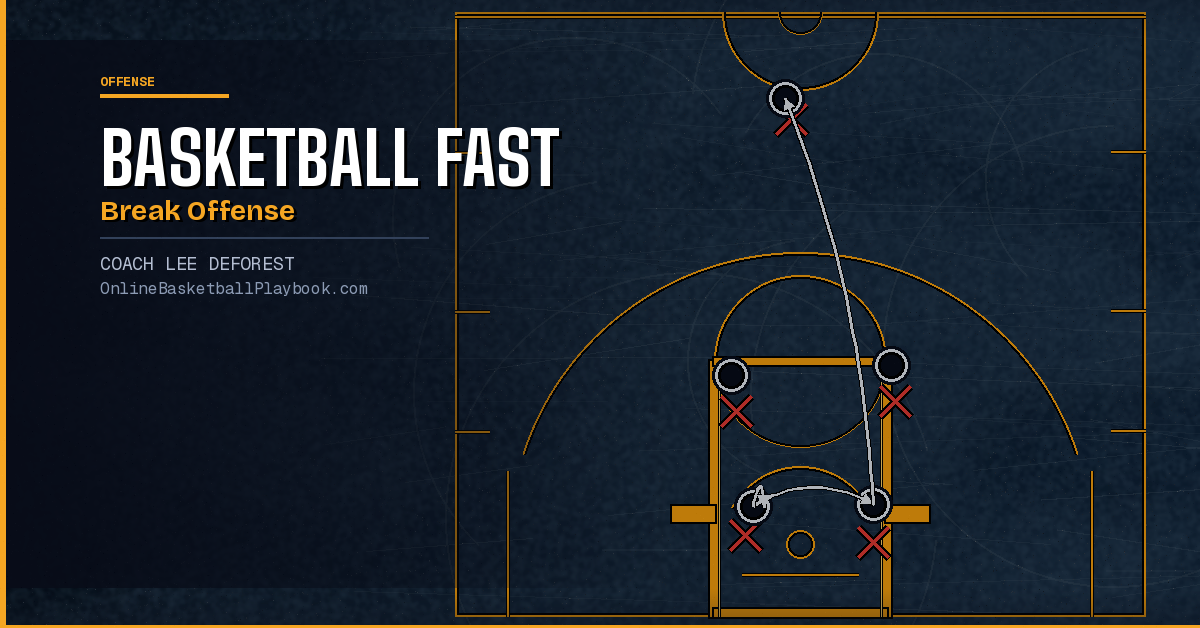
Fast Break: Running the ball upcourt for a quick scoring opportunity before the defense can set up. The goal is a numbers advantage — a 3-on-2 or 2-on-1 — that results in a layup or a high-percentage shot. Fast breaks can come from steals, defensive rebounds, or made baskets, and they set the physical and emotional tone of a game.
Half-Court Offense: The organized offensive system used when the fast break is not available and both teams are set. Half-court offense requires patience, spacing, and execution. Most set plays and motion principles are designed for the half-court setting.
Matchup Zone: A hybrid defense that looks like a zone but assigns defenders based on offensive player positioning. The matchup zone can confuse offenses that prepare specifically for man-to-man or standard zone, because it has elements of both. It requires extensive communication and defensive IQ to run effectively.
Press Break: The organized system a team uses to advance the ball against a full-court press. A good press break attacks the middle of the court, moves the ball quickly against the traps, and converts pressure into fast-break opportunities going the other way. Players who have practiced a press break handle adversity calmly; players who haven't tend to panic and turn the ball over.
Practice Planning: The structure and intentionality behind how a team uses its time at practice. A great basketball practice plan moves quickly, puts the most important skills first when attention is highest, and builds toward the upcoming opponent's tendencies. Standing in lines is wasted time — every minute should have a player touching the ball or engaged physically.
"Fun first — 'if they don't enjoy it, they won't play it.' Enjoyment is the key ingredient in developing motivation."
— Basketball Vault
Don't try to introduce every term at once. Build your team's shared vocabulary one concept per week, starting with the terms that apply to your current defensive and offensive system. Players learn faster when language is tied directly to what they're doing in practice.
- Pick and roll: ball-handler uses a screen, screener rolls to the basket — creates two defensive problems simultaneously
- Spacing: keep players spread so the defense cannot help without leaving someone open for a catch-and-shoot
- Help defense: stop the drive, then recover — every player must know their rotation when the ball beats someone
- Closeout: sprint, then chop your steps — never arrive flat-footed or the offensive player drives straight past you
- Box out: make contact first, pivot to seal, then pursue the ball — the rebound belongs to whoever wants position more
- Transition defense: sprint to the paint before worrying about your assignment — stop the layup first, guard your man second
Get free play diagrams, drills, and coaching guides delivered weekly.
Keep Building
Related breakdowns
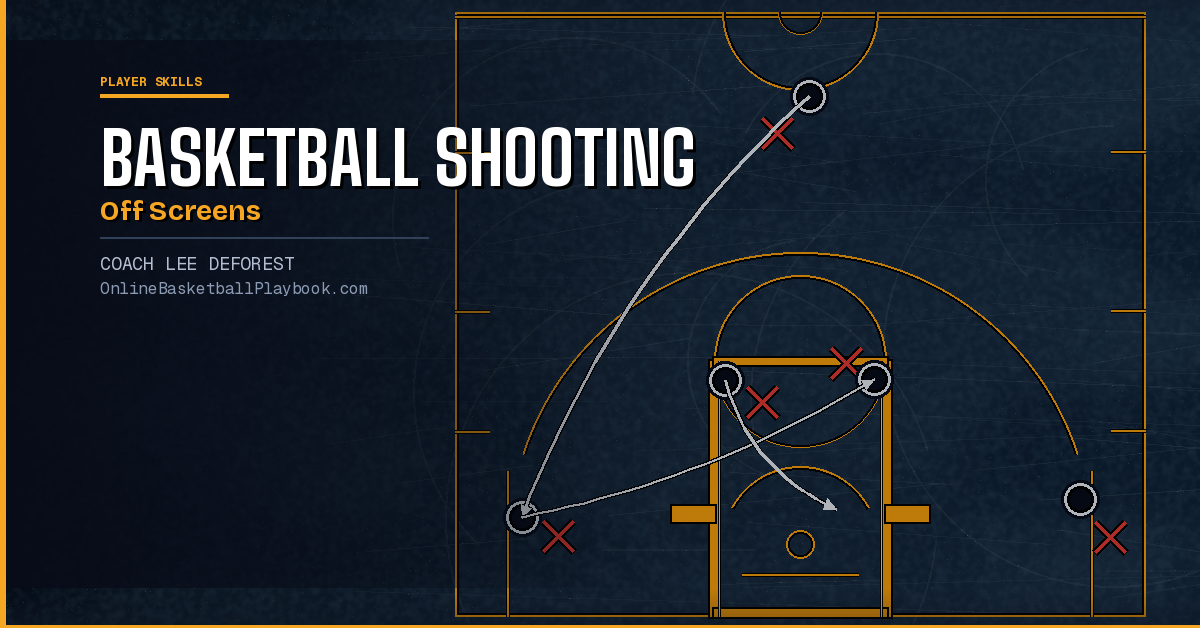
Basketball Shooting Off Screens: Complete Guide
Basketball Shooting Off Screens: Complete Guide
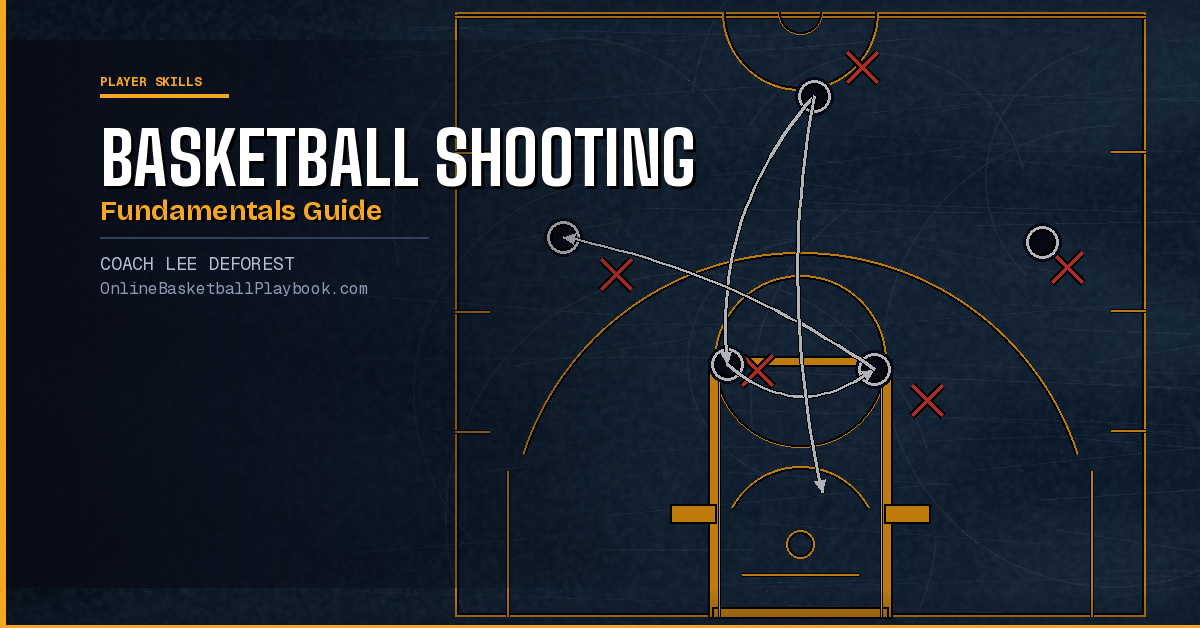
Basketball Shooting Fundamentals: Complete Coach Guide
Basketball Shooting Fundamentals: Complete Coach Guide