The point guard mindset comes down to preparation. A point guard has to be thinking all the time and ready for every situation, and that takes a great deal of mental preparation. The leadership side of the job, carrying the coach's philosophy to the team, is on Guard Skill Development Drills. The habits with the ball are on How to Play Point Guard, and the 1 is compared with the 2 on Point Guard vs Shooting Guard.
From Scorer to Point Guard: The Role
Don Meyer sums up roles in four words: learn, understand, accept, fulfill. One college point guard came in as a scoring guard. As a freshman backup, 38 of his 64 shots were threes. When he became the starter as a sophomore, his coach told him his role was to get the ball to the big men inside, find the shooters, avoid turnovers and defend as well as he could. He took 10 threes as a junior and none as a senior, and led his league in assists and assist-to-turnover ratio. The sacrifice is different for every point guard, but each one has to learn his role and decide whether he will accept it for the good of the team.
Know the Coach and Write It Down
- Know the plays and sets at both ends, and what the coach expects at different times. If he wants the ball pushed for easy baskets and you walk it up after every rebound or make, there is a problem. If he wants a slow, methodical game, play it that way.
- Teammates will sometimes go to the leader before they go to the coach, so the point guard has to understand the coach's philosophy well enough to pass it on.
- Keep a notebook. Write down the philosophy, the sets and the game situations before and after practice. If the coach does not require it, write down everything you can remember at home after practice.
- Practice the rare situations too, such as where everyone stands on a jump ball, with a player ready to steal the tip, and a set pattern for going full court in a few seconds while down two.
Energy and Life Off the Floor
- Don Meyer says a team has two types of people: those who give energy to it and those who drain energy from it. Find a way to get ready so you give energy.
- Rest, because a tired player struggles to bring energy. Some players take a couple of minutes alone before practice to clear the mind. One teammate wrote WDTWT in his notebook before every practice, short for We Deserve To Win Today.
- Meyer's three areas for a college athlete come in order: the classroom first, then the right things off the floor (enough sleep, taking care of the body, staying out of trouble), then basketball. He made it clear that a player who falls behind in any one area cannot stay on top of the other two.
- Know your strengths and weaknesses. One 6 foot 1 point guard without great quickness got as strong as he could in the weight room and used that strength to make up the difference against quicker or bigger players.
Get the next coaching guide in your inbox
One email when a new guide or diagram set goes up. Free.
Reading the Team
- Know what the team needs. If the strength is inside, get the ball inside first.
- Learn how each teammate ticks. Some can take constructive criticism and others tune everything out when they are yelled at. A teammate who takes the time may be able to get inside their heads more easily than the coaches can.
- Read the team's mood from day to day, and tell the coaches when the team has lost its energy or is worn out, so changes can be made.
- The biggest mistakes point guards make are being shy and being too cool.
Point Guard Mindset: Six Intangibles and Eight Qualities
A point guard can master six intangibles:
- Spirit: give two positive comments a minute and do not let the coach's voice dominate practice. Make energy even when you do not feel like it.
- Communication: use names, give information that matters right now, and watch your tone and eye contact.
- Hustle: go hard all the time, on and off the court. Keep the herd together like a sheepdog so teammates do not scatter.
- Approach: body language, including how you carry yourself when things go badly.
- Precision: do things exactly right every time, down to touching the lines when running.
- Enhancement: leave the place better than you found it. Come earlier, stay later, do the extra work and do not expect praise for it.
A quality point guard must also have eight things: a high skill level that strings skills together, such as a dribble into a shot or a pass, physical and mental stamina, courage to make the play, intensity, communication as a coach on the floor, awareness of what has happened and what will happen, timing that knows what teammates can do and where, and deception, where every move looks the same until the last second and the eyes disguise the intention.
Confidence and Daily Work
- Confidence comes from preparation and from what you think about all day. Write down 10 good things you did in a game or practice.
- Respond to mistakes better than anyone you know: clap, smile, nod.
- A daily made-shot routine: 20 swishes in a row to warm up, 200 catch and shoot twos and threes, 100 drag foot and fake sandwich shots, 100 pull-up jumpers, then 50 more fake sandwiches. The drag foot sets one foot behind the three-point line with the toes to the goal and the shoulders open to the passer. A fake sandwich uses a fake at the start and the end of a move.
- One on one is practiced with restrictions, not as free play. Become a better shooter, unbalance the defender with a jab step, a peek and a shot fake, use a fake sandwich, beat him with one explosive dribble, and do everything on balance.
Helping a player accept a role is also on Basketball Positions Explained, leadership for the whole roster on Basketball Leadership, and guard workouts on Guard Workout.
Questions Coaches Ask
What qualities does a point guard need?
A high skill level that strings skills together, physical and mental stamina, courage to make the play, intensity, communication as a coach on the floor, awareness of what has happened and what will happen, timing and deception.
How does a point guard lead teammates?
Know what the team needs, learn how each teammate ticks and read the team's mood from day to day. Teammates will sometimes go to the leader before they go to the coach, so the point guard has to understand the coach's philosophy well enough to pass it on.
How does a point guard build confidence?
Confidence comes from preparation and from what you think about all day. Write down 10 good things you did in a game or practice, and respond to mistakes better than anyone you know.
Related Guides
Back to Basketball Positions and every Player Development page.
Keep Building
Related breakdowns
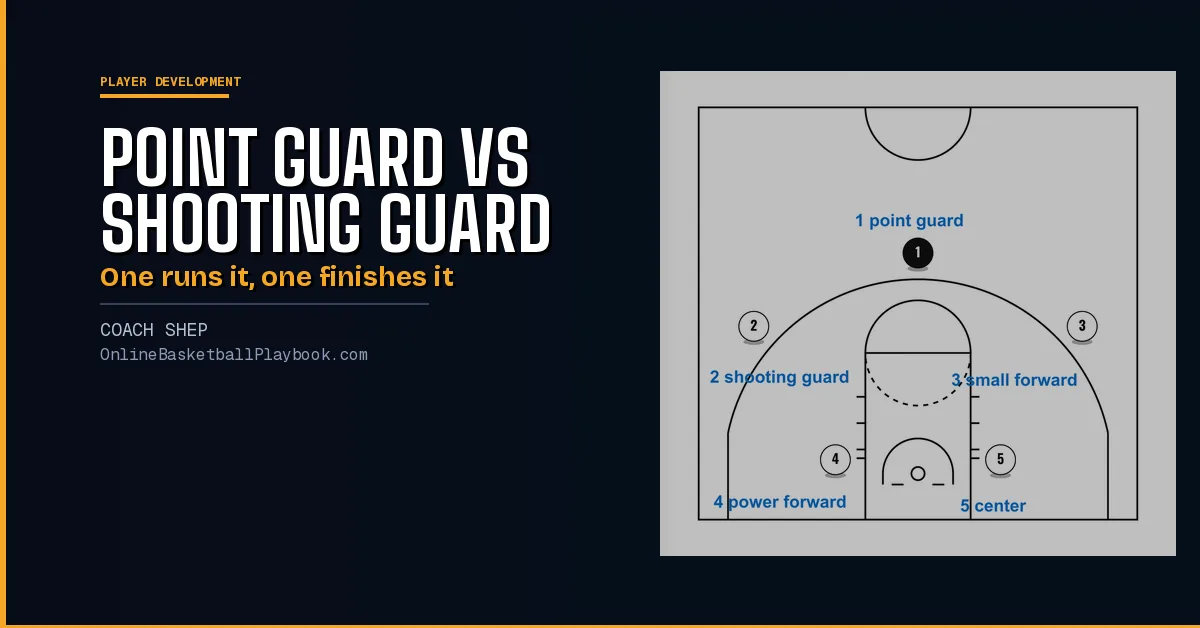
Point Guard vs Shooting Guard: Roles, Skills and Reads
The 1 runs the offense with the ball and the 2 scores without it. Here are both jobs side by side, on offense, on defense, in the break and by type.
How to Play Point Guard: Pace, Shot Selection and Press Reads
Habits for the guard with the ball: pace and the paint, passes to cut out, a shot scale, tempo calls, beating pressure and reading the break.
Guard Development: Skills, Drills and Workouts for Guards
Guard development in order: balance, the handle, ball security, reads, finishing, shooting and on-ball defense, plus a sample session and first fixes.