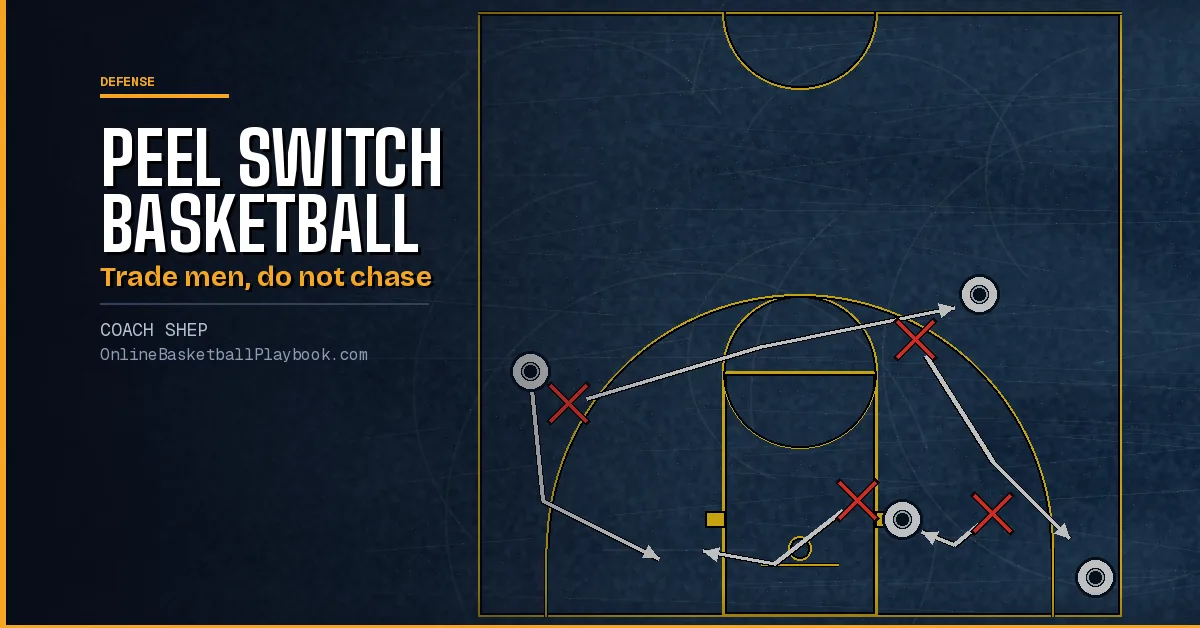
Help defense often breaks on the pass after the drive. The peel switch in basketball fixes that with one rotation: the helper keeps the driver and the beaten defender takes the open man.
A driver beats his man, a helper steps up, and for a moment two defenders are on the ball. The ball goes back out and a defender has to close out from a long way away. One clinician calls the offense's chain of advantages "dominoes," and once the ball leaves the driver, the advantage gets even bigger. The peel switch is a different answer to the beaten defender.
"His man is too far away from him to recover so he is calling help."
This guide covers the two-man peel switch, the full peel rotation, the four ways teams pick the helper, where helpers stand, what the switch costs and how teams teach it. The usual answer it replaces is on help defense principles, and the whole switching picture is on how to coach effective defensive switching.
What Is a Peel Switch in Basketball?
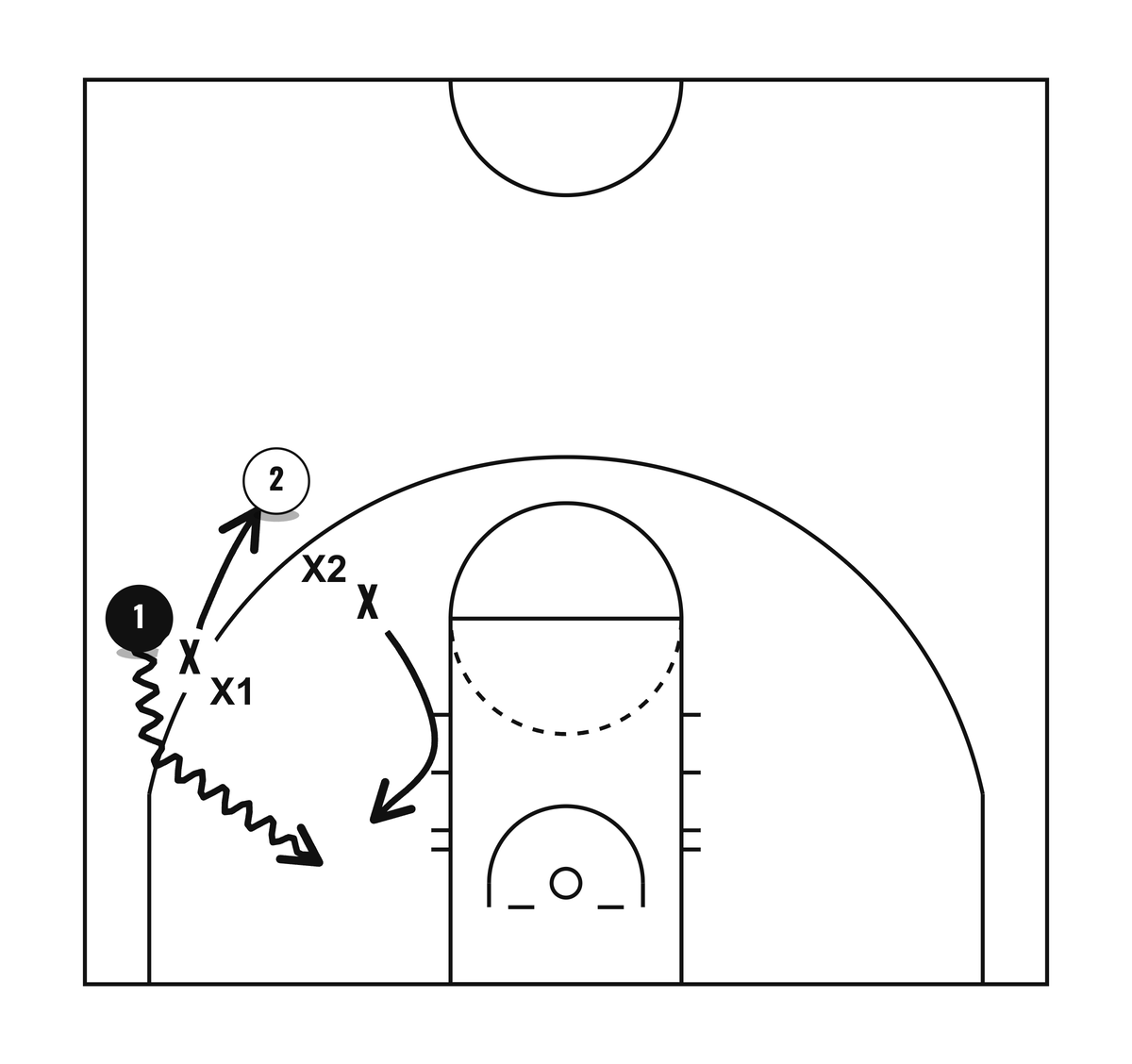
A peel switch is a rotation for the moment the ball gets past its defender. A helper steps in front of the driver and keeps him for the rest of the play. The beaten defender stops chasing and peels off to the player the helper left. The two defenders have traded men.
Compare it with help and recover. There, the helper stops the ball and then has to get back to his own man while the beaten defender catches up. For a moment two defenders are on the driver. If the ball moves in that moment, the open man catches with a head start and the offense's edge grows.


The same trade works on a baseline drive. The helper drops to meet the ball low and the beaten defender bends back out to the helper's man.
The peel rotation
With three or more defenders involved it becomes a peel rotation. One helper meets the ball, often the rim protector on a baseline drive, and every other defender moves up one man. One coach compares it to a clock: switch, then peel, peel, peel.
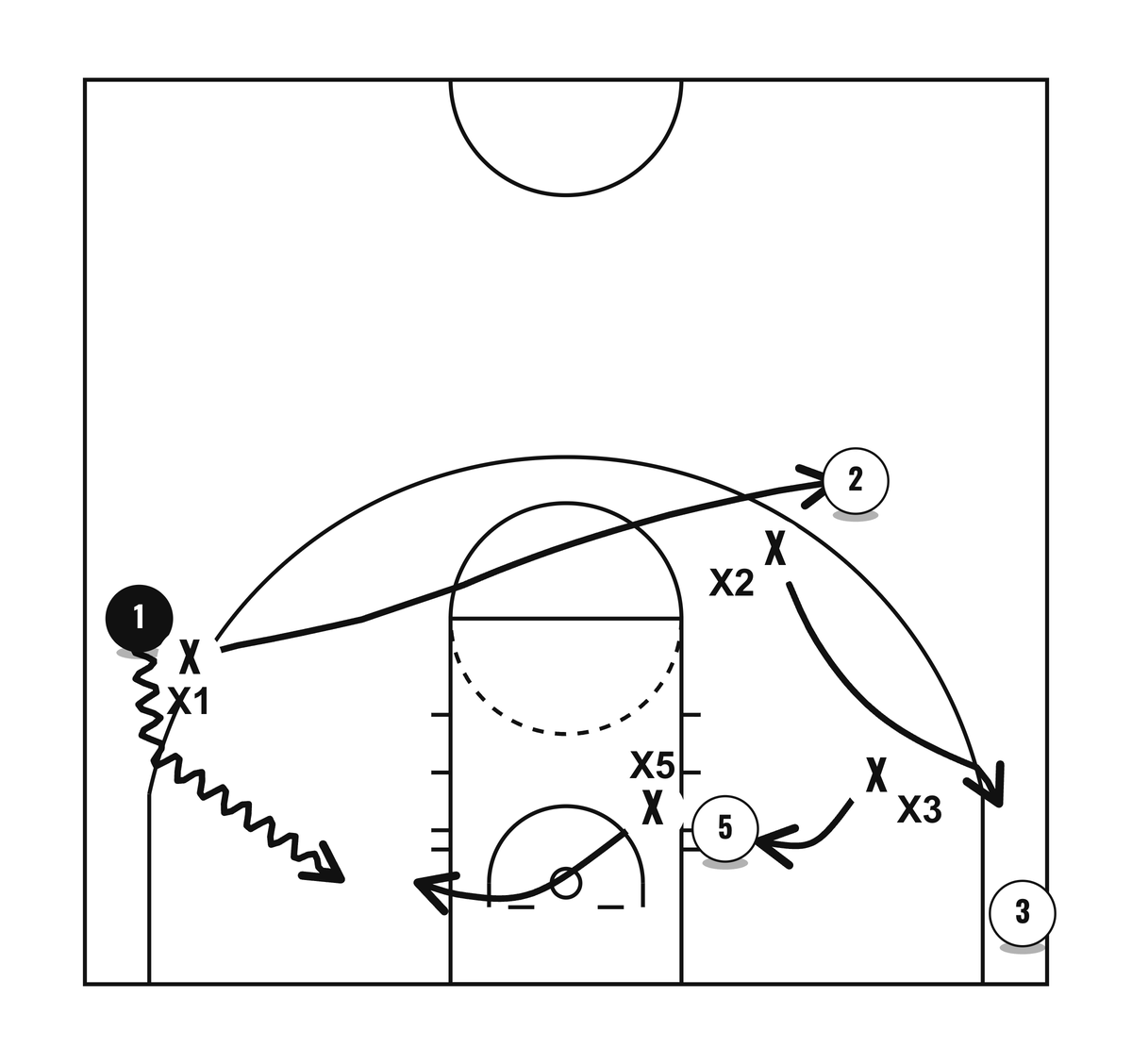
Why rotate this way? Because two defenders on the ball let the advantage grow once the ball moves, and the defense can struggle to get back to even. With one good rotation, the chain stops right there. Trade, do not chase.
The Rules That Make It Work
- Somebody calls it. One player owns the call, "switch" or "peel," and yells it. Without the call, the helper and the beaten defender both stay on the ball and the defense is back to two on one. Some teams give the call to the rim protector. Others let the beaten defender or his helper make it. In Dave Smart's lock left defense the helper calls it, and the beaten defender stays with the ball until he hears "help."
- The helper keeps the driver. He does not help and recover. Once he steps up, the driver is his man.
- The beaten defender leaves on the call. If he keeps chasing the driver before he turns, he faces a very long closeout. If he leaves the moment he hears the call, he may be able to steal the next pass.
- Everyone else drops. On a peel rotation the rest of the defense moves up one man.
The rotation does not change against a four-out, one-in set with a dunker on the weak side. The rim protector still makes the call and takes the driver, and the rest of the defense still moves up one man.
Who Steps Up: Four Versions
Teams run the peel switch in different ways, and the choice depends on the system around it. Here are four.
Version 1: the defender one pass away
The man guarding the next player up steps in front of the drive and keeps it, and the beaten defender takes his player. This is the two-man peel switch in the diagrams above.
Version 2: the rim protector
The defense names one player, who one coach calls the MIG (most important guy or girl), to call "I'm big" and protect the rim. Once the driver has clearly won and his own defender is chasing from behind, the MIG calls "switch," takes the ball, and the other four each rotate one spot. Against a very poor shooter, helping off the strong side is fine: the defense wants that pass, because it ends the chain right there.
Version 3: help side only
"If you do not make this guy think you're helping when you know you're not helping you're not doing your job."
This fits a pack line team that, as a rule, does not help one pass away. The ball-side defender bluffs at the drive and gets back to his man, and the low man on the help side rotates up and stays with the driver. He does not help and recover. The beaten defender then rotates to the next man and the rest of the defense drops.
Version 4: by alley
Divide the half court lengthwise into three lanes, a sideline alley on each side and a middle alley between them, and use the baseline hash marks to set their width. The ball's lane tells every defender which teammate is his nearest help. Ball near a sideline: the corner defender helps, and that is a corner peel. Ball in the middle lane: the defender at the nail helps, and that is a middle peel.


Whichever version you choose, every player has to know who steps up before the drive happens.
Where Helpers Stand
Line rules
A help-side rotation only works if the helpers start in the right place. One set of line rules:
- When the ball is higher than the free-throw line, help-side defenders put one foot on each side of the lane line.
- When the ball drops lower than the free-throw line, they slide over and straddle the midline instead.
On a baseline drive, a helper standing a step or two away from his line arrives late. Instead of a contested two or a charge, the offense gets an and-one or an easy layup.


Where to meet the drive: two versions
- Version 1, high in the gaps. Help defenders stand high in the gaps instead of deep, so the driver sees a wall and they can still get back out to their men.
- Version 2, wait for the spot. Helpers wait and meet the drive at a set spot closer to the rim.
In Version 2, players new to the rotation tend to help too early, meeting the driver at the elbow or 10 to 12 feet from the rim. One program uses the volleyball line on its court as the spot where the helper puts his heels to help. The big walls up and contests the pull-up about 10 feet away, and that contested pull-up is the tough two this kind of defense wants.

In this top beat, the corner defender is already straddling the lane line, so his drop inside the big is short. The elbow drive is the hardest one to defend at any level, because it reaches the rim too fast for a big to come across. As the ball gets near the elbow, even a team that forces baseline everywhere else should think about help from the nail.
A guard who has to help should meet the drive well outside the restricted arc, since helping under the rim usually ends in a dunk. A big can help closer to the rim and contest. Know your spot before the drive starts.
What the Peel Switch Gives You
- Fewer closeouts. The aim is to stop the drive early, not to stay in rotation, and a defense that is closing out is already behind. The peel switch settles the drive with one trade instead of a chain of rotations. Technique for the closeouts that remain is on closeout and recover.
- Steals on the next pass. The driver sees the helper step up and looks for the man that helper left. He often cannot see the defender rotating from outside his line of vision toward that same man. Kick-outs and dump-offs to a slipping screener can both get deflected this way.
- The corner pass. Many offenses are drilled to make the pass to the corner on a baseline drive, and fewer can make the pass to the 45. Against an offense that always looks for the corner pass, the peeling defender is in a good spot to steal it.
- A change-up for a team without stoppers. A team with no lockdown on-ball defender, or one that plays mostly zone, can use the peel switch to give its man defense a different look.
What It Costs
Trading men creates mismatches. A guard lands on a post player.
- Box out and send help. After a late switch leaves a guard on the roller, the guard boxes him out anyway and two teammates come over to help him rebound.
- Get physical. An undersized team can get thrown over the top. Get inside your man and be physical, so that pass is not easy.
- Switch again. A third defender can come across to take the big and send the guard to his man, so three defenders trade and the mismatch goes away. This is a triple switch.
- Watch the offense pull your rim protector. An offense facing a great shot blocker may space him away from the rim so he cannot be the one who steps up.
Expect the offense to hunt the mismatch. Its counters are on how to coach effective defensive switching.
The Same Idea Against Other Actions
Once players understand "trade, do not chase," the same rule answers a lot of actions. These switches are built the same way:
- Late switch, or veer. In drop coverage, the guard stays on the handler for a while, then he and the big trade late.
- Ice to switch. The defense ices a side ball screen. When the handler turns down the sideline anyway, the big picks him up and the guard switches to the screener.
- Next, wall or jump switch. The nearest defender, one pass from the ball, jumps out to wall off the handler, and the handler's own defender takes his man. The rotation version is an X-out.
- Zipper switch. A cutter comes up off a down screen to catch. The passer's defender takes the cutter as he arrives, and the cutter's defender peels back to guard the passer.
- Tag switch. A weak-side defender tags the roller, and the guard switches to the tagger's man. One version tags the roller high after a hard hedge against a short roll.
- Triple switch. When a switch on a ball screen leaves a small on a big, a third defender comes across and trades in to fix the size problem.
The ball screen coverages these grow out of are on how to defend the pick and roll. The peel switch is also the half court cousin of the full court run and jump, where defenders trade men on the move in the same way. One rule, many triggers.
How Teams Teach It
- Show it, then play live. One approach shows the rotation once as a principle of play and then goes straight to live play, so players practice it live instead of as a shell drill.
- Start with a head start for the offense. The coach stands behind the defense and gives the offense a baseline drive every time. Play goes live once a defender slaps the coach's hand, so the driver starts with an edge. Middle drives come later.
- Keep score on stops. Watch whether the offense can keep the advantage going and whether the defense can end it with a peel switch. A stop is one point, and the first team to five wins. If the offense is not getting out to space, add a constraint that pushes it there.
- Drill two rotations every day. One program drills the baseline drive and the top or outside drive daily, from a dribble drive setup with the 5 opposite the ball in the dunker spot. The setup is on dribble drive motion offense.
More rotation drills are on drills to teach help and rotation, the whole chain behind the first helper is on how to coach defensive rotations, and the diagram symbols are explained on how to read a basketball play diagram. Whichever version you run, call it every time and rep it live.
How to Apply the Peel Switch to Your Team
- Pick the helper. Decide who steps up on your team: the man one pass away, the rim protector, the help side only, or the man in the drive's alley. Then pick the call word.
- Set the line rules. Help-side defenders straddle the lane line with the ball above the free-throw line and the midline with the ball below it.
- Mark the help spot. Meeting the drive at the elbow is too early. Give helpers a spot closer to the rim, or teach them to stand high in the gaps, whichever version you run.
- Leave on the call. The beaten defender peels the moment he hears "switch" or "peel."
- Play it live. Show it, then play it live in the head-start game, a point per stop, first team to five.
- Baseline first. In the head-start game, give baseline drives first and add middle drives later.
- Two rotations daily. Another version reps the baseline drive and the top drive every day, from a dribble drive setup.
Final Thoughts
The peel switch asks a defense to trade men on a drive instead of chasing the ball. Every version on this page comes back to the same three jobs: one player makes the call, the helper keeps the driver, and the beaten defender leaves for the open man right away.
Pick the version that fits your system, start with baseline drives, and add middle drives later.
Questions Coaches Ask
What is a peel switch in basketball?
A rotation for a beaten defender. A helper takes over the driver for good, and the beaten man peels off to the player the helper left, so the two trade men instead of doubling the ball.
What is the difference between a peel switch and help and recover?
In help and recover the helper stops the ball and then goes back to his own man. In a peel switch the helper keeps the driver and never goes back, and the beaten defender takes the open man.
What is a peel rotation?
The peel switch with three or more defenders. One helper meets the ball and every other defender moves up one man, like a clock.
Who calls the peel switch?
It depends on the team. Some give the call to the rim protector, who yells "switch." Others let the beaten defender or his helper call "peel." Every team needs one clear call.
What is a corner peel?
A peel switch where the corner defender is the helper, because the ball is near a sideline. When the ball sits in the middle lane, the nail defender helps instead, and that is a middle peel.
Does the peel switch create mismatches?
Yes. Trading men can leave a guard on a post player. Teams box out and send rebounding help, get physical against the throw-over, or switch again with a third defender to remove the mismatch.
Get the next coaching guide in your inbox
One email when a new guide or diagram set goes up. Free.
Back to Types of Defense and every Defense page.
Keep Building
Related breakdowns
Competitive Defense Drills: Make a Stop the Only Way to Score
Two drills that make a defensive stop the only way to score, so players finally compete for stops in practice.
Switching Defense Basketball: How to Switch Ball Screens
Switching defense in basketball: when to switch ball screens, who calls it, the jump switch, the late switch, the scram after a mismatch and drills to install it.