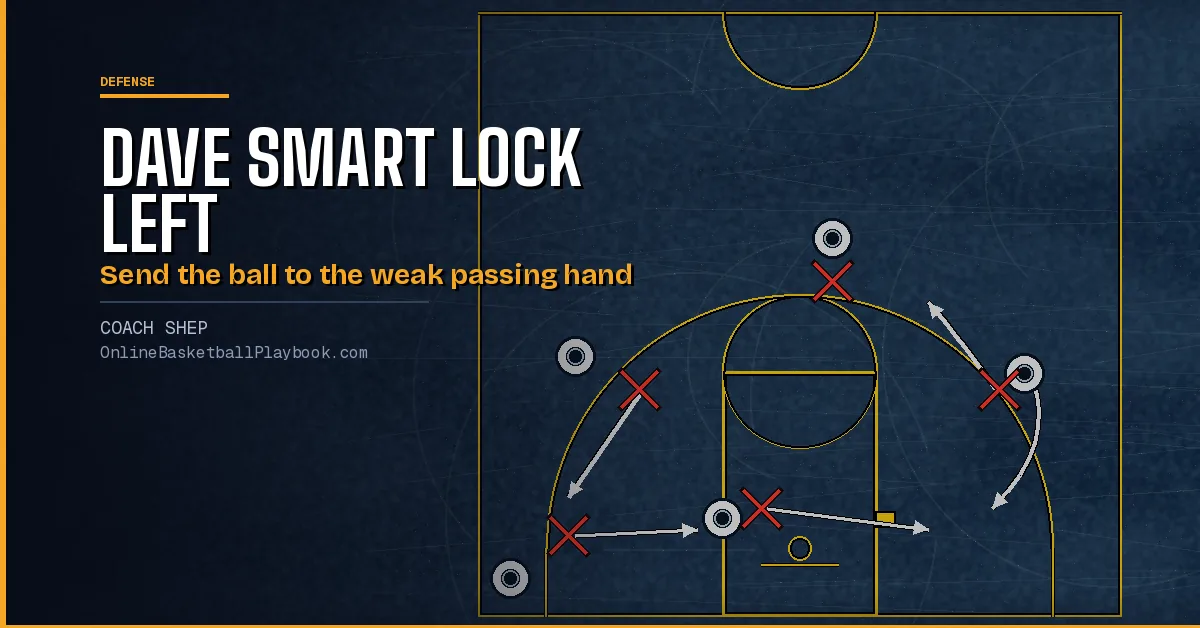
Dave Smart lock left defense takes its name from the way it pushes most ball handlers to their left. Smart's Carleton University teams won many national championships, and he now coaches at the University of the Pacific. Smart has his own view of that name.
"We very seldom ever want a lock."
Smart's rule is to send every ball handler toward the hand he passes worst with. Most players are right-handed, so most of the time that means left, and that is where the name comes from. Against a lefty, the force flips. At Carleton he even forced Philip Scrubb, a right-hander, to his right, because Scrubb passed the ball so well going left.
The other system that carries the same name, with a fixed force to the offense's left, is on lock left defense. Other force rules are compared on types of defense in basketball.
- Why Dave Smart Forces the Weak Hand
- Cover the Ball First, Lock Later
- The Four Areas of the Floor
- Four Calls on the Ball
- The Helper Calls Help
- Lock the Ball on Screens and Handoffs
- Teach It With a 1-on-1 Point Game
- Three Rules for the First Weeks of Preseason
- Find Their Kryptonite
- How to Apply Dave Smart's Lock Left Defense to Your Team
Why Dave Smart Forces the Weak Hand
Most coaches who argue with this defense say the same thing. Their players score better going left. Smart's answer is that a player who can score will score either way.
"Ours is all about on target, on time."
Good offensive coaches tell their players to make every pass on target and on time, and Smart wants to take that pass away. He points to one pass. A right-handed driver kicks the ball across his body to the far corner. Going right, he throws it with his right hand over his left shoulder. Going left, he has to throw it with his left hand over his right shoulder. Very few players make that second pass on target and on time.
Smart says the same goes for finishing at the rim over a help defender with the weak hand. His rule for all of it is to play the percentage, and the higher the level, the more a coach plays it.
The Target Is the Pass. Send the handler to the hand he passes worst with, cover the ball straight up, and lock only the actions that would free his strong hand.
Cover the Ball First, Lock Later
Smart covers the ball straight up until the offense runs an action at it. A defense that locks the ball on one side too early gives the driver a straight line to the rim, and the help has to rotate when it did not need to.
The lock comes with actions, and Smart picks which ones. He locks wing ball screens, actions on the left slot, and handoffs that head toward the strong hand. On the right slot and in the middle of the floor he pushes the ball toward the middle and the weak hand instead. Until an action comes, the on-ball defender squares up and uses the floor. The stance and footwork for that are on defensive stance.
The Four Areas of the Floor
Smart cuts the half court into four areas. For an all right-handed team, each one gets a different rule.

- Right wing. Square him up. Smart is fine with his first move going right. When it does, the defender gaps it, cuts it off, and spins him back to his left hand. Do not let him rip straight to the middle.
- Right slot. Square him up and cut off the right hand at 10 to 12 feet. This is the danger spot for ball screens and handoffs, so Smart spends about 70 percent of his defensive practice time covering it.
- Left slot. Square him up. Cover the ball, or peel off fast when a teammate yells help.
- Left wing. Chest to shoulder. Never get beat to the right hand. Push him down the baseline to about 15 feet, where the baseline, the on-ball defender and the rotating defender are all waiting for him.
Wing or Slot? Look at the Corner
Smart decides wing or slot by looking at the ball-side corner. If the corner is empty, it is a wing. If someone is standing in the corner, it is a slot.


The player with the ball can stand in the same spot either way. The rule changes because a filled corner gives the defense a stunt helper and different rotations.
The Right Wing Rule

Letting him go right first has a reason. A straight rip to the middle, even with his left hand, puts the defense in a harder rotation. A player who goes right, gets cut off and has to spin back to his left is making a second move with his weak hand, with help ready for him.
Four Calls on the Ball
Every on-ball defender makes one of four calls. Each call tells the other four defenders when help is coming.

- Left. An even matchup. This is the base call. Square up, then send him to his weak hand by 10 feet. Teammates echo it.
- Early. Their star, or a matchup the defense loses. Help comes early and all four defenders show bodies, like a zone. Smart's goal is to make that player a hockey-assist guy, the one who makes the pass before the assist. Most stars do not want to play 40 minutes with no points and no assists.
- Dead. The best defender is on one of their weakest players. Everyone else denies. That player is on an island.
- Late. A small guard. Let him go to his weak hand and help late, at about 5 feet, with size. A small guard has a hard time scoring over a big man at the rim or making the pass he wants to the other side.
Smart never lets a player call "ball" in the half court. It tells nobody anything. The only time it is used is in transition, when a player says he has the ball. The calls also work on the ball handler. A guard who hears his defender yelling left in his face starts thinking about the call instead of his next move.
The Helper Calls Help
Smart says most of his new players get this rule backwards. The defender who gets beat does not yell help.
"They call help when they need help, not when you need it."

The beaten defender keeps covering the ball until a teammate yells "help." Then he peels off and takes the next pass. The helper has three calls.
- Help. He leaves his man to stop the ball.
- Bluff. He fakes help and stays home. The goal is to make the driver think help is coming.
- Stay. He tells the beaten guard to stay on the ball. The big then bumps back to his own man to get the matchups right again.


The Baseline Rotation
On a baseline drive, three more defenders have jobs. One rotates to the big. One drops to the lowest man on the baseline, or the diver if someone dives. The last man, Smart calls him the logo, guards two up top. More on help spots is on help defense principles.

Rotations Beat Respacing. Run shooters off the three-point line. Smart is betting that his rotations are faster than the offense's respacing, because his defenders always know which way the ball is going. Closeout footwork is on closeout and recover.
Lock the Ball on Screens and Handoffs
On a wing ball screen, the screener's defender yells "screen" and keeps yelling it until the ball defender changes his feet. On that call, the ball defender jumps up and locks, pushing the ball away from the screen.

If the screener can shoot, his defender calls "shooter." The big hits the ball handler hard and the ball defender goes under the screen. If the screener cannot shoot, his defender stunts for a count and gets back. Behind the ball, the other three stop guarding men and call "zone." They form a triangle. One guards the basket, one is high, and one takes away the pocket pass and the roll. Other screen coverages are on defending screens, ice coverage and hedge.
Handoffs get one more rule. If the handoff takes the player toward his strong hand, the defender fakes going over, then whips under to the other side and turns it into a lock. If the handoff takes him toward his weak hand, the defender chases over the top and keeps him going that way.
Teach It With a 1-on-1 Point Game
Smart lets players figure it out first, then coaches what they cannot solve. His tool is a 1-on-1 game where the points do the teaching. More 1-on-1 formats are on 1-on-1 basketball.

- Right-hand layup: 3 points.
- Left-hand layup: 1 point.
- Pull-up inside 15 feet going right: 2 points. Going left: 0.
- Shot off the dribble between 15 feet and the three-point line: 0 points, but the offense keeps the ball.
- Standstill three: 1 point.
Defenders lose this game by giving up right-hand layups. So they start taking away the right hand at 15 feet and are done by 10. Smart plays 3 to 4 minutes of this game every day, and 5 minutes of 2-on-2 ball screens every day, with no exceptions.
He closes out with one hand up, the stick hand. When the shooter drives right, gap him and cut him off. When he drives left, body him and push him off his line.
Three Rules for the First Weeks of Preseason
Smart's preseason defense lives on three non-negotiables. Break one and the player loses points or runs. In scrimmages, the offense keeps the ball.
- Never get beat to the strong hand inside 10 feet.

- Never get straight-lined. A defender in one straight line with his man and the ball gives up the back cut or the face cut.

- Never get touched by a screen. Unless it is a clear moving screen, the offense gets a free possession.

Smart tells a story about one August scrimmage with these rules and a 24-second shot clock. One team shot quickly on its first two trips. The other team decided nobody would shoot early. They kept moving, screening and cutting, and kept the ball because the defense kept breaking a rule. Smart says that team went 56 straight possessions without playing defense and won something like 32 to 0.
The Rules Teach Both Ends. The offense learns to move the ball, cut and get to its strong hand. The defense learns to jump to the ball, because a defender who does not jump to the ball gets straight-lined on almost every other cut and gets hit by screens.
Find Their Kryptonite
The last piece is the scout. Smart's rule for the other team's best three players is to find the thing each one hates doing and make him do it every possession, for 40 minutes. For players 6 through 10, take away the one thing each does best. Players 4 and 5 depend on the team.
"Everybody has their Kryptonite."
Players who are both good and smart never do the thing they hate, so it rarely shows up on film, and finding it takes a lot of film. Scouting reports are covered on basketball scouting.
How to Apply Dave Smart's Lock Left Defense to Your Team
- Point game daily. Put the 1-on-1 point game in at 3 to 4 minutes a day, so defenders learn to take the right hand away at 15 feet.
- Four calls. Teach Left, Early, Dead and Late, and have every on-ball defender use one. Ban "ball."
- Ball screens daily. Run 2-on-2 ball screens for 5 minutes a day, locking the screen and building the triangle behind it.
- Non-negotiables. Use the three rules in early-season scrimmages, with the free possession as the penalty.
- Scout for kryptonite. Find the one thing each of the next opponent's best three players hates doing.
Transition matchups for the same defense, guards on guards and bigs on bigs with a Rover picking up the ball at 23 feet, fit with transition defense. More defensive guides are on the defense hub.
Final Thoughts
Smart's defense has a lot of rules, and they all come back to one idea. Make the ball handler play with the hand he passes worst with, and build every call, rotation and drill around knowing where the ball is going.
Steal what fits your team. Start with the point game and the four calls, then add the screen lock and the rotations as your players learn them.
Questions Coaches Ask
Does Dave Smart's lock left defense always force left?
Smart sends each player to the hand he passes worst with. Against right-handers that is usually left. Against a lefty the force flips, and Carleton even forced right-handed Philip Scrubb to his right.
When does the defense lock the ball?
On wing ball screens and on handoffs that head toward the strong hand. On the right slot and in the middle of the floor the ball is pushed toward the weak hand instead. Until the offense runs an action, the on-ball defender squares up and covers the ball straight up.
What are the four on-ball calls?
Left for an even matchup, Early for their star or a bad matchup, Dead when the best defender is on a weak player, and Late for a small guard.
Who calls help in Dave Smart's defense?
The helper. The beaten defender keeps covering the ball until a teammate yells help, then peels off to the next pass.
What is the difference between a wing and a slot?
The ball-side corner. With the corner empty the ball is on a wing. With a player in the corner the same spot is a slot.
Every diagram on this page uses the symbols on how to read a basketball play diagram.
Get the next coaching guide in your inbox
One email when a new guide or diagram set goes up. Free.
Back to Types of Defense and every Defense page.
Keep Building
Related breakdowns
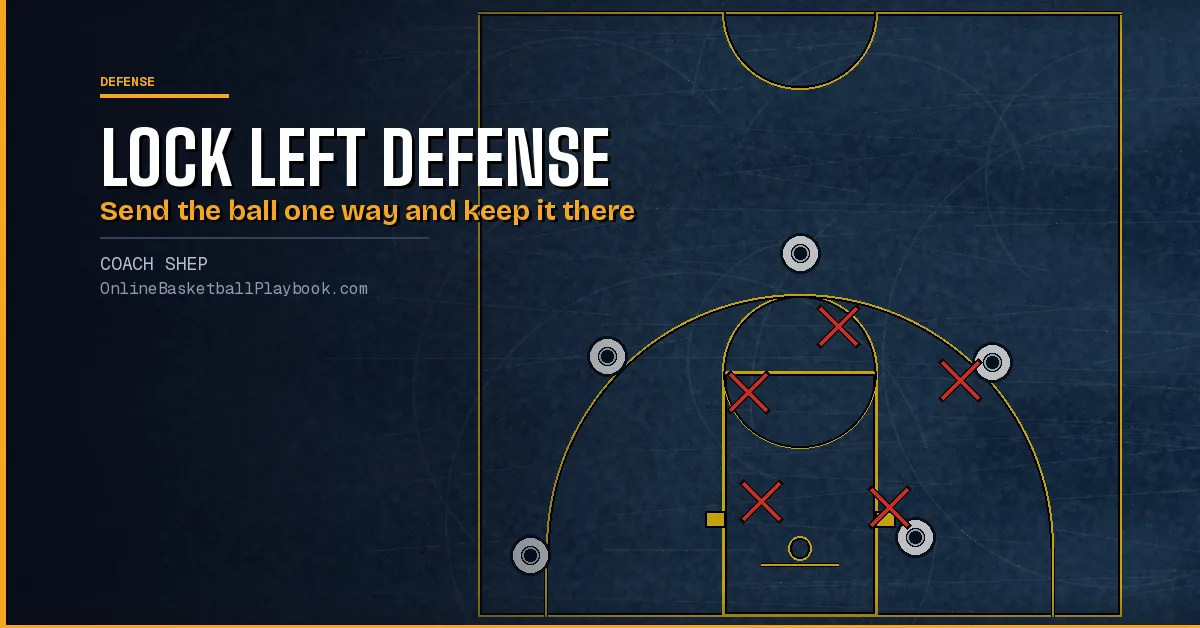
Lock Left Defense: Force Direction, Rules and Help Rotations
Lock left defense explained: force the ball to the offense's left all game, the stance and layers, how help changes, and the other ways to force the ball.
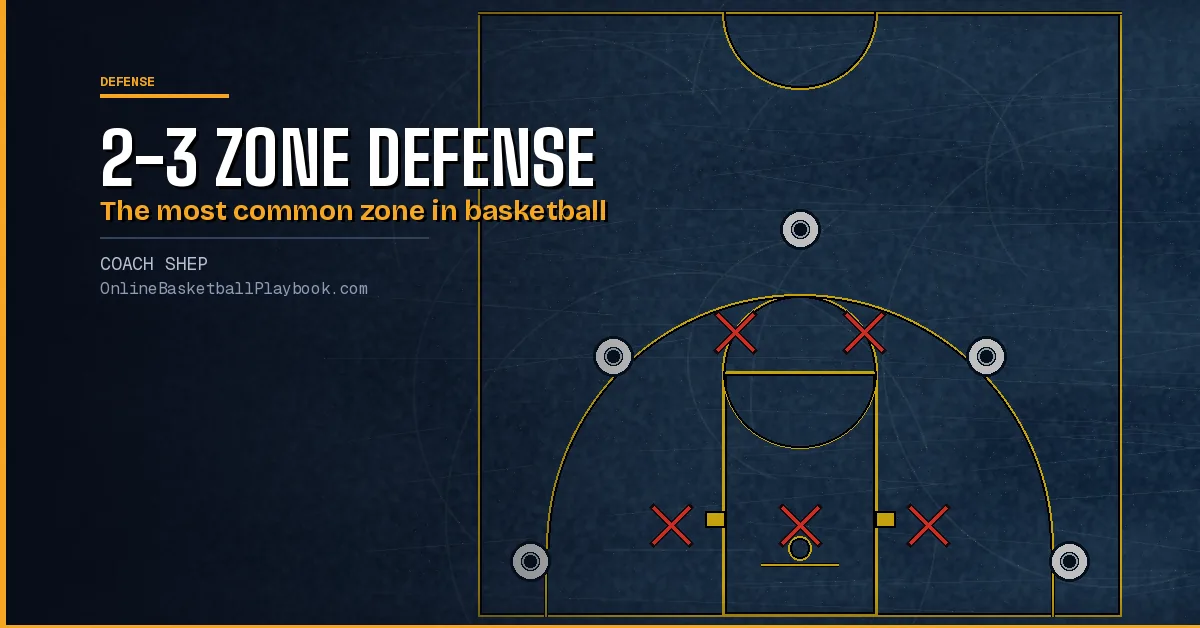
2-3 Zone Defense: Rotations, Weak Spots and Drills
How to play the 2-3 zone defense: the starting positions, how it shifts to the ball, where it leaks, when to trap, and the drills that install it.
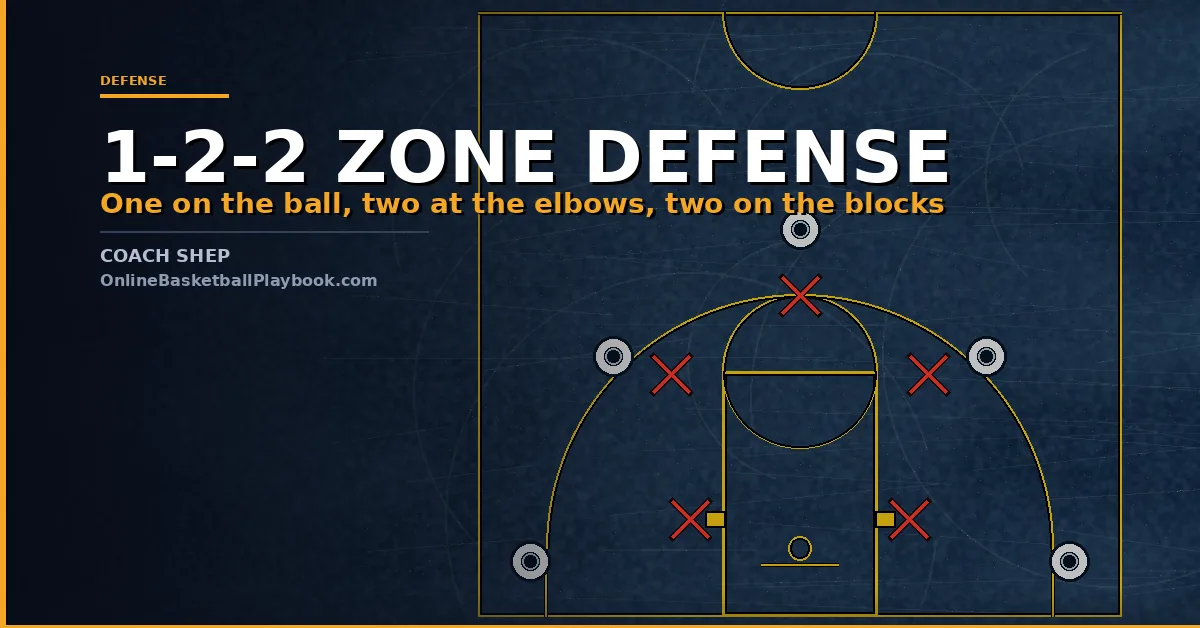
1-2-2 Zone Defense: Rotations, Weak Spots and Drills
1-2-2 zone defense: the five roles, rotations for every ball spot, the corner trap, the high post problem, variations coaches run and the drills.