A youth basketball offense built on the seven-concept order teaches young players how to play instead of plays. Every player learns every skill, because fixing positions early can leave a player short of skills when he is later asked to play somewhere else. Like school, players master one grade before the next.
It is one of the rule-based approaches on concept based offense. A starting offense for beginner teams is on simple basketball offense.
The Court Grid
This youth version opens with grid dribbling before the games. Cut the court across into four zones, from the baseline to the foul line extended and the foul line extended to half court at each end, and three lanes, left, center and right. That makes 12 rectangles. Ask each player to find space in one rectangle, then explore it.
- Edge. Dribble around its outside.
- Center. Find its middle.
- Landmarks. Find the part closest to the far basket, the sideline or the center circle.
- Figure eight. Dribble a figure eight inside it.
The rectangles also bound small drills, such as partner passing with two balls, pass and replace against pressure, partner mirror dribbling, 1-on-1 across two rectangles and three-player dribble protect. Small-sided games use part of the grid with restrictions the coach chooses.
- No dribbles. Pushes passing and cutting to get open.
- One-second rule. Pass, shoot or dribble within a second of each catch. Pushes penetration and anticipation.
- No scoring in the key. Works outside shots.
- One player per rectangle. Two offensive players in the same rectangle is a violation, except on a rebound, so players have to track where teammates are.
For the youngest groups the games stay at 3-on-3 or 4-on-4, which means more touches and more room. The games run as whole-part-whole teaching. Play, then break down the spots where players struggle.
More ball-handling work for young players is on youth basketball dribbling drills.
Youth Basketball Offense: The Seven Concepts in Order
- Attack the basket. With the eyes, scanning to see if the rim is open or a teammate has an advantage. With the body, running the floor on a change of possession or basket cutting when nobody stands between you and the rim. With the ball, by passing, dribbling and later shooting. The 1-on-1 order runs from facing the basket to dribbling with either hand, then to layups and shooting, and last to fakes. The handler may dribble to shorten a pass or find a better angle, and teammates cut back to help a handler in trouble.
- Space. When the rim is closed, the players off the ball make space. Pylons for spots tended to become crutches, so the order teaches the idea of spacing over standing on a spot. Should I be close to my defender or far away, close to the ball or away from it?
- Penetration. It comes third because children find dribbling easier than passing. A dribble coming at you pushes you away, and a dribble going away from you pulls you along, with some exceptions. Attack the basket still holds. When a defender helps on the drive, his man cuts for the layup.
- Pass, cut, fill. After the pass, cut to the rim. When the rim is covered, by a defender in the path or a teammate already there, look for open space as the others rotate into the gaps. The read-rule system drops the automatic cut from U16 up, as set out in options instead of musts.
- Rebounding and defensive coverage. Decided by floor position at the shot, not by position names.
- Post or seal at the rim. A cutter whose defender is out of position seals him at the rim. Teammates keep their spacing and form triangles, so the pass comes direct or as a relay. This one may wait until a later stage.
- Screening. Held until a later stage, because screens do work with young players, and the quick wins they bring can stop players from mastering the base. Examples include the player at the basket screening to open it for a teammate, a cutter who gets stopped and screens for the teammate who would normally fill his spot, and a ball screen where the screener slips to the rim if his defender shows early.
Each concept layers on the ones before, so attack the basket still applies when players drive, cut or screen. With only these seven, one team can stress pass, cut, fill and another penetration.
Crash or Back
Two floor-position rules decide who rebounds and who gets back.
| Version | Crash | Back |
|---|---|---|
| Two-zone | Below the foul line extended | Above the foul line extended, as a safety |
| Three-zone | In the key, go to the glass. Near the foul line extended, go to the nail. | Anyone higher than the free-throw line |
The rest of crashing and getting back is on tagging up.
Teach one concept, then layer the next on top.
Questions Coaches Ask
What are the seven concepts for young players?
In order: attack the basket, then space, then penetration, then pass, cut, fill, then rebounding and defensive coverage, then post or seal at the rim, and last screening.
Why is screening taught last to young players?
Screens do work with young players, and the quick wins they bring can stop players from mastering the base, so screening is held until a later stage.
Should youth players play fixed positions?
In this order every player learns every skill, because fixing positions early can leave a player short of skills when he is later asked to play somewhere else.
How is the court grid set up?
Cut the court across into four zones, from the baseline to the foul line extended and from the foul line extended to half court at each end, and into three lanes, left, center and right. That makes 12 rectangles.
Fitting the concepts into practice is on youth basketball practice plans, the rest of running a young team on coaching youth basketball and long-term growth on how to develop youth basketball players.
Get the next coaching guide in your inbox
One email when a new guide or diagram set goes up. Free.
More Concept Based Offense Guides
- Layered Reaction Offense: Every Layer, Drill and Install Step
- 4 Out 1 In Drive Line Offense: Phases, Signals and Screens
Back to Concept Based Offense and every Offense page.
Keep Building
Related breakdowns
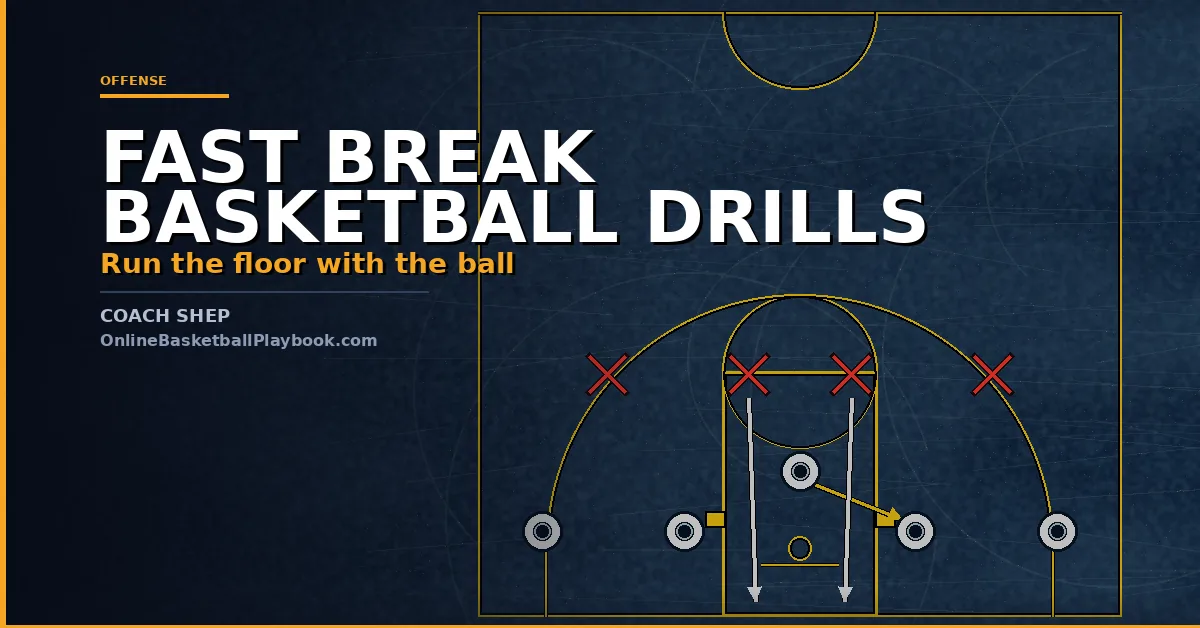
Fast Break Basketball Drills for Youth and Varsity Teams
Fast break basketball drills that run the floor with the ball: weaves, partner and no-dribble drills, catch-up drills, a finishing series and youth versions.
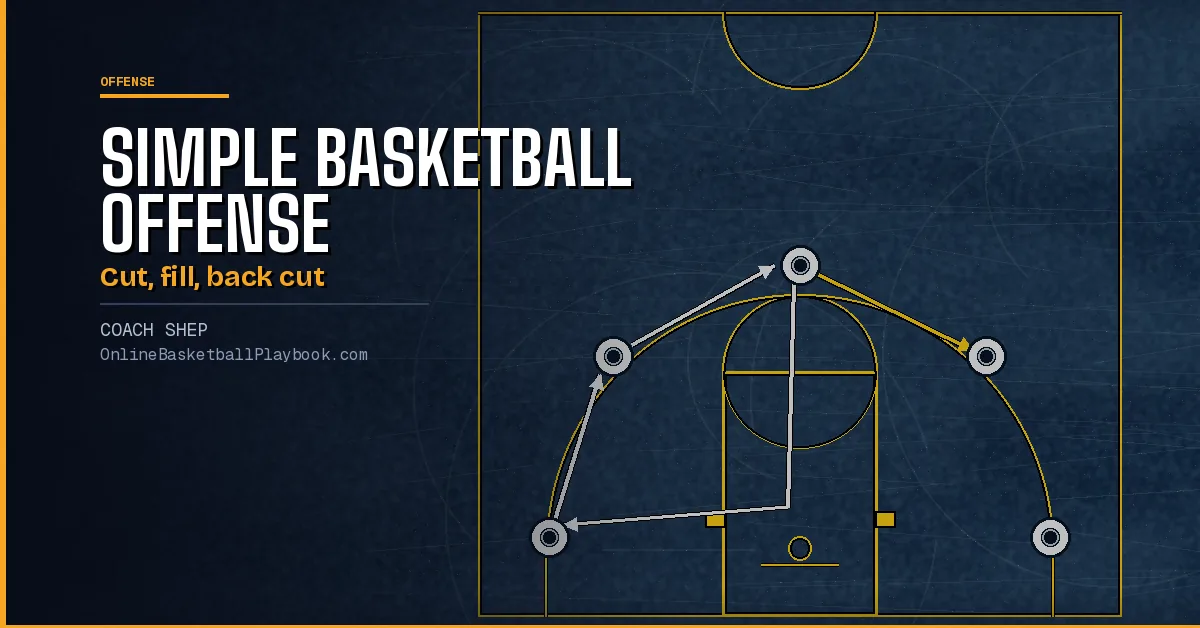
Simple Basketball Offense for Youth and Beginner Teams
A simple basketball offense for youth, middle school and beginner teams: a spacing set, the three-rule 5-out, 4-out options, a zone answer and a press break.