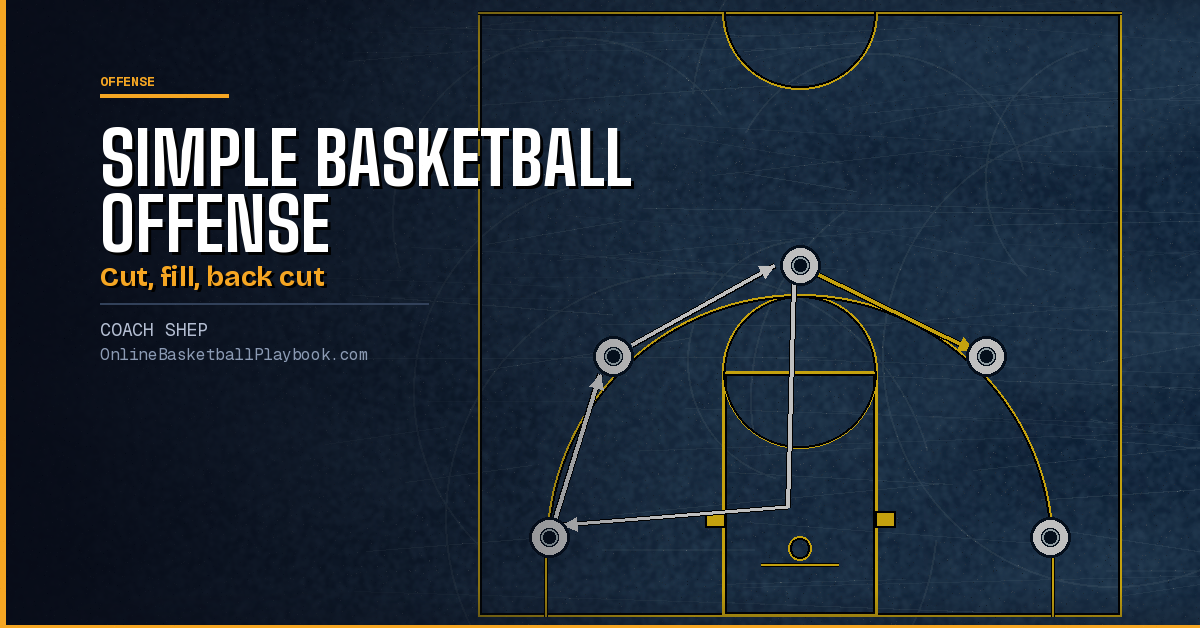
A simple basketball offense is a short set of rules that every player can follow without a coach calling a play. For a youth team, a middle school team or a group of beginners, that usually means five spots on the floor and a few habits: pass, cut, fill the open spot, and cut behind a defender who takes the pass away. This guide lays out the versions youth coaches use, from a spacing set for the youngest players to a 4-out with one post, with diagrams, the rules each one runs on, how to install it and where coaches disagree. The full systems these come from are linked as you go.
The Versions at a Glance
| Version | Alignment | Core rules | Fits |
|---|---|---|---|
| Spacing set | 3-out 2-in, 1-3-1 or 4-out 1-in | Stay spread, cut and move, take the first open shot in range, everyone rebounds | 1st to 6th grade recreation teams |
| Three-rule 5-out | Five spots outside the arc | Cut after every pass, fill to the ball, back cut when denied | Most youth teams |
| Circle 5-out | Five spots outside the arc | Pass, cut and everyone rotates the same way | A first step for very young teams |
| Cut and fill with named cuts | Five spots, any player in any spot | Quick cut on a one-away pass, nail cut to fill the top of the key, the cut chosen by where the defender is | Middle school |
| One-second 5-out | Five spots outside the arc | Shoot, drive or pass within a second of the catch, fill to the ball, fill the open corner, back cut when denied | Teams ready to attack on the catch |
| 4-out 1-in pass, cut and fill | Two slots, two wings, one post | Every pass triggers a basket cut, the post stays weak side and flashes to the ball a set number of times | A team with a real post |
| 3-out 2-in motion | Top of the key, two wings, two posts | Posts stay on opposite sides of the lane, high-low when fronted | Only with two posts who move, cut and pass |
Choosing a Simple Basketball Offense
Four things decide which offense fits a team: the players' age and the practice time available, what the coach believes in (freedom or control, fast or slow, inside or outside), the personnel, and how the offense fits the team's defense. A youth team with one 30-minute practice cannot install a full continuity like the triangle.
A positionless offense is the usual pick for young players. Nobody knows who will grow, and a tall kid parked in the post never learns to dribble or shoot from the perimeter. The 5-out is the only fully positionless alignment, and it is recommended for most youth and high school teams. The trade-offs are real. Motion reads are hard for young players, the first weeks look ragged, and the best players may not get the most shots unless roles are defined. The positions themselves are explained on basketball positions, and the wider menu of systems, actions and sets is on basketball offense.
The Spacing Set for the Youngest Teams
For a 1st through 6th grade recreation team, one version skips offense rules almost entirely. The team lines up in a 3-out 2-in, a 1-3-1 or a 4-out 1-in, and the alignment exists only to keep five players from bunching into one corner. It is not a play. Players are taught to cut and move instead of standing still, and the coach teaches the position numbers early: 1 the point guard, 2 the right wing, 3 the left wing, 4 the right post and 5 the left post.

The shot rule in this version is a first shot mentality. The first player with an open shot in range takes it, and everyone crashes the boards for the second and third chances. The reason given is that at this age extra passing ends in a turnover more often than in a better shot. The same version keeps one ball handler and one rebounder on the floor together when substituting.
The Three-Rule 5-Out
The youth version of the 5-out has three rules: cut to the basket after every pass, fill toward the ball when a spot opens, and back cut when you are denied. Five players start in five spots outside the arc (the top of the key, the two wings and the two corners), and cones on those spots help in the first weeks. The lane stays empty, which gives cutters and drivers room. The full system is on 5 out offense.

The pass-and-cut step has four passes to learn. On a pass from the top of the key to a wing, the passer cuts to the basket and on to the far corner, and the two players behind him fill up. A wing-to-corner pass works the same way. On a corner-to-wing pass, the passer cuts and comes back to his own corner. On a wing-to-top pass, the passer cuts and fills the corner on his own side. Cutters set up the defender with a step away before they go, cut hard so the help has to come, and watch the ball for a rebound.

The back cut rule has three conditions. You are one pass away, the defender has a hand in the passing lane, and the passer is looking at you. When all three are true, cut behind him to the rim right away. Two more rules go with it in the full 5-out. If you can beat your man to the rim on the catch, go. And square up to the basket on every catch. How to read the denial is on cut or backdoor: reading the denial.
A simpler step down from this is the circle version, in which everyone rotates the same direction after a pass (pass, cut, fill). It is the most structured form of motion and serves as a first step for very young teams.
Cut and Fill With Named Cuts
A middle school version keeps the five spots and lets any player fill any spot, with spacing and balance as the stated aim. After a pass to a player one spot away, the passer quick cuts to the basket. The player filling the top of the key always gets there with a nail cut, through the middle of the free-throw line. What makes this version different is that the cut is named by where the defender is:
- Quick cut when the defender does not jump toward the pass.
- Delay cut when the defender drops into the lane after the pass. Go two steps away, then cut across his face.
- Rear cut when the defender jumps to the ball.
- Back cut when the defender is above the three-point line.
- On the nail cut, pop to the top of the key if the defender is below the nail, and back cut to the rim if he is above it.

On drives, players spot up or move to an open window for the kick-out. On a middle drive from the wing or the corner, the opposite corner back cuts, because his defender is likely helping. The same version teaches each cut alone first, then plays 3-on-3 cut and fill, first with no dribble and later with two dribbles allowed.
A related five-out version asks players to shoot, drive or pass within one second of the catch and decide before the ball arrives. It runs on three fixed rules (fill to the ball on the perimeter, fill to the open corner inside the arc, back cut when denied) and lets a player stay in the post only for a three count.
4-Out 1-In and 3-Out 2-In for Youth Teams
When a team has a real post, a 4-out 1-in puts the other four in two slots and two wings, a step outside the arc. The first progression is pass, cut and fill. Every pass triggers a basket cut and everyone fills toward the ball. On a slot-to-wing pass the passer cuts and replaces the weak-side wing. On a wing-to-slot pass he cuts and returns to his own wing. On a slot-to-slot pass he cuts through and out to the weak-side wing, and the post crosses the lane to stay away from the ball. This progression is not to be rushed. It can take weeks or months.

The post's job is the main decision. The recommended start is to keep him on the weak side and let him flash to the ball a set number of times, one flash per possession at first, holding for two or three seconds before getting out. A post who cannot create stays weak side every time. The choice can differ by player. The starter flashes, the backup stays away. The full offense is on 4 out 1 in offense.
A 3-out 2-in keeps two posts on opposite sides of the lane, one low and one high, with three players on the perimeter. It suits only two posts who are comfortable inside and can move, cut and pass. It has fewer driving lanes, and with only three players outside the long perimeter passes are a turnover risk at the youth level. Running it without two skilled posts is named as the classic reason a motion offense breaks down. Details are on 3 out 2 in basketball offense.
How to Install It
The motion versions are taught in layers. Start with pass and cut only, pick one offense and stay with it, and do not add a layer until the current one is mastered. A team that runs the first step well beats a team that runs four steps badly. The first step can be running in a couple of weeks. A full motion offense takes a season or more.
The 5-out is installed in four steps:
- Basic cutting. The four passes and cuts described above.
- Screen away. On any pass except corner to wing. In the youth option, the player screened for always curls to the rim and the screener pops back to his spot. The experienced option lets the cutter choose curl or pop, and the screener goes the other way.
- On-ball screen. After any pass. Do not screen for a player who cannot dribble.
- Dribble at. When passes are denied, the player being dribbled at back cuts. That is the youth rule. A hand-off is the option for older players.
The drills that carry over to every version are no-dribble games, a constraint that makes standing after a pass a turnover, and required ball reversals before a shot. The 5-out drill set, with diagrams, is on 5 out motion offense drills, and more motion drills are on motion offense drills.
Get the next coaching guide in your inbox
One email when a new guide or diagram set goes up. Free.
A Simple Answer to a Zone and a Press
A youth team will meet a 2-3 zone in tournament play sooner or later. One simple answer lines up in a 1-3-1 with the wings high and wide so the first pass is hard to steal. The high post flashes from along the lane to the free-throw line as the ball comes up. When he catches it, he faces the rim and can shoot, or if the middle defender steps up, he bounce-passes to the low post hiding behind the zone. Two ground rules come first: beat the zone with quick passing rather than dribbling, and crash the offensive glass, because zone defenders often have no clear box-out assignment. The version teaches the gaps with coins on a clipboard and then hoops and mats on the floor before running it live. More answers are on zone offense vs a 2-3 zone.

Against a full-court press, a simple 1-1-2-1 break has 3 take the ball out of the net quickly, away from directly under the basket. The entry goes to 1, who can dribble, pass up the sideline to 2 or pass to 4 in the middle. 3 stays behind the ball as the safety valve for a pass back, and 5 runs deep to the spot the team uses in its secondary break. If 1 is not open after a two count, 2 and 4 cut hard toward the ball. The same shape works as the team's break when nobody presses. Full press breaks are on basketball press break.

How Many Plays a Young Team Needs
Very few. Set plays are called unnecessary for players under 10. One youth version allows nothing beyond a basic out-of-bounds play. Another version puts four baseline out-of-bounds plays, each built for one pass and a layup, as a good number for grade school and middle school. A team does need a few pieces beyond its base offense: a zone offense, a few plays, out-of-bounds plays and a press break. Simple plays with diagrams are on simple basketball plays, and baseline plays for young teams on baseline out of bounds plays.
Where Youth Coaches Split
- When to shoot. The spacing-set version takes the first open shot in range. Other versions set a patience floor before a shot, such as two passes. College motion offenses go further, with four passes before a 15-footer or the ball on top twice.
- Triple threat. Some youth fundamentals lists teach the triple-threat stance on every catch. The one-second version does not teach it, because holding the ball lets the defense set.
- Dribbled at. Back cut is the youth rule in the 5-out and 4-out versions. A hand-off is the option for older teams.
- Screen away. Always curl for beginners, or let the cutter read curl or pop once the team is experienced.
- Which alignment first. Some coaches start at the 5-out. Another ladder starts at 3-out 2-in, then moves to 4-out 1-in, then 5-out.
The spacing behind every version is explained on what is spacing in basketball, and the defense that usually goes with a youth offense is on best defense for youth basketball. The wider picture of coaching young teams is on coaching youth basketball and middle school basketball coaching.
Questions Coaches Ask
What is the best offense for youth basketball?
There is no single answer, but the 5-out with three rules (cut after every pass, fill to the ball, back cut when denied) is a common recommendation for youth teams, because every player learns every spot.
What is a simple motion offense for youth basketball?
Five players in five spots outside the arc who pass, cut to the basket and fill the open spot, with a back cut whenever a defender takes the pass away.
Should youth basketball teams run set plays?
One youth practice plan calls set plays unnecessary under age 10, and another youth version allows only a basic out-of-bounds play. For grade school and middle school, one version carries four baseline out-of-bounds plays, each built for one pass and a layup.
What offense should a middle school team run?
A five-spot cut-and-fill offense with named cuts, a 5-out, or a 4-out 1-in if the team has a real post. Pick one and stay with it all season.
What is a 4 out offense in youth basketball?
Four players on the perimeter in two slots and two wings, with one post who stays away from the ball and flashes to it a set number of times.
How long does it take to install a youth offense?
The first step, pass and cut, can be running in a couple of weeks. A full motion offense takes a season or more.
Want every diagram, printable?
OBP Pro members get the full diagram files for every rule and offense on this page, ready for a practice binder or a parent meeting. $9 a month. Or draw your own version free in the play drawer.
See what OBP Pro includesMore Guides From This Batch
- Basketball Rules for Beginners: The Basic Rules of the Game
- How Long Is Basketball Halftime? Halftime Length by Level
Back to Basketball Offense and every Offense page.
Keep Building
Related breakdowns
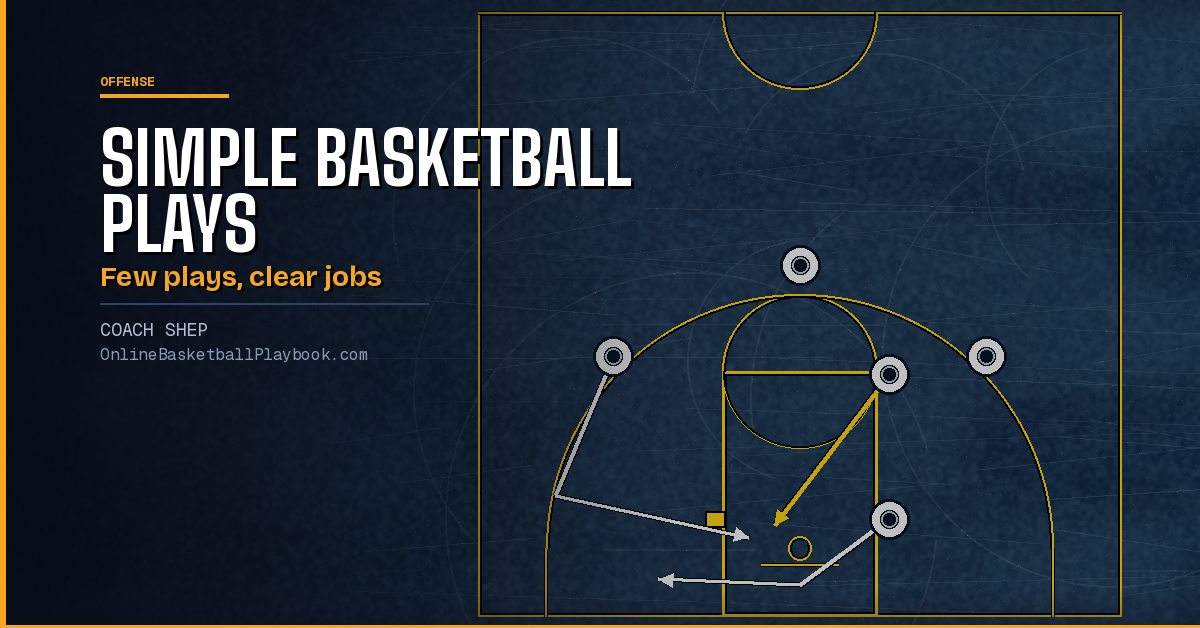
Simple Basketball Plays for Youth and Beginner Teams
Simple basketball plays for youth and beginner teams. Six easy plays with diagrams and plain steps, plus how to build a small play menu.
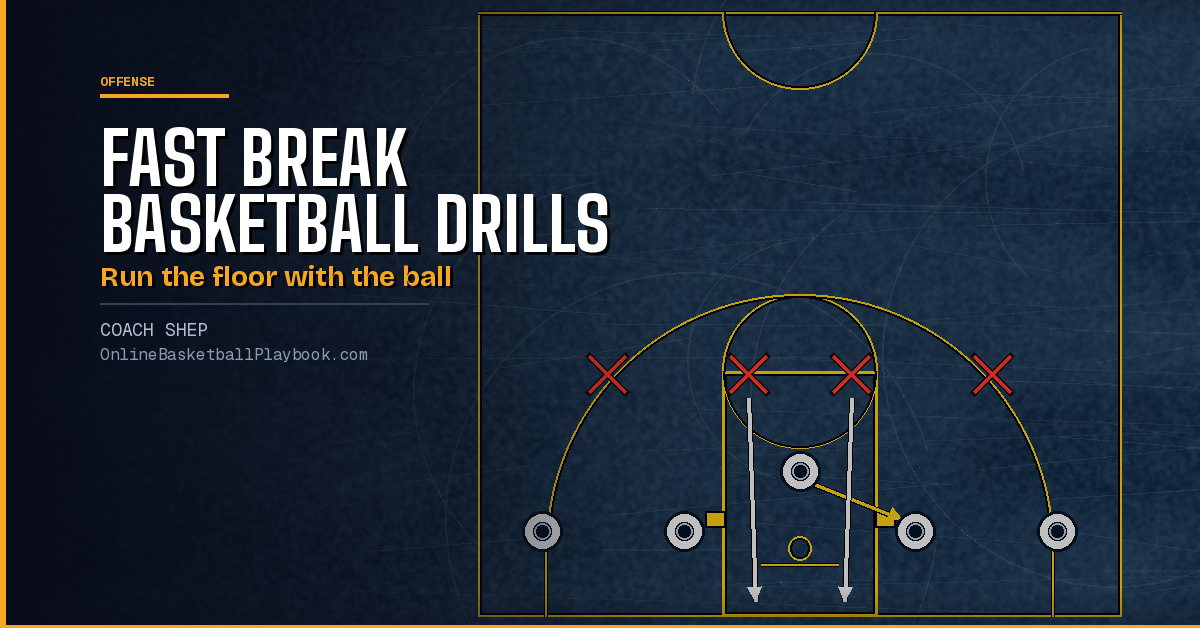
Fast Break Basketball Drills for Youth and Varsity Teams
Fast break basketball drills that run the floor with the ball: weaves, partner and no-dribble drills, catch-up drills, a finishing series and youth versions.
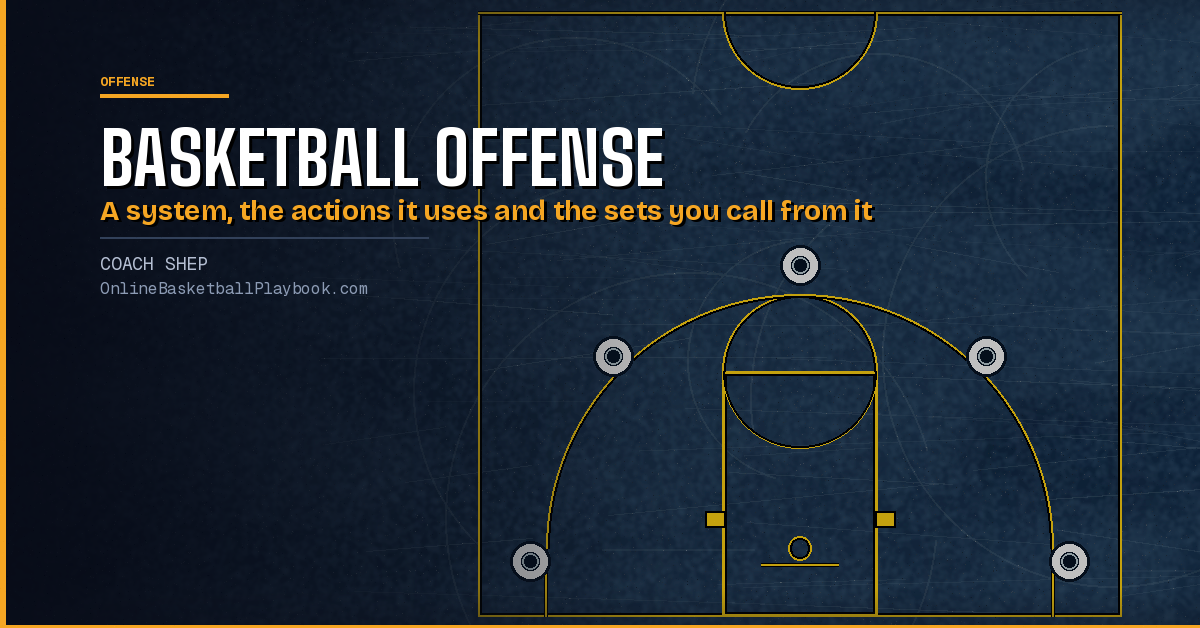
Basketball Offense: Systems, Actions and Sets Explained
Basketball offense explained as three layers, systems, actions and sets, with the formations, spacing numbers and a map of the major offenses and their pages.