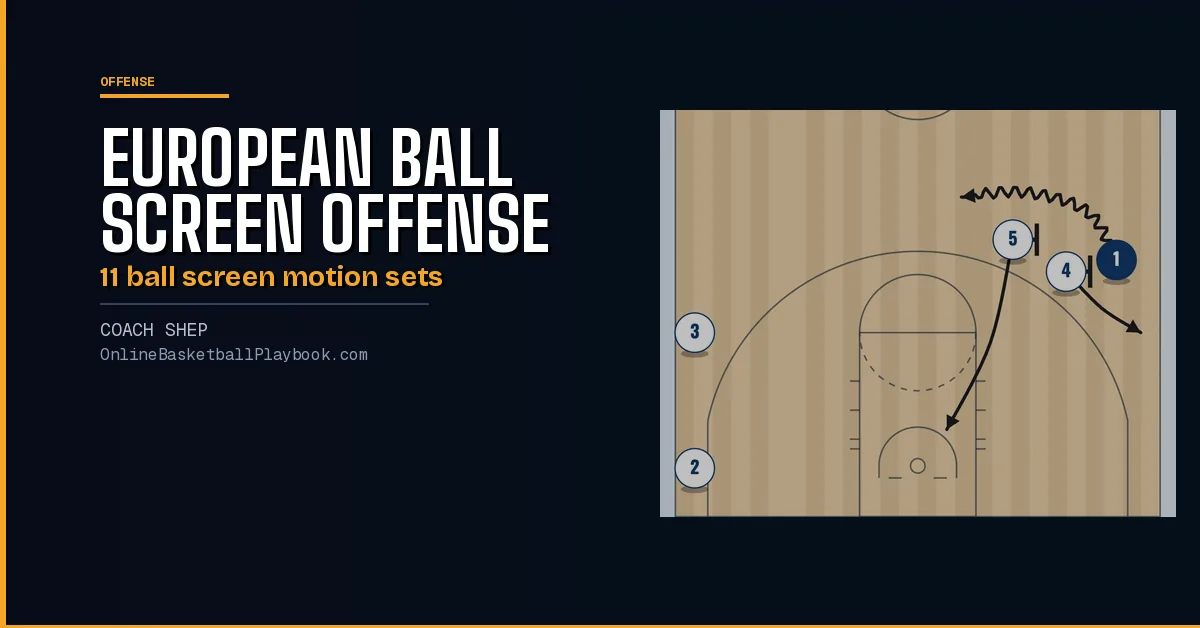
A European ball screen offense runs on a simple loop. The post at the top hits a wing and follows the pass to set a ball screen for him. The other post runs up to fill the top. When the roll is not there, the post at the top dribbles at the far wing, that wing goes backdoor on eye contact, the post passes, and the screen repeats on the new side. The full rules for that loop are on ball screen continuity offense.
The 11 ball screen motion sets on this page ride on top of that loop. Eight of them use the same backdoor and replace, either at once or after a side ball screen and a swing. The wing cuts backdoor and the corner player replaces him on the wing. In seven of those, the big then dribbles at the replacer and hands him the ball. The other three start with a delay at the top, a side ball screen or a handoff. Each set takes its name from what comes next, such as the Rip, the Double, the Stagger or the Floppy.
One Start, Many Endings. Players learn the backdoor, the replace and the handoff once. The coach adds one ending at a time, and every ending leaves the defense with two threats.
The Shared Start: Backdoor, Replace, Handoff
The cue is the trail man's catch at the top once the European ball screen is done. When he catches at the top, the wing cuts backdoor and the corner player replaces him on the wing. The big then dribbles at the replacer for a dribble handoff.
The backdoor here is not a read off a denial. It is automatic on the trail entry, and the cutter's real job comes next. He curls back to set a Rip screen, a cross screen or a screen under the rim, and his defender has just turned his head to follow the cut. For the read version of the same cut, see cut or backdoor: reading the denial.
Six Rules Behind the Sets
- One start, many endings. Players learn backdoor and replace once. The coach adds one ending at a time.
- The start is cued, not called. The trail man's catch at the top is the signal for the wing to cut and the corner to replace.
- Use the defender who is busy. When the big's defender is getting ready to guard a handoff, a back screen from the returning cutter catches him.
- The backdoor cutter becomes a screener. After the cut he screens again, and his screen comes from the defender's blind side.
- Every set ends in two threats. A roller and a popper, a post and a popper, two floppy cutters, or a stagger cutter and a diver.
- The step-up comes from the weak side. The big away from the first screen steps up the moment the swing pass lands, before the defense resets.
Rip, flare, pin down, cross, stagger and floppy screens all show up below. Each one has its own guide on basketball offensive actions.
Get the next coaching guide in your inbox
One email when a new guide or diagram set goes up. Free.
All 11 Sets at a Glance
| Set | What happens after the start | First look | Second look |
|---|---|---|---|
| Backdoor and Replace Into a Rip Screen | Big passes to the replacer. The cutter comes back and Rip screens the big. | Big cutting to the rim | Flash backdoor counter |
| Delay Flare Into a Rip Screen | Big holds at the top. The corner flares the wing, then Rip screens the big. | Big to the rim | Flare shooter |
| Backdoor Handoff Throwback | The new handler dribbles away while the big pins down for the cutter. | Throwback to the cutter on the wing | Cut and re-cut to the ball side |
| Backdoor Handoff Into a Double Ball Screen | Both bigs set a double ball screen. | Roller | Popper |
| Side Pick and Roll Into a Cross Screen | The cutter cross screens for the big, then gets screened. | Big posting on the cross | Cutter popping to the wing |
| Backdoor Handoff Stagger | The other two stagger for the cutter. The handoff man screens and dives. | Stagger cutter on the wing | Diver, or a slip against a blitz |
| Backdoor Handoff Into a Reverse Stagger | Ball screen, pass to the top, second handoff, reverse stagger. | Cutter off the reverse stagger | Roller |
| Backdoor Handoff Screen the Screener | The cutter screens for the baseline runner, then the big screens the cutter. | Cutter popping out | Baseline runner |
| Side Pick and Roll Into Floppy | Both cutters under the rim split off screens on each side. | Either floppy cutter | Screeners slipping |
| Side Pick and Roll Into a Weak Side Step-Up | Swing, then the weak side big steps up and screens. | Drive off the step-up | First roller, with the step-up as a decoy |
| Handoff Into a Weak Side Step-Up | Handoff, swing, then the same step-up. | Drive off the step-up | Roller |
The 11 European Ball Screen Offense Sets
Each set is drawn one step at a time. The basket is at the bottom of every diagram. The dark circle has the ball. A solid arrow is a cut, a dashed arrow is a pass, a wavy arrow is a dribble, a line ending in a bar is a screen, and the # mark is a handoff. The full key is on how to read a basketball play diagram.
- Backdoor and Replace Into a Rip Screen
- Delay Flare Into a Rip Screen
- Backdoor Handoff Throwback
- Backdoor Handoff Into a Double Ball Screen
- Side Pick and Roll Into a Cross Screen
- Backdoor Handoff Stagger
- Backdoor Handoff Into a Reverse Stagger
- Backdoor Handoff Screen the Screener
- Side Pick and Roll Into Floppy
- Side Pick and Roll Into a Weak Side Step-Up
- Handoff Into a Weak Side Step-Up
1. Backdoor and Replace Into a Rip Screen
The wing cuts backdoor and the corner replaces him. This time the big passes to the replacer instead of handing off. The backdoor cutter then comes back up and sets a Rip screen for the big. The big's defender is getting ready to guard a handoff, so he is the one caught in the screen.


First look: the big cutting to the rim. Second look: a flash backdoor counter.
2. Delay Flare Into a Rip Screen
No backdoor here. The big holds the ball at the top. The corner player flares the wing to the deep corner, then turns and sets the Rip screen for the big. It is the same finish as the first set with a different start.


First look: the big to the rim. Second look: the shooter coming off the flare. More on the screen itself is on flare screen.
3. Backdoor Handoff Throwback
Backdoor, replace and the dribble handoff. The new ball handler dribbles toward the top. Behind him the big sets a pin down, and the backdoor cutter comes up out of the lane to the wing. The ball is thrown back to him.


First look: the throwback to the cutter on the wing. Second look: a cut and re-cut back to the ball side. The pin down is covered on down screen.
4. Backdoor Handoff Into a Double Ball Screen
The handoff turns into a double ball screen. The second big comes up and sets a screen beside the first one. One big pops and the other rolls.


First look: the roller. Second look: the popper. Two counters off this set are a re-screen into a chop cut and Spain, a back screen on the roller's defender.
5. Side Pick and Roll Into a Cross Screen
A side ball screen comes first. The screener rolls to the far block and the ball swings. Then the backdoor, the replace and the handoff. After his cut, the backdoor man sets a cross screen for the big, and a teammate then screens him, so this is a screen the screener action.


First look: the big posting on the cross. Second look: the cutter popping to the wing. The cross screen is on cross screen.
6. Backdoor Handoff Stagger
Backdoor, replace and the handoff on one side. On the other side two players line up a stagger for the man who cut backdoor. After the handoff, the big screens for the new ball handler and dives.


First look: the stagger cutter on the wing. Second look: the diver. Against a blitz, the screener slips. Blitz coverage is on blitz and trap ball screens.
7. Backdoor Handoff Into a Reverse Stagger
The longest set on the page. Backdoor, replace and a handoff that becomes a ball screen. The ball goes to the top, a second handoff follows, and the player who cut under the rim comes off a reverse stagger. The big who rolled is the first screen in it, and the big who made the second handoff steps down to be the second.


First look: the cutter off the reverse stagger. Second look: the roller.
8. Backdoor Handoff Screen the Screener
On the ball side the handoff turns into a ball screen. Away from the ball, the backdoor man screens for a teammate who runs the baseline. A big then screens him, and he pops out to the slot for the pass.


First look: the cutter popping out. Second look: the baseline runner.
9. Side Pick and Roll Into Floppy
Side ball screen and swing, then the backdoor, the replace and the handoff. Both cutters finish under the rim. One screens the other's defender there, then the two break out in opposite directions off a screen on each side, and the ball can go to either one.


First look: either floppy cutter. Second look: the screeners slipping. More floppy reads are on floppy action.
10. Side Pick and Roll Into a Weak Side Step-Up
Side ball screen and swing. The big on the weak side, the one away from the first screen, steps up and screens for the catch at once, before the defense resets.


First look: the drive off the step-up. Second look: the first roller. The step-up can also be a decoy that leaves the first roller open. Other counters are a re-screen, a reject into a drive and kick, and a weave entry. The screen is on step-up screen.
11. Handoff Into a Weak Side Step-Up
The same step-up, started with a dribble handoff instead of the ball screen. The big dribbles at the wing, hands off, and rolls. On the swing, the weak side big steps up and screens.


First look: the drive off the step-up. Second look: the roller. The handoff is covered on dribble handoff.
How to Install Ball Screen Motion
Because the sets share a start, the install is the start first and one ending per practice after that.
- Day 1, the start only. 3 on 0: the wing cuts backdoor, the corner replaces, the big dribbles at the replacer and hands off. Run it on both sides.
- Day 2. Add the Rip screen.
- Day 3. Add the double ball screen.
- Day 4. Add the stagger.
- After that. Throwback, screen the screener, cross, floppy and the weak side step-up, one at a time. Delay flare and the reverse stagger fit in the same way.
The Cue Drill
Play 4 on 0 with the trail entry. When the trail man catches at the top, the wing must already be cutting. A late cut means the rep starts over.
On the Rip screen, the returning cutter screens the big's defender while that defender leans toward the handoff. The big cuts the instant the replacer catches.
Live Progression
Start 3 on 3 on one side with the start plus one ending. Move to 4 on 4 and add the weak side screens. Then go 5 on 5 with the coach calling the ending on the trail entry. More ways to build the pieces are on drills to teach ball screen offense and drills to teach off-ball screens.
Final Thoughts
The European ball screen offense gives a team one start it runs on a cue and a menu of endings built on top of it. Teach the backdoor, the replace and the handoff until they happen on the trail entry without a call. Then add the endings one at a time, and keep the ones that fit your players.
For the reads after the screen, see pick and roll reads and screener reads: roll, pop or slip. More offense guides are on the offense hub and the continuity offense page.
Questions Coaches Ask
What is a European ball screen offense?
A ball screen offense in which the top post passes to a wing and follows with a ball screen, and the other post runs up to fill the top. When the roll is not there, the post at the top dribbles at the far wing, the wing goes backdoor on eye contact, the post passes, and the screen repeats on that side.
What is backdoor and replace?
The wing cuts backdoor toward the rim and the player in the corner moves up to take his spot on the wing. In ball screen motion the big then dribbles at the replacer and hands him the ball.
What is a Rip screen?
A back screen for the big. In these sets the backdoor cutter comes back up and sets it on the big's defender while that defender is getting ready to guard a handoff.
What is a weak side step-up?
After a side ball screen or a handoff, the ball swings and the big on the weak side steps up and screens for the catch at once. It can also be a decoy that frees the first roller.
Which ball screen motion set should a team learn first?
The shared start, with no ending. After that, the Rip screen, the double ball screen and the stagger, one per practice.
Every set on this page can be redrawn in the free play drawer.
Back to Continuity Offense and every Offense page.
Keep Building
Related breakdowns
Pass-and-Cut Motion Offense: Reads, Backdoor and Install
This motion offense is a read-based system built on spacing, ball movement, and purposeful cutting. Every pass triggers a decision.
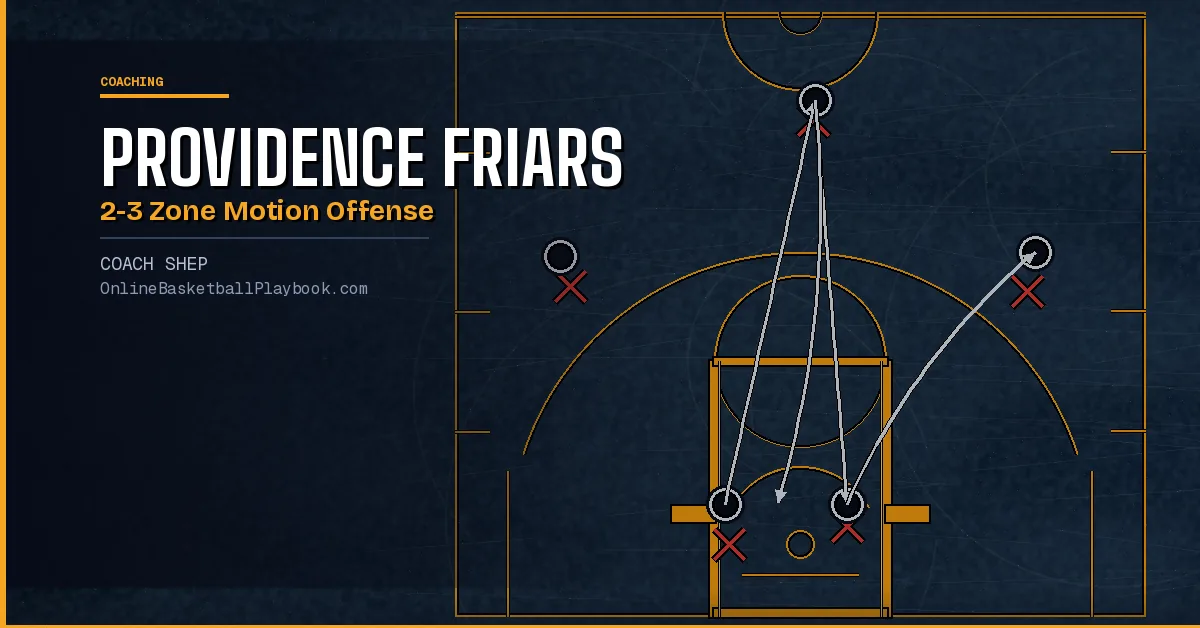
Providence Friars 2-3 Zone Motion Offense Baseline Runner Basketball Play
Providence Friars 2-3 Zone Motion Offense Baseline Runner Basketball Play