
The flex is a continuity offense. It is a set sequence of passes, cuts and screens that flows from side to side and repeats without a reset. It is most effective against man-to-man defense.
Its defining action is screen the screener. A player sets the baseline screen for the flex cut, then receives a down screen himself. The cutter's defender needs help from the screener's defender, and that helper is being screened at the same moment. The offense forces that decision three or four times a possession.

Because the cutter becomes the next screener, every player passes through every spot. Guards post up and posts handle on the perimeter. That makes it a good teaching offense.
The base can be written as two rules. On a guard to guard pass, the weak-side corner player runs the flex cut off the post, and the passer then screens down for that post. On a guard to wing pass, the passer screens away toward the baseline. A team can run the base after 10 to 15 minutes of teaching.
The common mistake is standing. Nobody stands on the perimeter. A player with no pass coming screens away at once, and a denied player goes away and screens for a teammate. For youth, use four rules: set a screen and you get one, get a screen and you set one or get a pass, pass and you set a screen, catch and you shoot or pass.
More Offense questions
Free playbook
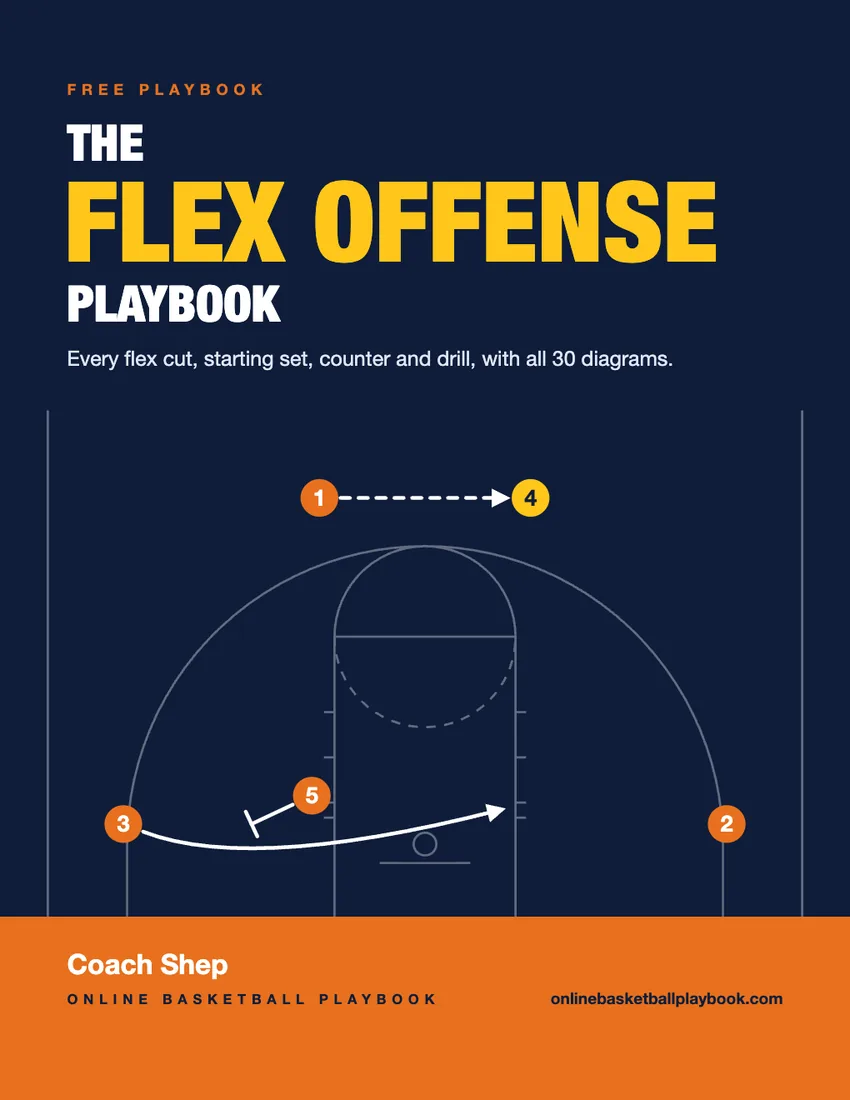
Get the free flex offense playbook
Every flex cut, starting set, counter, special and drill, with all 30 diagrams, in one printable PDF.