
An inbound play is a called set that starts from a throw-in. A BLOB is thrown in from under your own basket, and a SLOB from the sideline. Every play needs a safety receiver.
Most baseline sets come from a few starting shapes. A box has players on each block and elbow. A stack lines four players up on one side. A line, or 1-4 flat, strings players across the lane. A triangle layers three players on one side. The shape stays the same and the call changes the finish, so players see one picture and learn one set of cuts.

Four habits sit under every call. Treat the inbounder as a receiver, because if the defense ignores him he can step in for the return pass. Pick the inbounder for passing and quick decisions. Build in a safety near the top of the key. And give players automatic reads when a defender turns his head.
Here is an example from a box. The posts start wide on the blocks. One screens for the shooter, who cuts to the arc, and a guard slides to the top of the key as the safety. If the shooter is covered, the ball goes to the safety and you are into your offense.
The common mistake is running too many plays. No coach names one best inbound play. Teach two or three from one shape and rep them until they are automatic. Young teams need the safety and a simple screen. Older teams can add counters.
More Special Situations questions
Free playbook
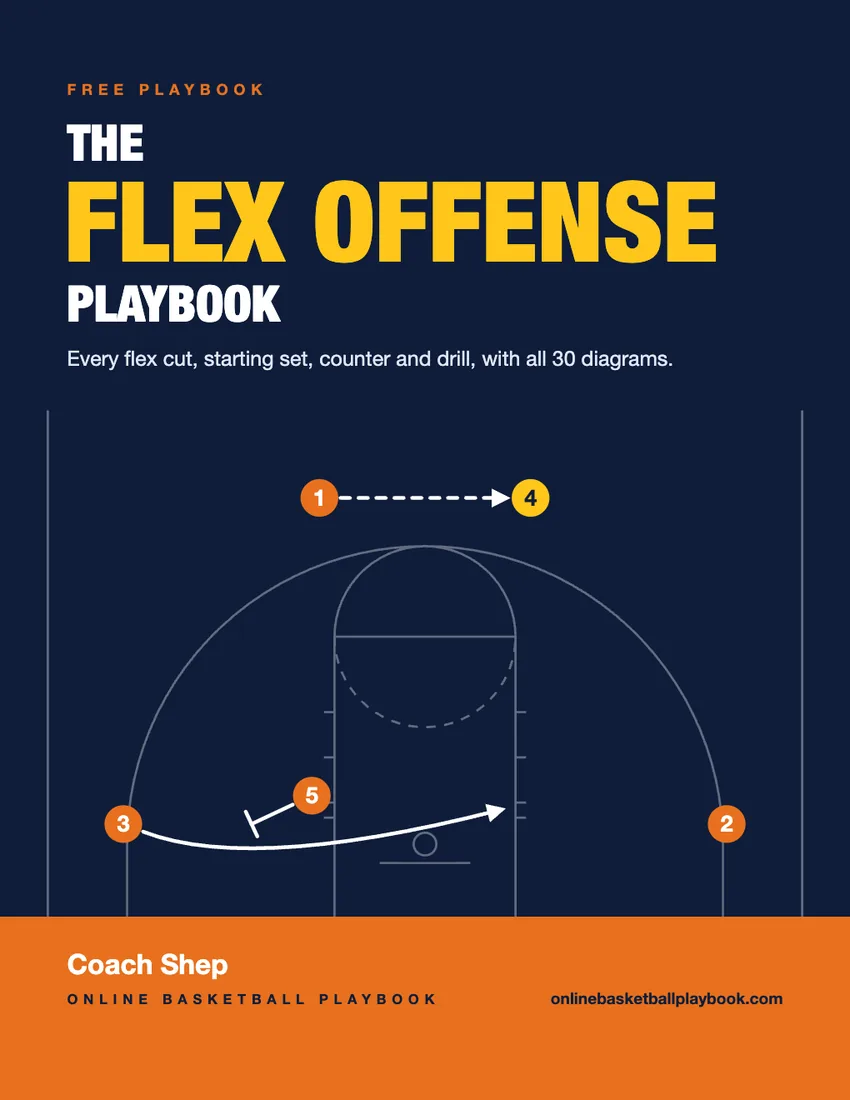
Get the free flex offense playbook
Every flex cut, starting set, counter, special and drill, with all 30 diagrams, in one printable PDF.