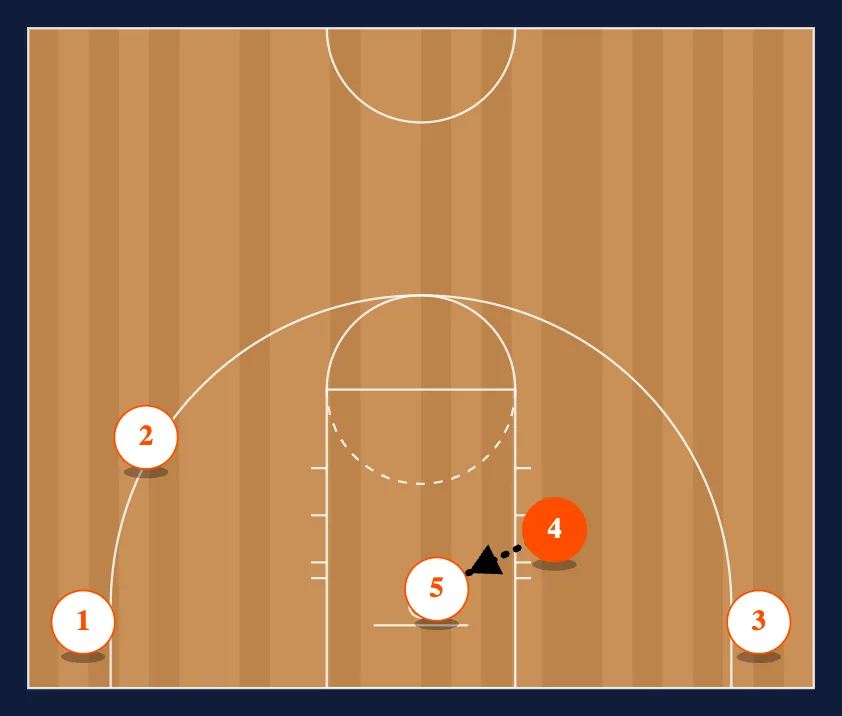
What is Horns Twist? Horns Twist pops 4 to the left slot for the catch, then 5 replaces him at the left elbow and steps out to ball-screen for him. Horns Twist starts from the standard horns look and turns it into a big-to-big pick and roll.
What is Horns Twist?
Horns Twist starts from the standard horns look and turns it into a big-to-big pick and roll. The guard does not use the elbow screens at all. He passes to the big who popped, then gets out of the way, and the other big comes across to screen for the new ball handler.
When to use it
Run it when your power forward can catch on the perimeter and put the ball on the floor. It also helps when the other team's guards are good at fighting over ball screens, because the screen comes for a big man and their big men have to guard it. The horns sets guide shows the other actions that start from the same look. Another play goes by the same name and flips the ball screen for the guard instead. The twist ball screen guide covers that one.
How to run it
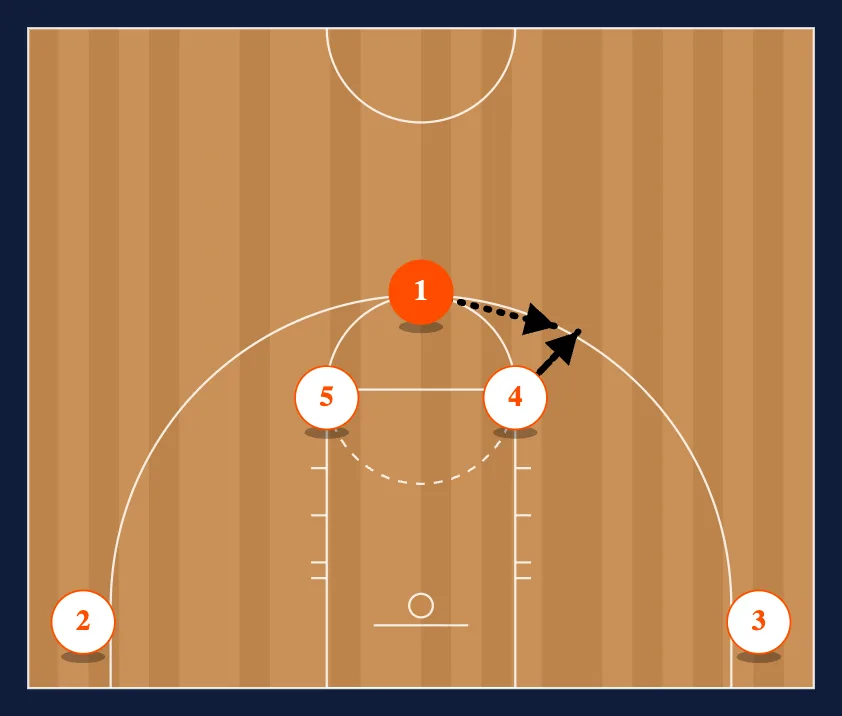
Step 1. 1 brings the ball to the top of the key with 4 and 5 standing at the left and right elbows, 3 in the left corner and 2 in the right corner. 4 pops out to the left slot for the first pass.
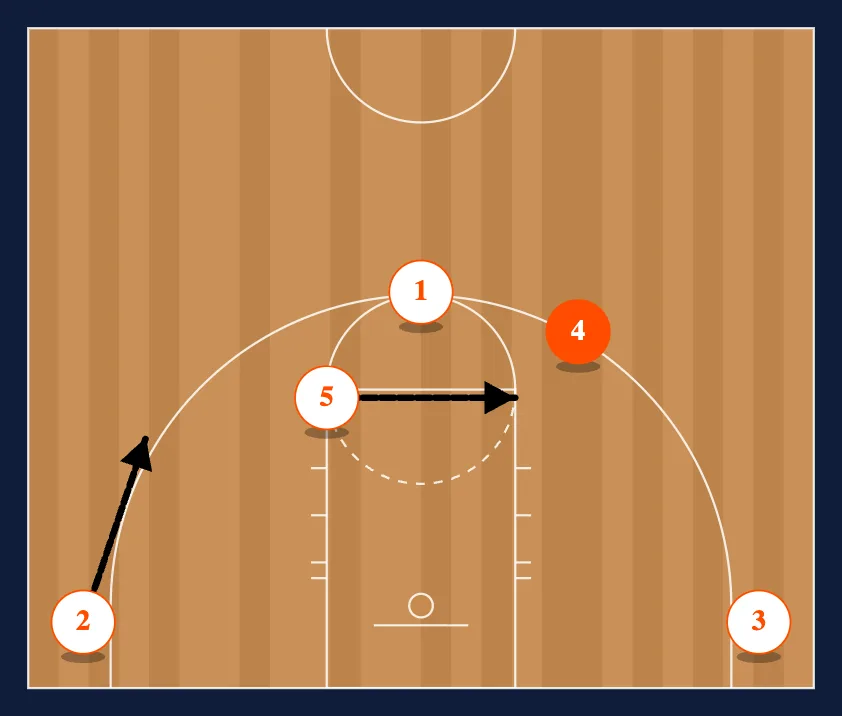
Step 2. 5 runs across the free-throw line to the left elbow, the spot 4 just left. 2 lifts from the right corner to the right wing.
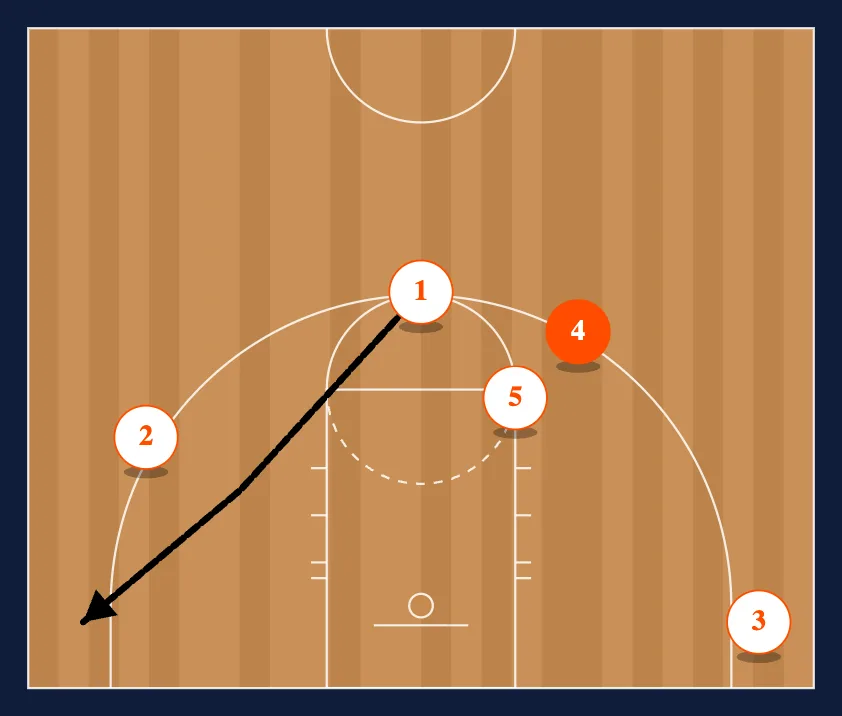
Step 3. 1 cuts down the right side to the right corner, so the top of the key is empty.
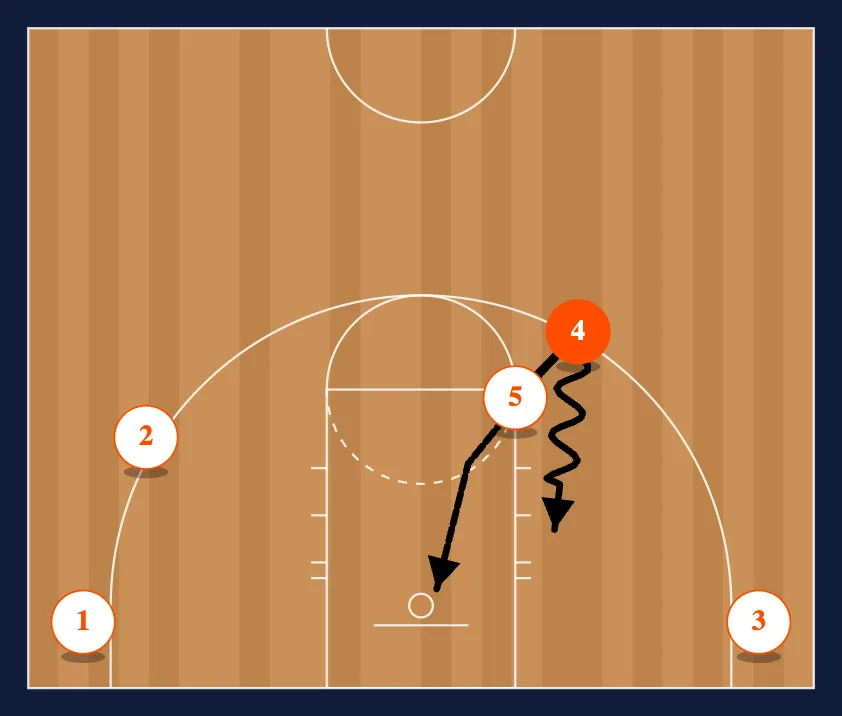
Step 4. 5 steps out from the left elbow and sets a ball screen for 4. 4 drives down the left side of the lane and 5 rolls to the rim.
Step 5. 4 hits 5 on the roll. If 5's man sits back to take the roll away, 5 pops to the left elbow instead of rolling and 4 finds him for the jump shot.
Counters
- 1 cuts too early and drags his defender into the lane right where 4 wants to drive. He leaves after 5 has crossed.
- 5 sets the screen from the elbow without stepping out, so 4 has to dribble back toward him and loses the angle.
- 4 drives with his head down and misses 5 popping open behind the play.
What it attacks
It beats a defense that is set up to stop the guard in the pick and roll. Here the ball handler is a big, so two big defenders have to guard the screen and neither is used to playing out on the floor. When 1 runs to the corner, he pulls his defender away from the top of the key, so no guard is there to help on the drive.
Teaching points
- 4 pops wide enough that his catch is outside the three-point line, not at the elbow extended.
- 5 waits until 1 has cleared to the corner before stepping out to screen.
- 4 catches and faces the rim first, so his man cannot crowd him before the screen arrives.
- 5 sprints to the rim on the roll or sprints out on the pop. A half roll gives the defense time to recover.
Build it in practice
Walk the first two steps with no defense until both bigs know their spots. Add the ball screen 2 on 2 with the bigs only, once with a defender who sits back and once with one who steps up, so 5 learns when to roll and when to pop. Then add the guards and corners and run it live. The ball screen plays guide has more ways to put a big in the pick and roll.
Related plays (same type)
More from this set type
More in Offense · Play library
Coaching guides: horns sets guide · twist ball screen guide · ball screen plays guide
How do you scout with this diagram?
Step through the frames, note who occupies each spot, and mark where help comes from on the first pass.
Is this play only for one level?
The spacing and reads are drawn on a standard court. Tighten timing for youth and add pressure for varsity.
Where do guides go deeper?
Follow the in-article links to coaching guides when you need rules, terminology, or system context.