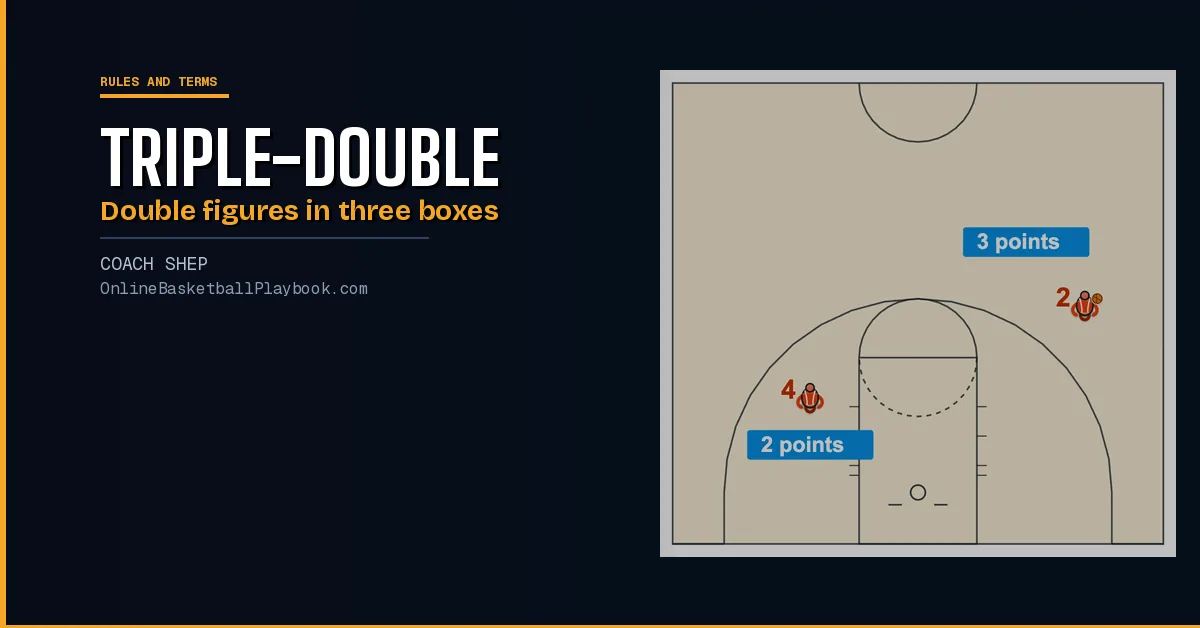
What is a triple-double in basketball? It is a single-game stat line where one player reaches double figures in three of the five main counting categories: points, rebounds, assists, steals and blocks. The name comes from "double digits" in three boxes. It is a box-score label, not a rule enforced by officials, and every level that keeps a full stat sheet can record one.
What Counts Toward a Triple-Double
A standard box score lists at least five personal stats for each player. For a triple-double, pick any three of these and require 10 or more in each:
- Points: field goals and free throws scored. See basketball rules for how points are counted.
- Rebounds: offensive and defensive boards combined.
- Assists: passes that lead directly to a made basket.
- Steals: taking the ball from an opponent.
- Blocks: deflecting an opponent's try on its upward flight.
Turnovers, fouls and minutes played do not count toward a triple-double. Full definitions of stat terms are in the stats section of basketball terminology and in basketball statistics guide.

Common Triple-Double Combinations
The most talked-about version is points, rebounds and assists, often from a versatile guard or forward who handles the ball and crashes the glass. Big men sometimes combine points, rebounds and blocks. A pressing guard might hit steals instead of blocks.
There is no extra value in the rulebook for reaching the milestone; it is a shorthand for an all-around game. Coaches care more about whether the production helped the team win than about the label itself.


What Is a Double-Double?
A double-double is when one player reaches double figures in two of the five standard box-score categories in the same game. The usual pair is points and rebounds for a big, or points and assists for a guard who runs the offense. Any two of points, rebounds, assists, steals and blocks count. There is no extra rulebook value; it is shorthand for a productive night in two areas. Full definition and youth tracking tips live on what is a double-double.
Double-doubles happen far more often than triple-doubles, especially at levels where one player dominates minutes or touches. For youth teams, a parent scorer might note a double-double to praise rebounding effort and scoring together, not to compare kids to pro box scores. Abbreviations on the stat sheet are defined in the stats section of basketball terms.
- Points + rebounds: common for posts and forwards who play near the rim.
- Points + assists: common for primary ball handlers who also score.
- Points + blocks or steals: less common but valid when a defender also scores in transition.
Coaches should still grade effort and decisions, not labels. A player with 8 points and 12 rebounds who kept the team on the glass may matter more than a empty 10 and 10 in a loss. Tracking categories honestly on a basketball stat sheet teaches what each number means before anyone chases milestones.
How the Term Is Used
Stat keepers and media use "triple-double" the same way they use "double-double" (two categories at 10+). The NBA and NCAA publish these numbers in official box scores when the arena keeps full stats. High school coverage depends on whether the home scorer tracks assists, steals and blocks or only points and rebounds.
Do not teach players to chase empty numbers. A forced shot to reach ten points hurts the team even if a reporter is counting. The teaching frame is still basketball stat sheet habits: accurate recording, honest assists and team goals first.
Quadruple-Doubles and Near Misses
A quadruple-double is 10+ in four categories in one game. It is extremely rare at the highest levels because steals and blocks are hard to stack with points and rebounds in the same night. A near miss such as 9 rebounds does not count; stat lines use whole numbers only.
Tracking a Triple-Double for Youth Teams
Most youth games do not have a press-box crew. If you want players to learn the five categories, use one printable stat sheet per game and rotate a parent or assistant as scorer. Mark points from the public address table if needed, but assign one trusted adult to rebounds, assists, steals and blocks so the numbers stay consistent.
- Print the stat sheet before the game and agree on what counts as an assist (one dribble or shot motion after the pass is a common youth standard).
- Record subs by quarter so minutes stay fair when you review the sheet with players.
- After the game, circle any player with 10+ in three columns and explain what they did well in each category, not just the label.
For simpler team metrics at young ages, see coaching youth basketball and 21 basketball rules for informal games without a full box score.
Questions Coaches Ask
What is a triple-double in simple terms?
One player gets 10 or more in three of these five stats in the same game: points, rebounds, assists, steals and blocks.
Can a triple-double include steals or blocks instead of assists?
Yes. Any three of the five standard categories count. A line with points, rebounds and blocks is still a triple-double.
Is a triple-double an official rule?
No. It is a stat-sheet summary. Officials do not stop the game when a player reaches it.
What is the difference between a double-double and a triple-double?
A double-double is 10+ in two categories. A triple-double is 10+ in three categories in the same game.
How should youth coaches use triple-double talk?
Use it to teach the five box-score categories and good recording on a stat sheet, not to push players to pad one number.
Get the next coaching guide in your inbox
One email when a new guide or diagram set goes up. Free.
Want the printable playbook packs?
Playbook packs: zone attack, press break, press defense, out of bounds, quick hitters, practice plans and the youth turnover cure, each a printable PDF. Or draw your own version free in PlayDraw.
See the playbook packsRelated Rules Guides
Back to Basketball Rules and Regulations and every Rules and Terms page.
Keep Building
Related breakdowns
What Is a Double-Double in Basketball?
What is a double-double? Ten or more in two of points, rebounds, assists, steals and blocks in one game, with common pairs and youth stat-sheet tips.
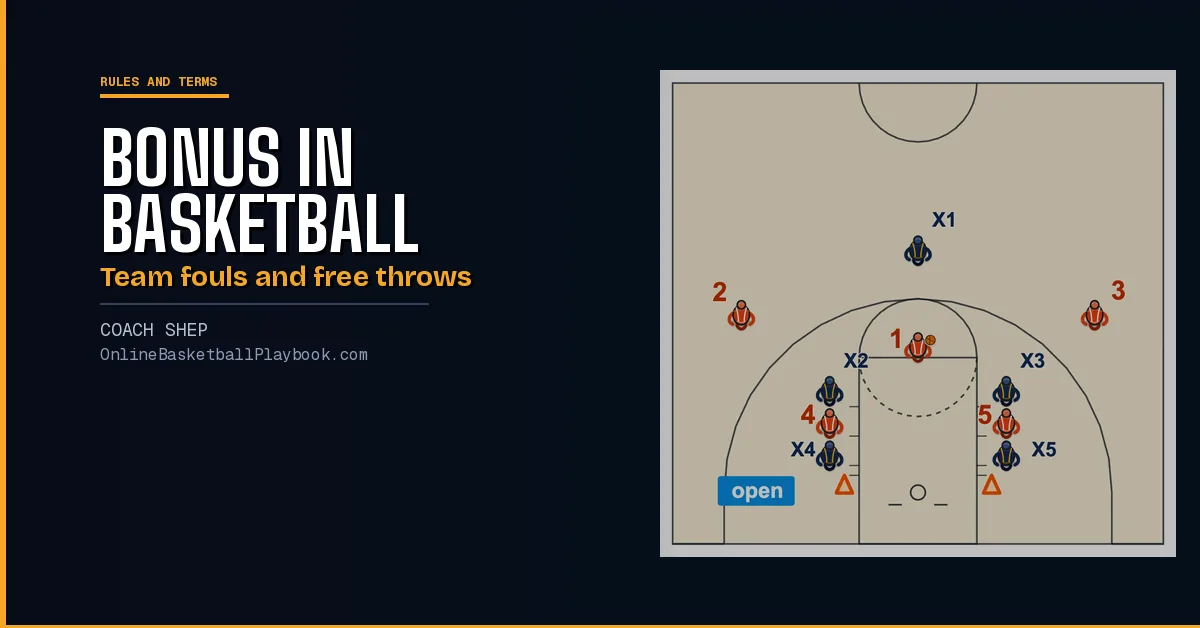
What Does Bonus Mean in Basketball?
What does bonus mean in basketball? Team fouls that send the other team to the line, with bonus and double bonus thresholds by NFHS, NCAA, NBA and FIBA.

High School vs College vs NBA Rules: What Changes for a Coach
High school vs college vs NBA rules: shot clock, three-point line, bonus, fouling out, timeouts, backcourt count and defensive three seconds, and what each changes.