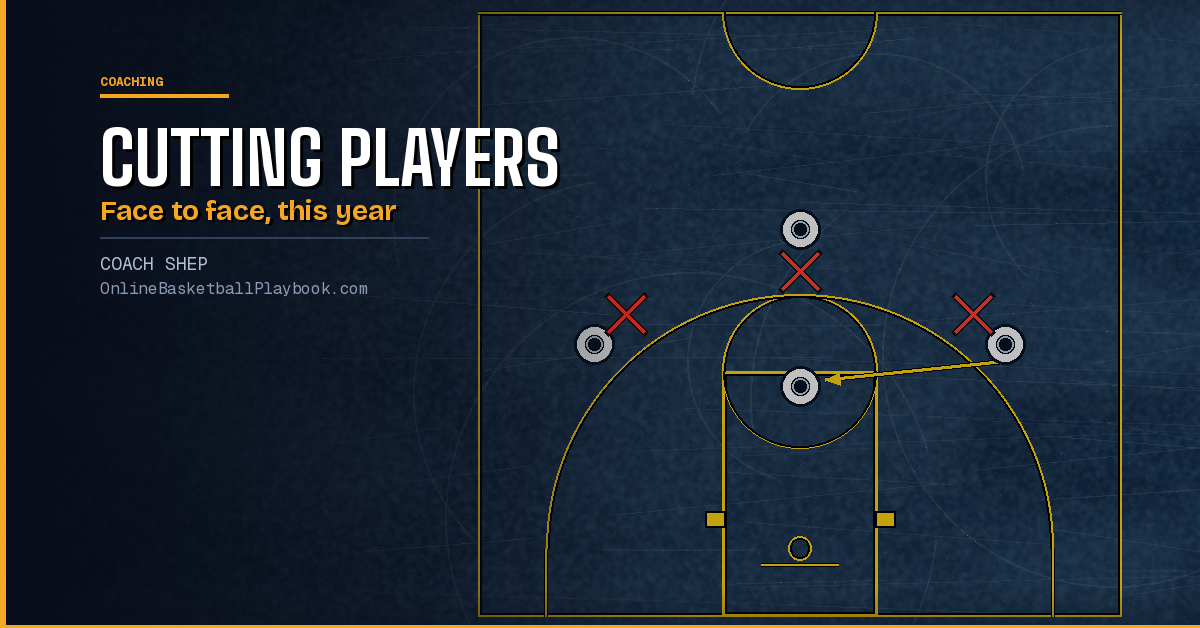
Cutting players is the part of the job most coaches dread, and what to say is the part they plan least. The answer starts long before the meeting. Tell the group on day one that some will not make it, be sure of every decision, then tell each player yourself, face to face, with specific things to work on and a reason to come back.
This page covers what to say before the tryout, how to be sure before you say anything, the meeting itself, the words to use and avoid, what to offer, the parents and the players who did make it. The full tryout plan is on basketball tryouts.
Cut Only When You Must
Avoid the cut first. Nobody can tell at a young age which players will grow into the best ones, so give all of them the chance:
- Make a second team. Too many players for one team means two teams, or three instead of two.
- Rotate the extras. With a few players more than one team holds and too few for a second, keep them all and sit a different player or two out of each tournament.
- Keep the unfinished players. At lower levels, where players improve every day, keep the bigs and the players who are not finished yet. Find reasons to keep rather than cut, and when in doubt, keep.
- Name the teams neutrally. If you split players by ability, call the groups something like Lions and Tigers instead of A and B, because letters run down the lower groups.
At high school and on senior teams there are times you have no choice. A team cannot carry 20 players.
Cut last, not first. Every player you keep is one conversation you never have to have.
What to Say on Day One
The cut conversation starts at the first tryout, before anyone steps on the court. Gather the players and parents at one end of the floor and keep it short:
- Welcome them. Your name and a thank-you for coming.
- Share the philosophy. Two or three sentences on how you play, how you hand out minutes and what the season is about.
- Explain the tryout. How many sessions, when, how long each runs and what a session looks like.
- Name what you look for. Two or three traits, such as players who listen and learn, support their teammates and love to compete.
- Say that some will not make it. Tell the group that some players will not make the team. If you know how many you will keep, say the number now.
- Explain the selection. When and how the team will be announced.
- Take questions. Then start.
It is not a positive note to begin on, but it is a necessary one. Players on the edge know they are on the edge, the warning gives them a reason to train harder, and nobody is blindsided later.
Explain the team rules, policies and season goals before you evaluate anyone. Tell parents the criteria ahead of time and keep them the same from season to season. Send the tryout and cut policy to players and parents to sign off in advance.
Hand the players a short sheet on what is watched. Effort and attitude are the only two things a player controls at a tryout, and fundamentals, hustle and a role-player mindset beat flash. The player's side of the tryout is on tips for basketball tryouts.
Say it on day one so the last day holds no surprises.
Be Sure Before You Say It
A cut is easier to explain when the staff is sure of it. The top 5 to 7 spots are clear within minutes. The work is the last 3 to 5, so build the last session around the players you are unsure of:
- Score alone, then agree. Each coach fills out a form alone, then the staff meets for a consensus.
- Look again in small games. When the staff splits on a few players, add 3-on-3 and 4-on-3 to the next session to watch them in small groups.
- Mix the teams. Spread the talent and the friend groups across the 3-on-3 teams, so skill shows and cliques do not form.
- Rank them one on one. One-on-one make it take it, three dribbles at most and no backing in, bigs with bigs and smalls with smalls, winners up and losers down.
- Test the mismatch. Put a player on the weakest lineup against the strongest and watch whether he lifts his teammates or sulks.


Keep a written note on every player, not just the top group, so the decision can be explained later. The scoring sheet is on basketball tryout evaluation form, and more drills are on basketball tryout drills.
You owe the player a decision you can explain. Get the second look before you say a word.
Cutting Players: What to Say in the Meeting
Getting cut can be a traumatic experience that lasts a lifetime. The players gave everything they could to the team, and they deserve the courtesy of hearing it from you. Cover these in the meeting:
- Tell him yourself. Face to face, in a private meeting. Not by email, and never on a list on the gym door. If you cannot meet every player alone, at least tell each one yourself.
- Say the decision plainly. He did not make the team this year.
- Be honest about why, short and specific. Something to work on before next year helps him more than gentle words with no reason. Give him a list of the skills he needs to improve.
- Ask for his view. Review the evaluation and the decision with him, and ask how he rates his own play.
- Never compare. Explain his game, not a teammate's. Word travels fast, and a comparison sets two players and two families against each other.
- Offer a role. Ask whether he wants another job on the team, below.
- End on a positive. Finish the meeting on something he does well and on next year.
Players do not need a speech. They need the truth, said kindly, and a plan.
Words to Use and Words to Avoid
The words that land with a player are not the words coaches use with each other. Coaches talk about cuts. With players and parents, choose words that keep the door open:
- Say "didn't make the team this year." Lean on "this year." It tells him that if he works hard on his game he has another chance next year.
- Avoid "cut." The phrase "cut from the team" carries a negative charge that the plain words do not.
- Avoid the soft letdown. Vague comfort with no reason gives him nothing to work on.
More on the words a coach uses is on how to give feedback to basketball players.
Choose the words before the meeting, and say them the same way to every player.
Get the next coaching guide in your inbox
One email when a new guide or diagram set goes up. Free.
What to Offer the Player
A player who loves the game can stay close to it. Offer something real:
- A job on the team. Team manager, statistician, video person or a practice player.
- First in line. Injuries and dropouts happen, and a player who stays involved is first in line when a spot opens.
- A second team. A place on the second or third team if the program has one.
- A follow-up meeting. Set a date for the player and his parents to come in and talk about his game and what to do to make the team next season. Tell every player who did not make it that he is welcome to come and talk about why and what to work on.
- A plan. The skills list turns into a workout. A plan for one player is on individual basketball workout plan.
Keep the door open on purpose. Plenty of players who miss a middle school team go on to start for the varsity, and Michael Jordan did not make his high school varsity as a sophomore. He played on the junior varsity that year and used it as fuel. Players develop at different rates, and a coach may not see the payoff of the hours he puts into a player right away.
Leave every player with a job, a plan or a date. Never with nothing.
Talking With Parents
Parents cannot be objective about their own child. The coach can be fair, consistent and early:
- Meet with player and parents. Offer the follow-up meeting to both, to talk about the player's game and next season, so the cut never comes with no explanation.
- Keep the player in the room. Make any talk about minutes or roles one the player is part of.
- Wait 24 hours. Ask parents to wait 24 hours after a game before asking for a conversation.
- Talk about his game only. The same rule as with the player: never compare him to a teammate.
- Settle the paper first. Decide before the tryout whether the evaluation forms are shredded, kept on file or handed to the player, and keep to it.
The full parent relationship is on basketball parent communication.
Parents hear the decision once. Say it the way you would want it said to your own child.
What to Say to the Players Who Made It
The last players kept need words too, because they will spend time on the bench:
- Name the role before the first game. Tell each player his role before the first game, a rule credited to John Calipari.
- Make the role an honor. Name the jobs, such as the sixth man, the defensive stopper and the designated inbounder, and acknowledge them all season. Every player gets equal opportunity, not equal playing time.
- One strength, one need. In a short talk after practice, give one strength and one thing to improve, positive first.
- Tell him his number will get called. Players 8th to 10th on the depth chart check out once they decide that getting better will not earn minutes. Injury, foul trouble and grades put them on the floor.
Roles on the bench are on managing bench players, and the rest of running a team is on the coaching hub.
Tell every player where he stands. The ones who made it deserve the truth as much as the ones who did not.
Questions Coaches Ask
How do you tell a player he got cut?
In person, in a private meeting. Say he did not make the team this year, give two or three specific things to work on, never compare him to a teammate, offer another role and end on a positive.
Should you post a cut list?
No. A list on the gym door or an email skips the courtesy every player is owed. Tell each player yourself.
What should you not say when cutting a player?
Avoid the word cut, avoid comparing him to a teammate and avoid a vague letdown with no reason. Say he did not make the team this year and name the skills to work on.
Should parents be in the cut meeting?
Offer a follow-up meeting with the player and his parents to talk about his game and next season. Keep the player in any conversation about his role.
How do you avoid cutting players?
Form a second or third team, rotate extra players out of tournaments, and at lower levels keep the players who are still growing into their game. When in doubt, keep.
Want every diagram on the site?
OBP Pro members get the full diagram files for every guide on the site, ready for a practice binder or a scouting report. $9 a month. Or draw your own version free in the play drawer.
See what OBP Pro includesMore Program and Rules Guides
- AAU vs High School Basketball: How Coaches Work Together
- Basketball Tryout Evaluation Form: What to Score and How
- FIBA Basketball Terminology: Words Coaches Hear Abroad
Back to Basketball Tryouts and every Coaching page.
Keep Building
Related breakdowns
Basketball Tryout Evaluation Form: What to Score and How
A basketball tryout evaluation form you can copy: the eight rows to score, what the scores mean, which drill fills each row, and how to turn scores into a team.
Coaching Communication: How to Explain Basketball to Players
Coaching communication for basketball: the teaching order, fewer and clearer words, how to correct a mistake, one team vocabulary and calls taught inside the drill.
Basketball Coach Resume: What to Put on It and What Gets Read
How to build a basketball coach resume: measurable lines, a specialty, the coaching portfolio, the program plan and how coaching jobs are really filled.