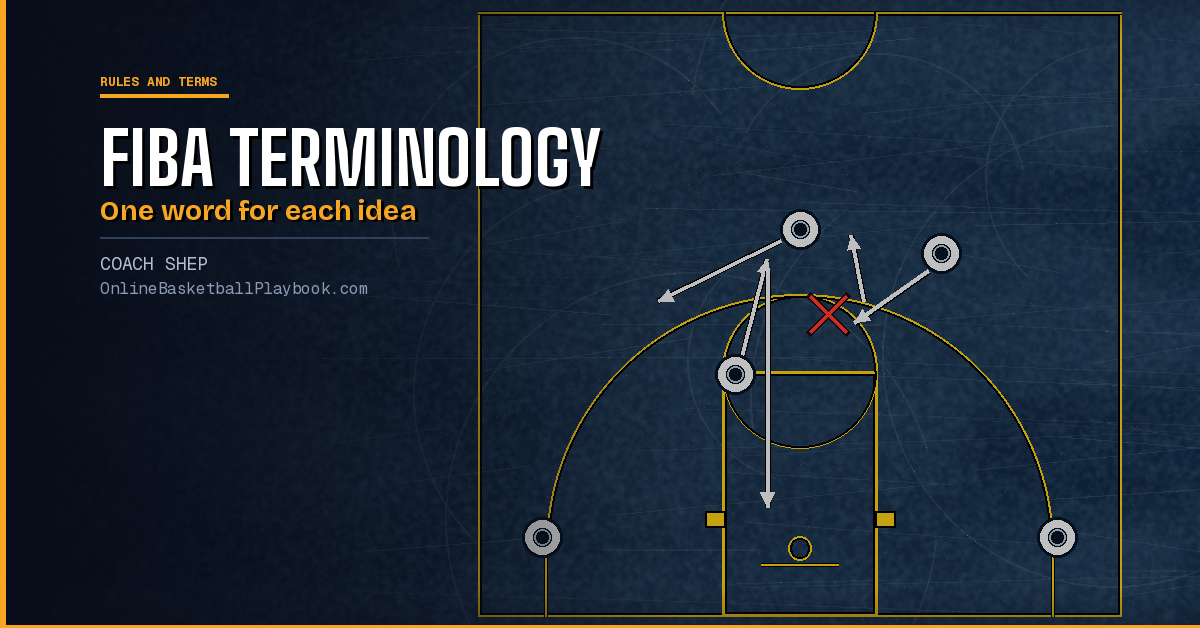
FIBA basketball terminology is the vocabulary of the international game: the coverage names a staff calls, the screen and cut names in a playbook, and the words in the FIBA rulebook that referees and the table use. A coach heading abroad, or coaching under FIBA rules at home, needs both sets.
The coaching words here come from FIBA Europe's official terminology glossary, a 67-page document from its coaching department, dated May 2024. The rule words come from the FIBA Official Basketball Rules 2026, in force from 1 October 2026. The full English glossary for every level is on basketball terms, and the rules side by side by level are on basketball rules and regulations.
FIBA Basketball Terminology for Ball Screen Defense
The coverage words are the most useful part of the glossary. Each one names where the screener's defender stands and what the on-ball defender does, so a loose word teaches the wrong footwork:
- Drop. The screener's defender sits a few steps below the screen and backpedals as the ball handler comes off it.
- At the level, or up to touch. The screener's defender starts at the level of the screen and touches the screener before the ball handler arrives.
- Hedge. The screener's defender steps into the ball handler's path to slow him while the on-ball defender recovers around the screen.
- Blitz. The screener's defender sits above the screen and traps the ball handler with the on-ball defender.
- Blitz-to-switch. A blitz that turns into a switch, to stop the ball handler attacking a mismatch or to keep the ball away from the go-to player late.
- ICE. The on-ball defender forces the ball handler away from the screen, and the screener's defender mirrors the ball on that side. On a side ball screen the ball goes toward the sideline and the baseline. Fan and push down are the same coverage.
- Over. The ball handler's defender goes over the top of the screen.
- Weak, to the weak hand. The on-ball defender forces the ball handler to his weak hand.

The switch words:
- Pre-switch. An off-ball switch before the screen is set, so the better defender is already on the screener.
- Peel switch. A help defender switches onto the driving ball handler after the screen, and the beaten defender peels off to the man left open.
- Steer switching. The defensive big pushes the screener toward the ball handler's defender to force a switch.
- Triple switch. After the first switch, a second switch between the new screener's defender and a teammate stops a mismatch from spreading.
Each coverage is taught in full on drop coverage, ice coverage and blitz and trap ball screens, and side by side on how to defend the pick and roll.
Calling one coverage by another's name teaches the wrong spot. Say the exact word, every time.
Screen and Ball Screen Names
The glossary names a ball screen by where the ball handler stands and how the screener sets it:
- High or top ball screen. The ball handler is at the top of the key.
- Slot or angle ball screen. The ball handler is in the slot.
- Side ball screen. The ball handler is on the wing, with the corner on that side empty or filled.
- Logo ball screen. The ball handler is at the short corner.
- Step-up screen. A big sets it so the ball handler attacks toward the baseline, often from below the free-throw line. It is also the answer when the defense plays ICE.
- Double drag. Two ball screens in a row for the ball handler to dribble toward the middle, a transition action.
- Spain, or stack, ball screen. A ball screen with a back screen on top: as the ball screener rolls, a teammate back-screens his defender.

Off the ball:
- Down screen, or pin down. Set from the wing down toward the block, for a player to come up to the wing or the elbow.
- Flare screen. Set for a player cutting away from the ball.
- Staggered screens. Two screeners a step apart, one after the other, for the same cutter.
- Elevator screen, or gate. A cutter runs between two screeners, who slide together behind him like elevator doors.
The screens in full are on basketball screens, with down screen, back screen, flare screen and elevator screen pages of their own. The Spain action inside a continuity is on ball screen continuity offense.
Name the screen by where it happens and who sets it. The name then tells players where to stand.
Cuts and Actions
The glossary's names for cuts and actions:
- Zipper. A down screen for a player on the block, who comes up to the slot to catch the ball.
- Iverson cut. A cut across the floor from one wing to the other, off screens from bigs at both elbows.
- UCLA cut. From the slot down toward the block, off a back screen at the high post.
- Flex cut. From the corner on the side away from the ball to the ball-side block, off a screen at the block.
- Backdoor cut. Step away from the basket, then cut behind the defender to the rim. Back cut is the same cut.
- I-cut. The opposite of a backdoor cut: step toward the basket, then cut back out to the perimeter.
- Zoom action. A pin down followed by a dribble handoff.
- Rip DHO. The player who just set a back screen gets a dribble handoff.


Entries named the same way, such as UCLA cut, zipper cut, power, wing exchange and horns, start many sets. Reading the diagrams is on how to read a basketball play diagram, and the international style behind these actions is on European basketball principles for American coaches.
Learn the action names before the playbook arrives.
Get the next coaching guide in your inbox
One email when a new guide or diagram set goes up. Free.
Spacing and Help Words
The glossary also names small moves that most playbooks leave undefined:
- Drift. A player without the ball moves down toward the baseline when a teammate drives, to adjust the spacing and keep his defender from stunting at the ball.
- Lift. The opposite, a move up toward midcourt after a drive.
- Tag. An off-ball defender bumps the rolling screener after a ball screen so he cannot cut deep to the basket.
- Pistol stance. The help-side stance, one hand pointing at the defender's man and one at the ball.
- Pack line defense. The ball handler's defender pressures the ball, and the other four sit inside the pack line in the gaps between the spots.

The tag on the roller is part of the help taught on how to defend the pick and roll. Pack line is taught in full on how to coach pack line defense.
Give every small move a word, and players start making it without being told.
Court Words
The glossary's court words match the ones this site uses: slot, elbow, nail, wing and the lane, also called the paint. A few carry a second name or a second meaning:
- Baseline and end line. The glossary lists them as two names for the same line at each end of the court.
- Backcourt and frontcourt. The half a team defends and the half it attacks. Both words also name a team's guards and its forwards and centers as groups.
- Ball side and help side. Ball side is the half of the floor, split lengthwise, that the ball is on. Strong side means the same, and weak side is the same as help side.
A FIBA court is 28 by 15 meters, measured from the inside edge of the boundary lines. The site's own court words are on basketball positions explained.
Use the same spot words in practice, on the diagram and on the bench.
Rule Words in the FIBA Book
The FIBA rulebook has its own words and its own numbers. These are the ones a coach meets first:
- Quarters and overtime. Four quarters of 10 minutes, then as many 5-minute overtimes as it takes.
- Shot clock. 24 seconds. After the ball touches the ring it resets to 24 if the opponents get the ball and to 14 if the same team gets it back. Shot clock lengths at every level are on basketball shot clock rules.
- Eight seconds. A team has 8 seconds to get the ball into its frontcourt.
- Restricted area. No more than 3 seconds in a row in the opponents' restricted area while your team has the ball in the frontcourt.
- Closely guarded. An opponent in a legal guarding position no more than 1 meter away. The player holding the ball has 5 seconds to pass, shoot or dribble.
- Throw-in. The thrower-in has 5 seconds to release the ball and may move sideways no more than 1 meter in total from the spot.
- Free throw. 5 seconds to shoot.
- Time-out. Each lasts 1 minute. A team gets 2 in the first half, 3 in the second half, no more than 2 of them when the game clock shows 2:00 or less in the fourth quarter, and 1 in each overtime. Unused time-outs do not carry over.
- Travelling. A player catching on the move or ending a dribble gets two steps to stop, pass or shoot. Zero step is not a term in the FIBA text. More on traveling in basketball.
- Cylinder. The space a player is entitled to, the base of verticality and legal guarding position.
- No-charge semi-circle. Contact by an airborne offensive player with a defender inside it is not a team-control foul, unless the offensive player illegally uses his hands, arms, legs or body.
The foul words changed in 2026:
- Unsportsmanlike foul. The 2024 book's name for both kinds of contact below. The glossary lists intentional foul as its old name.
- Disruptive foul. The 2026 name for unnecessary contact, not a play on the ball, that stops a transition, stops the clock at the end of a quarter, or hits a player from behind or the side with no opponent between him and the basket. 2 free throws, or the shot rule on a shooter, and a throw-in from the frontcourt throw-in line.
- Flagrant foul. The 2026 name for contact that is not a legitimate play, is reckless, violent or dangerous, or is excessive and hard. Two flagrant fouls, two category 1 technical fouls, or one of each disqualify a player.
- Technical foul. Split in 2026 into category 1, which counts toward disqualification, and category 2, which does not. A player's technical counts as a team foul.
- Fouls. A player with 5 fouls leaves the game. A team is in the penalty after 4 team fouls in a quarter, so later fouls on a player not shooting are 2 free throws.
The full lists are on basketball fouls list and technical foul in basketball.
Read the current rulebook before your first game abroad. The numbers decide your end-of-game plan.
Referees' Signals
The referees' hand signals are drawn in the FIBA rulebook. Learn them from the current edition.
Teach your bench the signals before the first game.
One Word Per Idea
The glossary lists synonym pairs side by side and does not pick one. A staff has to choose, or players hear one word in practice and another in the game:
- Box out or block out. The glossary leads with block out.
- Backdoor cut or back cut. The glossary leads with backdoor cut.
- Ball side or strong side. Used interchangeably.
- Help side or weak side. Used interchangeably.
- Floater, runner or teardrop. One finish, three names.
- ICE, fan or push down. One coverage, three names.
Two stat words are defined tightly. A pass is an assist when it leads straight to a score. If the scorer caught it outside the paint and dribbled, it counts only when he did not need to beat his own man. Points per possession divides points scored by possessions. The 3x3 game uses its own rules, covered on 3x3 basketball rules, and every rules page sits on the rules and terms hub.
Pick the word, write it on the call sheet, and correct anyone who uses the other one.
Questions Coaches Ask
What is ICE in FIBA basketball terminology?
A ball screen coverage. The on-ball defender forces the ball handler away from the screen, and the screener's defender mirrors the ball on that side. On a side ball screen the ball goes toward the sideline and the baseline. Fan and push down are the same coverage.
What is a Spain ball screen?
A ball screen with a back screen on top. As the ball screener rolls to the basket, a teammate back-screens his defender.
What is a zipper in basketball?
A down screen for a player on the block, who comes up to the slot to catch the ball. It is one of the common entries into a set.
What is the restricted area in FIBA?
The area where an attacking player may not stay more than 3 seconds in a row while his team controls the ball in the frontcourt and the game clock runs. Both feet must be outside it to count as out.
What replaced the unsportsmanlike foul in FIBA?
The 2026 rulebook splits it into the disruptive foul, for contact that stops a transition or the clock, and the flagrant foul, for reckless, violent or excessive contact.
Is the FIBA shot clock 24 seconds?
Yes. It resets to 24 when the opponents gain the ball after it touches the ring, and to 14 when the same team gets it back.
Want every diagram on the site?
OBP Pro members get the full diagram files for every guide on the site, ready for a practice binder or a scouting report. $9 a month. Or draw your own version free in the play drawer.
See what OBP Pro includesMore Program and Rules Guides
- AAU vs High School Basketball: How Coaches Work Together
- Basketball Tryout Evaluation Form: What to Score and How
- Cutting Players: What to Say and How to Say It
Back to Basketball Rules and Regulations and every Rules and Terms page.
Keep Building
Related breakdowns
Basketball Rules and Regulations by Level: NFHS, NCAA, NBA, FIBA
Basketball rules and regulations from the official books by level: court, clock, shot clock, fouls, violations, free throws and timeouts for NFHS, NCAA, NBA, FIBA.
3x3 Basketball Rules: FIBA Scoring, Clock, Check-Ball and Fouls
3x3 basketball rules from the FIBA rulebook: teams, scoring, the 21-point win, the 12-second clock, check-ball, clearing the ball, fouls and penalties.
HORSE Basketball Rules: How to Play the Shooting Game
HORSE basketball rules: how many play, setting the order, calling a shot, copying it, taking letters, who calls next, the shorter PIG game and HORSE in practice.