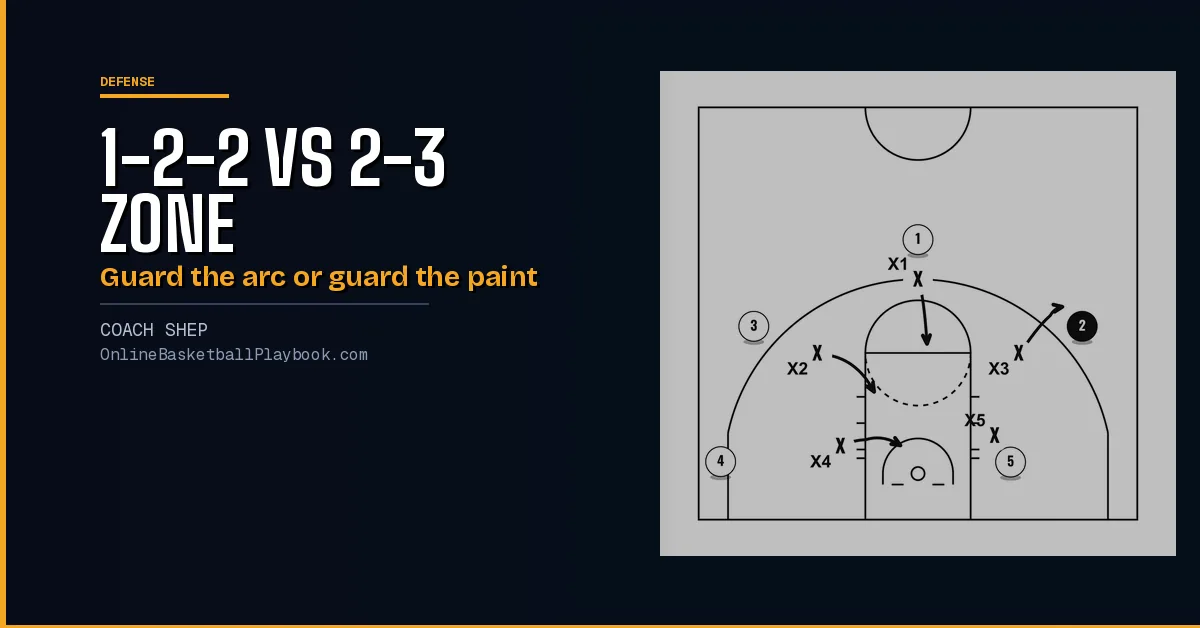
The 1-2-2 vs 2-3 zone question is a question about the arc. The 2-3 puts two guards up top and three defenders across the back, near the rim. The 1-2-2 puts one defender on the ball, two at elbow height and two near the blocks, so every one of the five owns a piece of the perimeter. It is the 2-3's relative that gives up some inside strength to contest every three. Below, the two shapes are drawn at the same ball spots so you can see what each one protects and what it leaves.
1-2-2 vs 2-3 Zone at a Glance
| 1-2-2 zone | 2-3 zone | |
|---|---|---|
| Shape | One on the ball, two at elbow height, two near the blocks | Two up top, three across the back |
| Starts near the rim | Two | Three |
| Ball at the top of the key | The top defender guards it, the wings pinch toward the high post | The two guards stand close together so no pass splits them |
| Strong | The perimeter, shooters, fast-break starts, corner traps | Baseline, paint, rebounding position, a big post |
| Thin | High post, the middle, corners, rebounding | Corners, high post, short corner, wings and top of the key |
| Who covers the corner | A back defender, which means a big closing out | Usually a back defender, sometimes the center |
| Key defender | The top defender | The center |
| Offense usually answers with | A two-guard front, a drive into the middle seam | A one-guard front, attacks on the high post and short corner |
Do not mix the 1-2-2 up with the 3-2. In the 1-2-2 the top defender guards the ball and the wings protect the high post. In the 3-2 the middle of the front line sags to the free-throw line and the wings deny the wing pass. The 3-2 vs 1-3-1 comparison covers that shape.
The Base Shapes


The 1-2-2 does not deny perimeter passes. It sags and takes away the inside pass, much like the pack line. The top defender turns the dribbler to one side, then drops to guard the high post whenever the ball is anywhere else. The two back defenders work as if a rope tied them together: when one goes to the ball, the other comes home.
Coaches split on the 2-3 wing pass. In one version it is not denied either. In an extended version the defenders play the passing lanes with hands high so every wing pass has to be a lob. Its guards stand close enough to touch hands, which shuts the gap to the high post. The center stays between the ball and the basket. The full set of 2-3 rules is on the 2-3 zone defense guide.
Ball on the Wing


The 1-2-2 has a wing defender on that side already, and he takes the ball. The two wings work in opposition: one goes out to the ball, the other drops toward the middle. The ball-side back defender fronts the low post, and the far back defender sits on the split line ready for a lob over the front.
The 2-3 has to pull someone out of a spot. Coaches split three ways:
- Guard takes it. The ball-side guard slides out, as drawn.
- On and off. The back wing closes out first, then goes back inside once the guard arrives and bumps him down.
- Back wing owns it. The back wing pressures the catch and stays with it.
Ball in the Corner


In the 1-2-2 a back defender closes out to the corner with high hands and takes away the baseline, so any drive goes into the middle of the zone. That is why its back defenders front the post on the wing: a post defender stuck behind cannot reach the corner. The ball-side wing then picks one of three coverages:
- Sag and take away the pass into the lane.
- Hard deny the pass back out to the wing.
- Trap with the back defender, as drawn, while the top defender cuts off the return pass.
The 2-3 handles the corner with the defender nearest it, usually the ball-side back defender, and the center fills the block he left. Some staffs send the center out and drop the other back defender to front the post. One view holds that every zone turns into a 2-3 once the ball reaches the corner.
Get the next coaching guide in your inbox
One email when a new guide or diagram set goes up. Free.
Ball at the High Post


The high post is the 1-2-2's weakest spot. The fix is to name which back defender steps up. The other one covers the middle of the lane, arms spread. The top defender sinks to help and both wings hold on the shooters. The trade is a long two over a hand instead of an open three. Another version has the back defenders carry a post who flashes high to a set line, then hand him to the wings.
The 2-3 answers the same catch four ways:
- Deny the entry. The guards start close together and keep it out.
- Cushion it. Let the catch happen and let the center guard it one on one while the other four stay out.
- Wait until he faces. Nobody guards the catcher until he turns to score.
- Collapse. The center jumps it, the back defenders pinch and the guards drop in, as drawn.
Pick one high-post answer and drill it until nobody hesitates.
Where Each Is Strong and Thin
1-2-2
Strong:
- Every three can be contested, because all five own part of the arc.
- Defenders start in the top and wing spots of a fast break.
- The corner is a natural trap spot.
- It extends into a half-court or full-court press with the same five spots.
Thin:
- The high post and the middle.
- The corners, where big defenders have to close out to shooters.
- Rebounding.
2-3
Strong:
- The rim and the paint, with three defenders inside.
- Slows the dribble and walls off a big post scorer.
- Rebounding position along the baseline.
Thin:
- The high post, the short corner and the corners.
- The wings and the top of the key against good shooters.
- The gap between the two guards.
From the offense's side, both are on How to Break a 1-2-2 Zone and How to Beat a 2-3 Zone.
Personnel
1-2-2: the top defender is the key player. He has to be athletic and smart, turn the dribbler and then live on the high post. Some staffs put a tall, athletic player on top and move the natural point guard out to a wing. The back defenders carry an odd load. They front the post on the wing, play behind it when the ball goes to the corner and close out to the corner shooter.
2-3: the center is the hub who guards the post, the short corner and the high post and talks the whole time. A slow, tall center can survive there. The guards are the quickest players on the floor and move sideline to sideline together. The back wings have to rebound.
Look at your bigs before you pick a shape.
Where Coaches Split
- Which opponent the 1-2-2 is for. Version 1: a team with good guards and three-point shooters but little inside, or a late lead against a team that has to shoot threes. Version 2: a surprise or change of pace against a team without shooters.
- Where the 1-2-2 top defender picks up. Pick up beyond the arc: meet the dribbler about 2 to 3 meters outside the three-point line, so the offense cannot go to the wing and into the high post right away. Pick up at about 22 feet: guard the ball an arm's length away, allowing lateral passes but nothing over his head.
- Trap the corner or not. Trap setting: trap every time the ball enters the corner. No-trap setting: same zone, no corner trap. A cautious version treats the wing trap as a gamble.
- Keep the bigs home. Two-stay-inside version: both bigs stay at the basket, the wings scramble to the corners and the posts never front, only against poor shooters. Point-drop version: on a corner pass the top defender slides down to front the post and the far wing takes the high post.
- Turn it into a 2-1-2. On the first pass to a wing the 1-2-2 can convert to a 2-1-2, with a new middle defender sliding between ball and basket, and stay in it once the ball goes back out front.
- Where the 2-3 back wings start. A step higher than the center, just above the blocks outside the lane, halfway to the nearest shooter, or up at the wing as in the tandem 2-3.
Pick It When
- The opponent shoots well from three and is weak inside: 1-2-2.
- You lead late against a team that has to shoot threes: 1-2-2.
- The opponent scores inside or has one dominant post: 2-3.
- The opponent feeds the high post well: be careful with the 1-2-2, or shade it into a 3-2.
- Your bigs are tall but slow: 2-3.
- You worry about the glass: be careful with the 1-2-2.
- You run a 1-2-2 press: either. The press can fall back into a 2-3, and the 1-2-2 zone uses the same five spots as the press.
- You want a change of pace for a few trips: either one can carry it.
More side-by-side pages: 1-3-1 vs 2-3 Zone, 2-3 Zone vs 3-2 Zone and Man-to-Man vs Zone Defense. The full 1-2-2 install is on 1-2-2 Zone Defense, every defense is sorted on Types of Defense in Basketball, and the zones are ranked by roster on Best Zone Defense for Your Team.
Questions Coaches Ask
What is the difference between a 1-2-2 and a 2-3 zone?
The 1-2-2 starts with one defender on the ball and two at elbow height, so all five guard the perimeter. The 2-3 starts with two guards up top and three defenders across the back near the rim.
Is the 1-2-2 zone good against shooters?
Yes, in the version built for it. Every defender owns a piece of the arc, so threes get contested. The cost is the high post and rebounding.
Is a 1-2-2 zone the same as a 3-2 zone?
No. In the 1-2-2 the top defender guards the ball and the wings protect the high post. In the 3-2 the middle defender of the front line sits on the free-throw line and the wings deny the wing pass, leaving the ball handler at the top of the key alone.
How do you beat a 1-2-2 zone?
Line up with a two-guard front, drive the middle seam, attack the high post and overload a side so the two back defenders are outnumbered. The full attack is on How to Break a 1-2-2 Zone.
Want the printable playbook packs?
Playbook packs: zone attack, press break, press defense, out of bounds, quick hitters, practice plans and the youth turnover cure, each a printable PDF. Or draw your own version free in PlayDraw.
See the playbook packsRelated Guides
Back to Types of Defense and every Defense page.
Keep Building
Related breakdowns
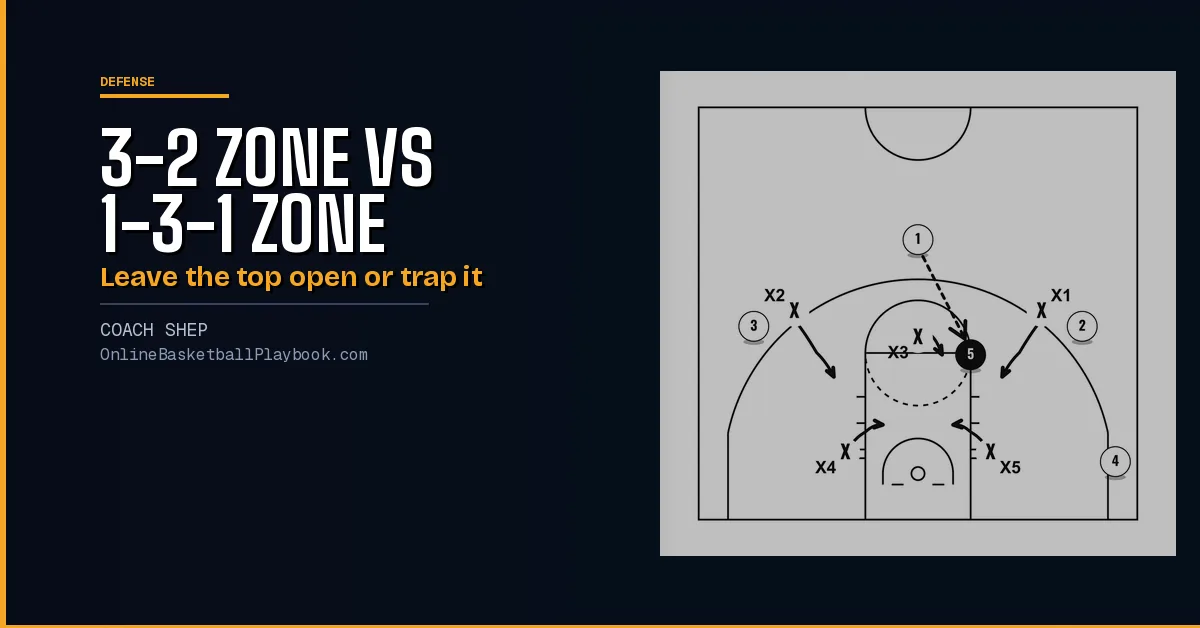
3-2 Zone vs 1-3-1 Zone: Who Guards the Top of the Key
Both zones load the free-throw line. The 3-2 leaves the ball handler up top alone, the 1-3-1 pressures and traps him. Drawn at the same ball spots.
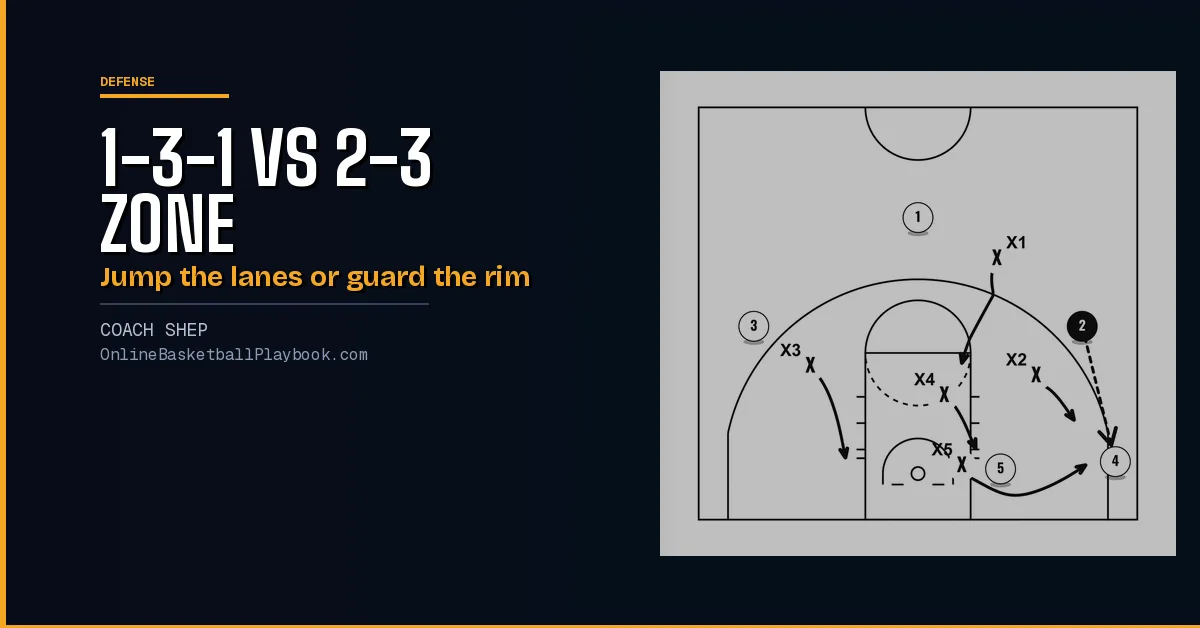
1-3-1 vs 2-3 Zone Defense: Side by Side
The 1-3-1 lives in the passing lanes and traps the corners. The 2-3 sits near the rim. Both drawn at the same ball spots, with the rosters each one fits.
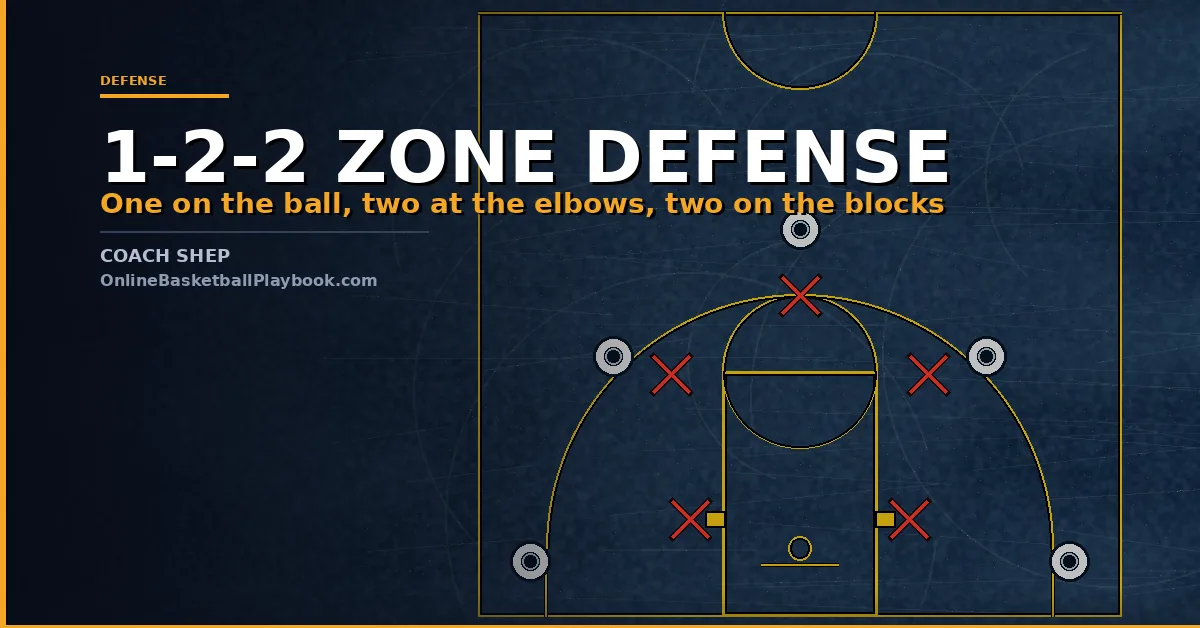
1-2-2 Zone Defense: Rotations, Weak Spots and Drills
1-2-2 zone defense: the five roles, rotations for every ball spot, the corner trap, the high post problem, variations coaches run and the drills.