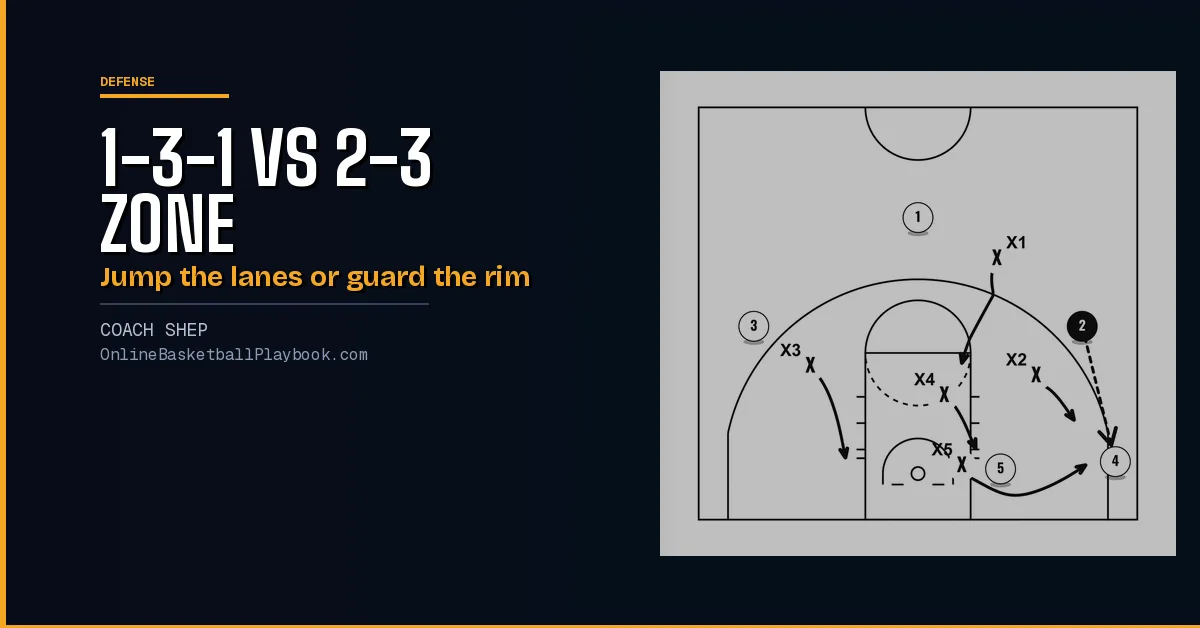
The 1-3-1 vs 2-3 zone choice comes down to where your five stand when the ball moves. The 2-3 puts two defenders up top and three across the back, close to the rim. The 1-3-1 puts one on top, three across the free-throw line area and one runner on the baseline, then overplays the passing lanes and looks for traps. Below, both are drawn at the same ball spots.
1-3-1 vs 2-3 Zone at a Glance
| 1-3-1 zone | 2-3 zone | |
|---|---|---|
| Shape | One on top, three across the free-throw line area, one on the baseline | Two up top, three across the back |
| Starts near the rim | One | Three |
| Built to | Overplay the lanes, force lobs and long passes, trap | Protect the paint, slow the dribble, wall off a post scorer |
| Strong | The free-throw line area and the top of the key | Baseline, paint, rebounding position |
| Thin | Corners, low post, the corner-to-elbow skip | Corners, high post, short corner, the gap between the guards |
| Corner coverage | One baseline runner covers both corners | A back defender on each side |
| Middle defender's job | Keep the ball out of the middle and front the post | Cover the post, the short corner and the rim |
| Offense usually answers with | A two-guard front | A one-guard front |
The Base Shapes


In the 2-3 the two guards start so close that their outstretched hands nearly meet, which shuts the passing gap to the high post. The center sits in the middle of the back line between ball and basket. Coaches place the two back wings at different heights: a step higher than the center, just above the blocks outside the lane, halfway between the block and the nearest shooter, or up at the wing as in the tandem 2-3.
The 1-3-1 moves in two directions. The wings move up and down with the ball. The top defender and the baseline runner move side to side. The top picks up the ball, steers it to one side and takes away any dribble back to the other side. The middle defender's first job is stopping any catch in the middle. The baseline runner thinks in segments: block to sideline, block to block.
Ball on the Wing


In the 1-3-1 the ball-side wing takes the catch. He pressures the ball handler's baseline hip and pushes him back toward half court. The far wing sinks to cut off the diagonal pass into the post or the elbow. The top defender has two jobs in the versions coaches teach: drop toward the ball-side elbow, or sit in the passing lane between the two guards so the ball cannot swing back. Either way the goal is to keep the ball on one side.
The 2-3 has nobody at the wing to start, so someone has to leave a spot. Coaches split three ways on who:
- Guard takes it. The ball-side guard slides out, as drawn.
- On and off. The back wing closes out first, then retreats inside once the guard arrives and bumps him back down.
- Back wing owns it. The back wing pressures the catch and keeps it.
Ball in the Corner


Here the two zones want opposite things. The 1-3-1 treats the corner as a trap door. Overplaying the lanes pushes the ball there, and the corner is where the trap springs. In the common version the ball-side wing and the baseline runner trap while the top drops to the elbow. The pass from the corner to the elbow is the one this zone fears most. Other versions trap with the wing and the middle so a big never leaves the rim, or spring the trap off a dribble.
The 2-3 treats the corner as a closeout. The usual owner is the ball-side back defender, and the center slides to the ball-side block behind him. Leave that block empty and the offense gets an easy pass and a layup. Some 2-3 coaches send the center to the corner instead and drop the other back defender to front the post. Some 2-3 staffs also trap the corner every time the ball arrives, once the team can handle it.
Whatever your corner rule, name the player who owns the elbow before the first rep.
Get the next coaching guide in your inbox
One email when a new guide or diagram set goes up. Free.
Ball at the High Post


The 1-3-1 is built to keep this catch from happening. Its middle defender denies above the free-throw line and fronts below it. If the ball gets to the elbow anyway, one version doubles it with the top defender and the middle defender and lets the pass back out go. One adjustment moves from the base zone to a 1-3-1 when the offense fills both the high post and the low post.
The high post is the 2-3's soft middle, and coaches answer it four ways:
- Deny the entry. The guards start close together and keep the ball out.
- Cushion it. Let the catch happen, stunt at it, and let the center guard it one on one while the other four stay home on shooters.
- Wait until he faces. Leave the catcher alone until he turns to face the rim. The guards stay with the wings, so his only outlet is a pass back out.
- Collapse. The center jumps the ball, the back defenders pinch for the high-low pass and the guards drop in, as drawn.
Where Each Is Strong and Thin
1-3-1
Strong:
- Passing lanes. Overplayed lanes force lobs, long passes and cross-court throws it can tip.
- Passers have to throw over raised arms, and ball handlers end up killing their dribble in poor spots.
- Traps can come high, low or in the middle.
- Young teams struggle with it because skip passes have to be on target and on time.
Thin:
- The corners. One runner covers both, so a skip to the far corner or a screen on the runner frees a shooter.
- A two-guard front that reverses the ball as the top defender commits.
- Pass fakes against defenders who lunge, and lobs to the weak-side block.
- The glass after a corner trap, with only three defenders left to rebound.
2-3
Strong:
- The rim and the paint, with three defenders already inside.
- Slows the drive and keeps a big post scorer walled in.
- Holds up against a team that shoots poorly.
Thin:
- The high post, the short corner and the corners.
- The gap between the two guards, which a point guard can split with the dribble.
- The instant after a reversal, while the defenders are still sliding.
- A team with good outside shooters.
Each zone also gives up something on purpose. Some 2-3 staffs run shooters off the line and live with long twos. Others concede threes to anyone but an elite shooter. A conservative 1-3-1 gives up the outside shot to protect the middle, while an active trapping version can be hurt by long shooting and corner shots. The offense's view of each is on How to Beat a 1-3-1 Zone Defense.
Personnel
2-3: the center is the hub. He guards the post, the short corner and the high-post catch, contests at the rim and runs the talk. He is usually the biggest player, though an aggressive athlete can play there. The two guards are the quickest players and move sideline to sideline together. The back wings need to rebound, and one of them is always on the weak side.
1-3-1: coaches split on who goes where.
| Spot | Version 1 | Version 2 | Version 3 |
|---|---|---|---|
| Top | A tall, long guard who makes the reversal pass hard | The quickest, most athletic player, who covers everything above the free-throw line | The point guard, who directs the ball to a side |
| Wings | The best athletes | Corner trappers who also guard the weak-side block | The strongest rebounder on the left wing |
| Middle | A post defender who fronts high and low | A hard worker who denies above the free-throw line and fronts below it | |
| Baseline | A small, quick, vocal guard | The most athletic player on the floor | A big who stays near the rim while the wings cover the corners |
Where Coaches Split
- Identity or change-up. Both zones have coaches who play them every possession for a whole season. Both also show up as a change-up for a few trips a game. A third view holds that any zone loses its bite after a few minutes, so it comes in short bursts.
- How much to trap. The 2-3 version: trap at agreed spots, with the short corner always doubled, the corner every time if the team can handle it and a point trap as a surprise. The 1-3-1 versions: a trapping version that springs traps at named spots, a no-trap setting in which the wing denies the pass back while the baseline runner plays the ball alone, and a loose setting that packs inside and plays it conservative.
- 1-3-1 rebounding. One side says it rebounds fine when roles are set, with the top defender crashing the weak side. The other says only one true low defender makes the glass its weak spot.
- 1-3-1 depth. Loose: pack inside about 20 feet and play it conservative against weak ball handlers and poor shooters. Tight: extend and deny against quick guards who cannot shoot.
The full menus live on the 1-3-1 zone defense and 2-3 zone defense guides.
Pick It When
- The opponent scores inside or has one dominant post with poor shooters around him: 2-3.
- The opponent is a high-tempo team that shoots poorly: 2-3.
- You need to protect a player in foul trouble: 2-3.
- The opponent's guards handle the ball poorly: 1-3-1, played loose.
- The opponent fills both the high post and the low post: 1-3-1.
- The opponent is young and cannot throw the skip pass on time: 1-3-1.
- The opponent has shooters in both corners and screens the baseline: be careful with the 1-3-1.
- The opponent shoots well from the wings and the top of the key: be careful with the 2-3.
- You press: the same 1-3-1 shift rules carry into half-court and full-court traps, and a 1-2-2 press can fall back into the 2-3.
For the other zone matchups, see 1-2-2 vs 2-3 Zone, 3-2 Zone vs 1-3-1 Zone and 2-3 Zone vs 3-2 Zone. Every defense is sorted on Types of Defense in Basketball, every zone is ranked by roster on Best Zone Defense for Your Team, and zone against man is on Man-to-Man vs Zone Defense.
Questions Coaches Ask
Is a 1-3-1 or a 2-3 zone better?
Neither wins in general. The 2-3 fits a team that needs to protect the paint against an inside-scoring opponent. The 1-3-1 fits a team that wants to trap and force bad passes, and long athletes make it easier. The table above lines them up spot by spot.
What is the main weakness of a 1-3-1 zone?
The corners. One baseline runner covers both, so a skip to the far corner, a screen on the runner or a quick pass from the corner to the elbow can beat it.
What is the main weakness of a 2-3 zone?
The high post, the short corner and the corners, plus good outside shooting. The gap between the two guards and the moment after a reversal are the other soft spots.
What offense beats each one?
Against the 2-3, offenses use a one-guard front and attack the high post, the short corner and the gap between the guards. Against the 1-3-1, they use a two-guard front, screen the baseline runner and skip to the far corner. Both are covered on How to Beat a 2-3 Zone and How to Beat a 1-3-1 Zone Defense.
Want the printable playbook packs?
Playbook packs: zone attack, press break, press defense, out of bounds, quick hitters, practice plans and the youth turnover cure, each a printable PDF. Or draw your own version free in PlayDraw.
See the playbook packsRelated Guides
- 1-2-2 vs 2-3 Zone Defense: Guard the Arc or the Paint
- 3-2 Zone vs 1-3-1 Zone: Who Guards the Top of the Key
Back to Types of Defense and every Defense page.
Keep Building
Related breakdowns
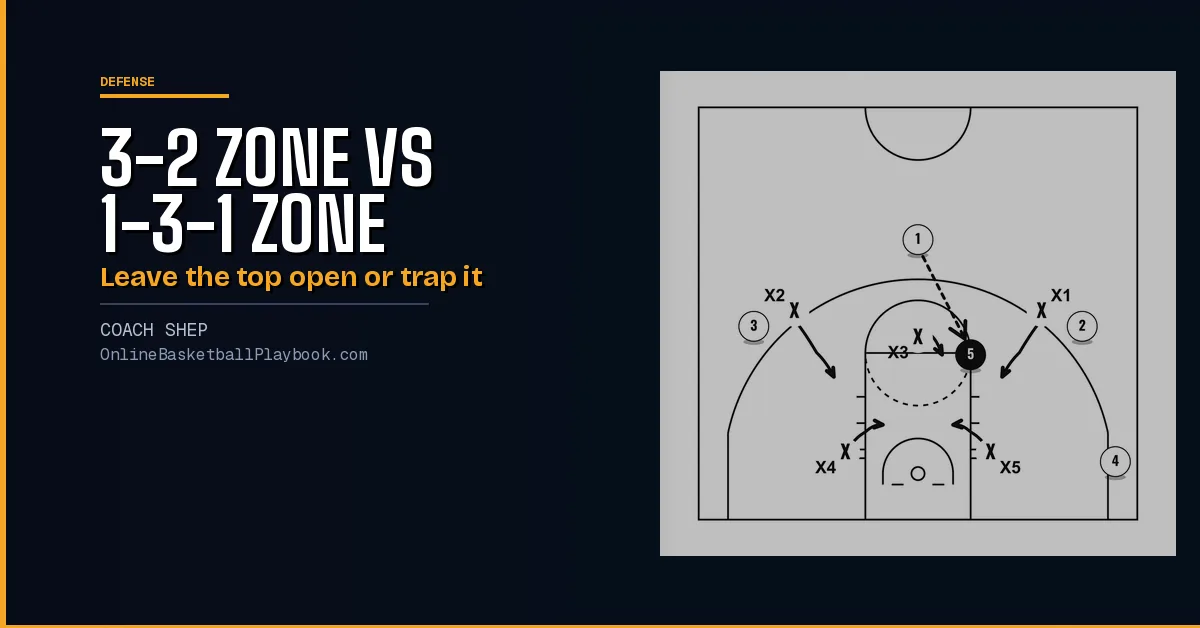
3-2 Zone vs 1-3-1 Zone: Who Guards the Top of the Key
Both zones load the free-throw line. The 3-2 leaves the ball handler up top alone, the 1-3-1 pressures and traps him. Drawn at the same ball spots.
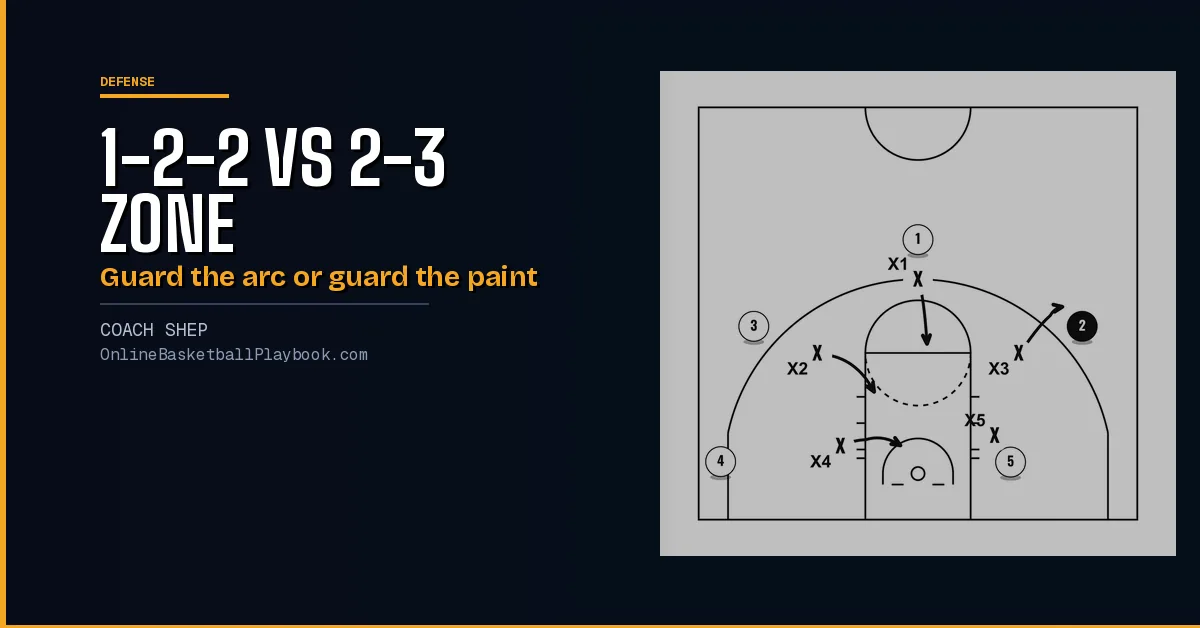
1-2-2 vs 2-3 Zone Defense: Guard the Arc or the Paint
The 1-2-2 gives every defender a piece of the arc to contest threes. The 2-3 keeps three near the rim. Both drawn at the same ball spots.
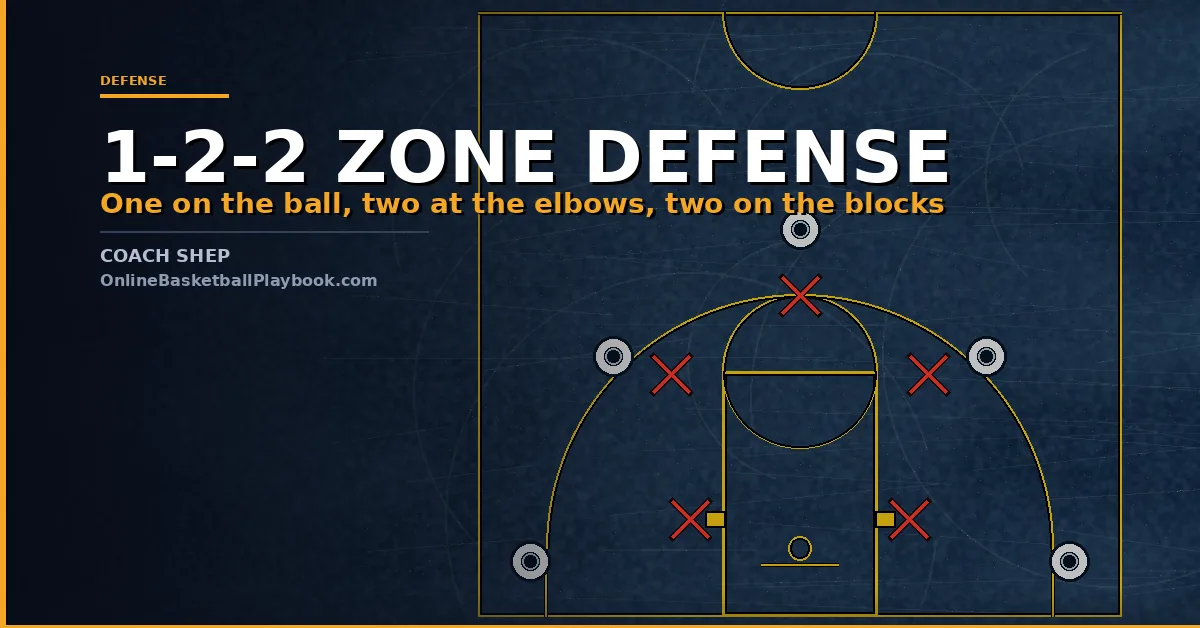
1-2-2 Zone Defense: Rotations, Weak Spots and Drills
1-2-2 zone defense: the five roles, rotations for every ball spot, the corner trap, the high post problem, variations coaches run and the drills.