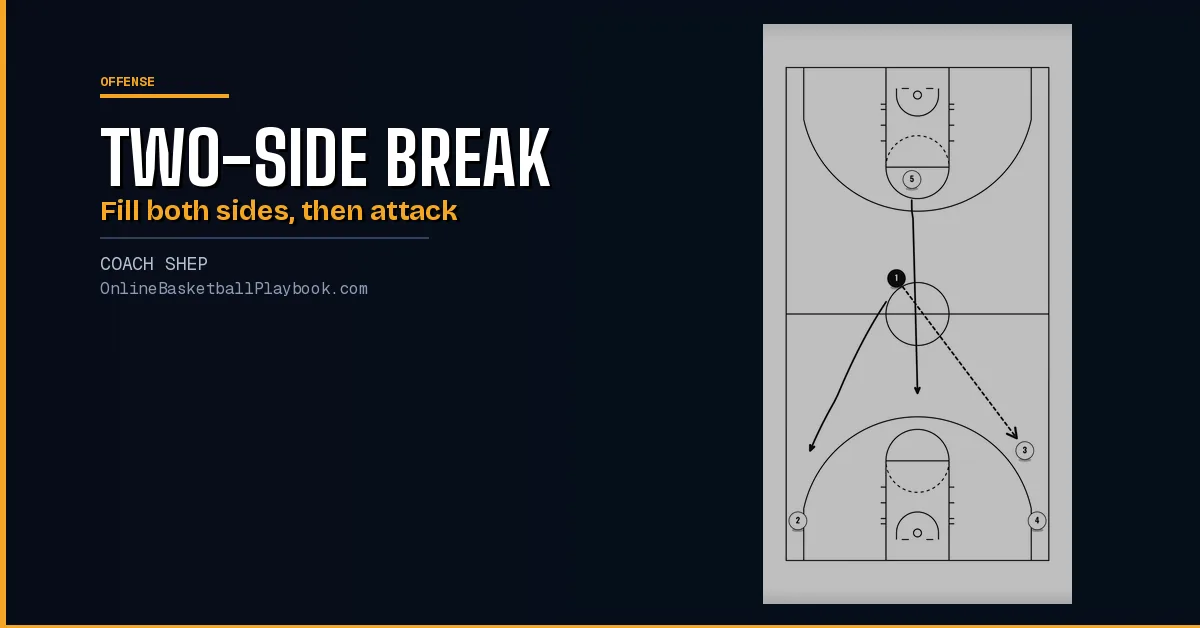
The two-side break in basketball is a fast break built on spacing. Two players sprint down one sideline and fill the corner and the wing. A third sprints the other sideline to the far corner. That leaves a two side and a one side, with the point guard bringing the ball and the rebounder trailing. The spots are scripted. What happens after them is not.
This guide covers the case for pace, the floor spots and who fills them, the three reads (early and opposite, early and up, the dribble push), what to do when the push is stopped, the three side, the triggers when the defense is matched, and the drills. Outlets, lane choices and the wider view of running are on fast break and transition offense.
What the Two-Side Break Is
The two-side break is a primary attack. It runs after a make, a miss or a turnover. The player with the ball passes ahead wherever there is an opening, to the ball side or to the weak side, whichever has the advantage. With no pass ahead, a pass across can change sides. With neither, the ball handler dribble pushes. The target is the ball across half court inside three seconds.
Treat it as a template for spacing. Filling both corners and a wing is the part you script. Everything that follows is left to the players. The order is spacing first, then the advantage, then the shot. Six teaching points carry the whole break:
- Transition rules and priorities
- Early and opposite
- Early and up
- Creating a three side
- The dribble push
- Triggers
An open player within his range shoots. If not, he moves the ball or drives to score. Each section below takes one of those six points in turn.
Why Play With Pace
The two-side break is a pace tool. The case for running it:
- Get a score inside the opening 8 seconds of the clock.
- Look for a big advantage shot in that window.
- Create numbers and mismatches in transition, such as 5 on 4, 5 on 3 or 4 on 2.
- Mask a lack of size or get more out of athletic players.
The shot clock splits into three phases, each with its own kind of shot:
| Phase | Shot clock | Shot to hunt |
|---|---|---|
| Phase 1 | First 8 seconds (24 to 16) | Big advantage shots |
| Phase 2 | Middle 8 seconds (16 to 8) | Small advantage to big advantage shots |
| Phase 3 | Last 8 seconds (8 to 0) | Best expected value |
As a rule, a shot's expected value falls the longer the clock runs. A Houston Rockets breakdown of field goal percentage by shot clock phase shows the drop: 53.7 in phase 1, 45.1 in phase 2 and 38.1 in phase 3. The phases assume a 24-second clock. Shot clock length differs by level, so check your league (see basketball shot clock rules).
An early shot off the two side is usually open, and open shots are hard to come by. The weak side also has an edge on the offensive glass. Two things decide whether a team can play this way:
- Stops. You need stops to play with pace. Defensive toughness turns defense into offense.
- Style of play. Are players sprinting to run sets or to hunt shots? Freedom or control? The answer sets the pace.
The wider pace question is on basketball pace and tempo strategy. Decide how fast you want to play before you teach the lanes.
The Spacing Template and Who Fills It

Every player's first three steps matter, because they create the numbers. Sprint to the nearest sideline first. The corners fill first, the wings next, and the first players down need to get behind the defense. The jobs:
- Rebounder. The nearest player takes the ball out. The rebounder always becomes the trail, his own outlet in effect.
- Point guard. Loop back toward the ball to shorten the outlet, hunt an early pitch ahead, and want the ball over half court in the air when he can.
- Corners. Find the nearest sideline, sprint and hug it, and hold the corner for width and depth. The corner sits at rim depth.
- Wing. Find the nearest sideline too, but delay the fill until after half court for stretched spacing. The wing (the 45 spot) sits at free-throw line extended.
Run with your back to the sideline to stretch the defense. Be in the corner before the catch: a catch on a baseline drift is less efficient than a catch from a set corner spot, because the movement costs efficiency. Corner spacing also creates chances for one more pass to an open three.
The spots are a template, not a rule. Ideally each player gets to one. If he does not, the others adjust their spacing with player movement or ball movement to make it work. The break can still run after a score. The key then is a deep outlet, so the ball handler does not come back close to receive the ball.
The priorities, in order:
- Transition reaction: sprint and hug the sideline.
- Hit ahead, early and opposite.
- Keep the ball hot with first touch decisions.
- Find a trigger if the break is in neutral.
Spacing comes before everything else in this break. More on the idea behind it is on what is spacing in basketball.
Early and Opposite

Early and opposite is the first read. The point guard looks to pitch ahead to the weak side, the two side, and to make that pass as soon as possible. It goes against how defenses tend to play, and it makes the defense change sides, so it moves twice. It can also leave a 2 on 1 on the two side. If he cannot throw it early, he can cross half court on the dribble to move the defense. One cue for it is drive the 45: pitch ahead opposite, then attack the gap.
Details that make the read work:
- Look early. Look early and opposite right after the outlet.
- Point to the pass. Players point to show where the ball should go. Without it, the rebounder may throw to the two side before it is ready.
- Jump on the skip. The pass across is most likely an overhead or a tennis ball pass.
- After the pass to the wing. The wing can swing it on to the corner, or boomerang it back to the trailer.
- After the extra pass to the corner. The corner can boomerang it back to the wing for a shot.
Two fills for the passer:
- Passer to the empty wing. The point guard pitches ahead, then fills the wing on the one side while the trailer runs to the top of the key, as drawn above.
- Passer to the weak-side corner. When the outlet skips, he fills the weak-side corner. That leaves room for a trailing player to fill the wing or weak-side 45 and create double gap spacing.
Make early and opposite the first look every time down, and reward it when it comes early.
Early and Up

Early and up is the pitch ahead on the ball side, up the sideline the ball is already on. The pass ahead can go to either side, depending on where the advantage is. When in doubt, the point guard keeps the ball.
When the ball gets to the wing early, encourage the wing to take his man on and drive. On a lift for a middle drive from the wing, the shooter does not run along the three-point line. He circles it so he can step into the shot. More on what the off-ball players do when the wing drives is on drive and kick drills.
Early and up is the second option, not the first. Teach the point guard to look opposite first.
The Dribble Push

When there is no pitch ahead opposite and no pitch ahead on the ball side, the ball handler attacks the 45 with the dribble, heads for the rim and keeps attacking until a defender stops the ball. He pushes it as deep as possible and looks to beat his man one on one.
On the dribble push the looks come in this order:
- The post.
- Opposite.
- The trail filling the safety spot, the pull concept.
If the rebounder cannot hit the outlet, he pushes it himself while the outlet runs to the far corner. The attack goes away from the two side. And if the single side has no advantage and no skip pass is there, dribble over to the two side and create a passing window or a dribble hand-off.
Push until someone stops you, then read.
When the Push Is Stopped
When the dribble push is stopped, the players off the ball react:
- Live dribble. Penetration reaction. The ball handler can also start a dribble hand-off if his dribble is still alive.
- Dead ball. Second cut reaction.
- Drive to score stopped. With no shot and no pass, the driver jump stops and counts on the second cutter for a scoring pass or a safety pass.
The smaller rules around the drive:
- Push early and pull late, which opens double gap spacing.
- If the drive is levelled off, go to a dribble hand-off. Two sideways dribbles is the limit.
- If you are denied on the two side, cut backdoor. If not, use the hand-off.
- The player handing off takes his teammate's spot.
- The weak-side corner lifts only when the ball, his defender and he are three in a row. If help is deep, he stays.
- On a pull, the player giving the snapback pass turns and sprints. If the snapback goes to a wing who is lifting, the corner player lifts too to get the ball.
Three individual skills carry the break: splitting the defense early and kicking to the weak-side corner as help starts to collapse, throwing the extra pass without turning the body, and stepping outside-inside when passing to the safety. Push and pull and the rest of the off-ball reactions are on teaching dribble penetration reads, and the hand-off itself is on the dribble hand-off.
Know your reaction before the ball handler is stopped, not after.
The Three Side

Sometimes three players end up on the same sideline. The answers, by action:
- Middle player cuts. The middle of the three cuts on the 45 to the other side, as drawn above.
- Deepest player goes through. Talk, and send the deepest of the three across the floor to balance it.
- Stay for an empty side. Leave all three there and play an empty side pick and roll.
- Run a three-side action. Use the three players, for example a stagger screen set for the lowest of them.
Pick one answer for your team and call it the same way every time.
Triggers When the Break Is Matched
Neutral means the defense is matched 5 on 5. The break then goes to a trigger, mostly played through the trailer:
- Early drag screen, or a throw and go
- Early dribble hand-offs
- Early away screens
Another version goes to a short list of quick actions when the two side is exhausted, or when the team crosses half court under control and has no edge in transition. The player waiting in the holding area moves up to the top of the key, and from there:
- A drag screen
- A dribble hand-off
- A throw and go in the high post
- A reversal to the top of the key and a pin-down
Each of these opens double gaps and room for one on one actions such as blast cuts, curls and backdoor cuts. When a non-shooter catches, his reads are drive, pass or dribble hand-off. A player who neither shoots nor drives keeps the ball moving with a pass or a hand-off.
More on the screens is on double drag screen basketball and early offense basketball, and the numbered follow-up to a primary break is on secondary break basketball. Keep the trigger list short so the trailer can call it on the run.
Two-Side Break Drills
4 on 2 transition. Four offense against two defenders, with one constraint on the point guard each time: early and opposite, early and up, or the dribble push. The early and up and dribble push diagrams above are this drill.

5 on 4 to 5 on 5 recognition. Players work out who the trailer is, then build a one side and a two side. One defender starts in the center circle and the other four on the baseline, which gives the offense a chance to work on its triggers through the trailer.
- The ball can go to any of the five. That player passes to the point guard and becomes the trailer.
- The offense gets 5 possessions in a row.
- A three counts 3 points, a finish in the paint counts 3, and anything else counts 1.
- Constraints, one per run: must go early and opposite, must go early and up, must form a three side, point guard push, early with the trail, triggers.

3 on 1. Play off the two side. The read drawn here is the skip to 2, who makes the extra pass to 3 for the three. Whoever makes the last pass gets back on defense while the defense rebounds, and as soon as the shot hits the rim the next two side players start sprinting.
- With no defense back, do not run to the corner. Score the lay-up.
- On a regular break advantage, angle to the rim and score.
- The key measure: when the ball handler drives the 45, both off-ball players are in push or pull.
- With no obvious read, the dribble hand-off from the alley to the wing keeps it going.

2 on 1 shooting. The last phase of the two side. The two side can start already formed, or the players can sprint into it. Once the dribble starts, the defender may go wherever he likes, and 1 has to make the right passing decision to get a score.
- Stress the close-out as much as the two side execution.
- Work different passes to the two side, such as the tennis ball pass and the skip.
- Load: a player must drive to score from the 45.
- Constraint: a two-pass maximum on the two side.
More full-court work is on drills to teach transition offense, fast break basketball drills and the 3 on 2, 2 on 1 drill. Add one constraint at a time until the reads come without a call.
Questions Coaches Ask
What is the two-side break in basketball?
A fast break that fills both corners and one wing on the run. Two players sprint one sideline to the corner and the wing, one sprints the other sideline to the far corner, and the rebounder trails. The point guard then reads early and opposite, early and up, or the dribble push.
What is the two side and what is the one side?
The two side is the sideline with two players on it, one in the corner at rim depth and one on the wing at free-throw line extended. The one side has a single player in the corner.
What does early and opposite mean?
The first read: pitch the ball ahead to the weak side, the two side, as early as possible. It makes the defense change sides and move twice.
Why does the wing delay his fill?
The wing waits until after half court to fill, for stretched spacing. The corners fill first.
What happens when three players run to the same side?
The middle player cuts to the other side, or the deepest player goes through. A team can also keep all three there for an empty side pick and roll or a three-side action, with a stagger for the lowest player.
What if the defense gets back and matches up?
Go to a trigger through the trailer: a drag screen, a dribble hand-off, away screens, a throw and go in the high post or a reversal and pin-down.
Every diagram on this page uses the symbols on how to read a basketball play diagram. The two-side break is one way to run the break on how to run a fast break.
Get the next coaching guide in your inbox
One email when a new guide or diagram set goes up. Free.
Want the printable playbook packs?
Playbook packs: zone attack, press break, press defense, out of bounds, quick hitters, practice plans and the youth turnover cure, each a printable PDF. Or draw your own version free in PlayDraw.
See the playbook packsBack to Fast Break and Transition Offense and every Offense page.
Keep Building
Related breakdowns
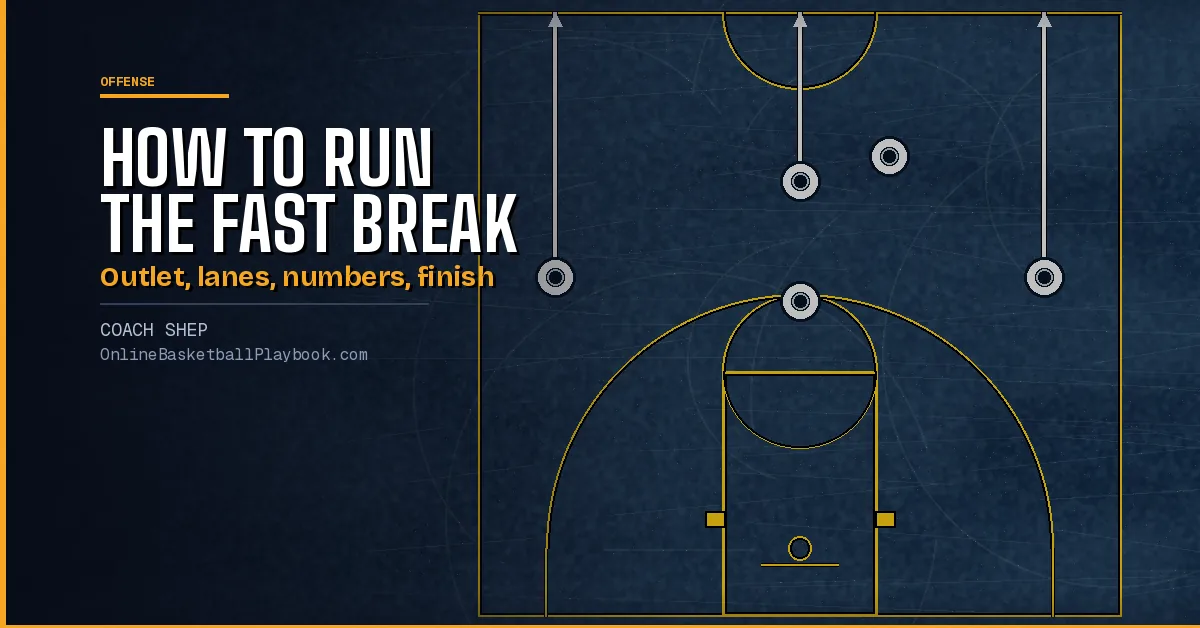
How to Run the Fast Break: Lanes, Reads and Drills
How to run a fast break: start it off a stop, fill three lanes, read each numbers situation, flow into a secondary break and build the habits with a drill ladder.
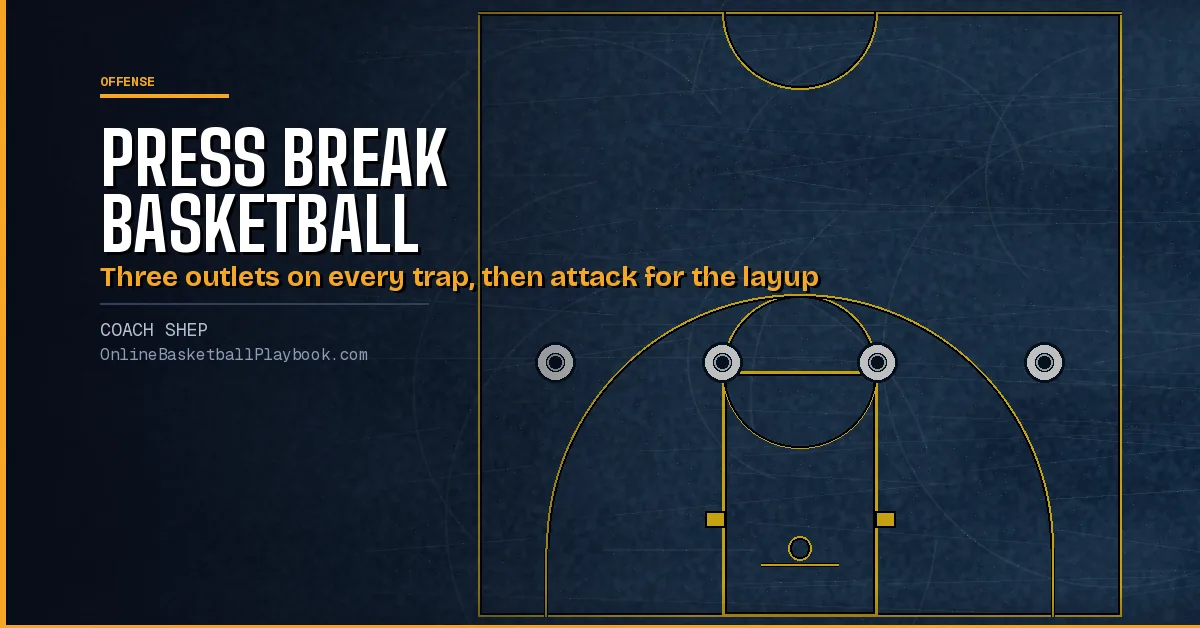
Press Break Basketball: Alignments, Reads and Drills
Press break basketball guide with the 1-4, 80-60-40 and 4-across alignments, reads against the 2-2-1, diamond and 2-1-2 press, and where coaches disagree.
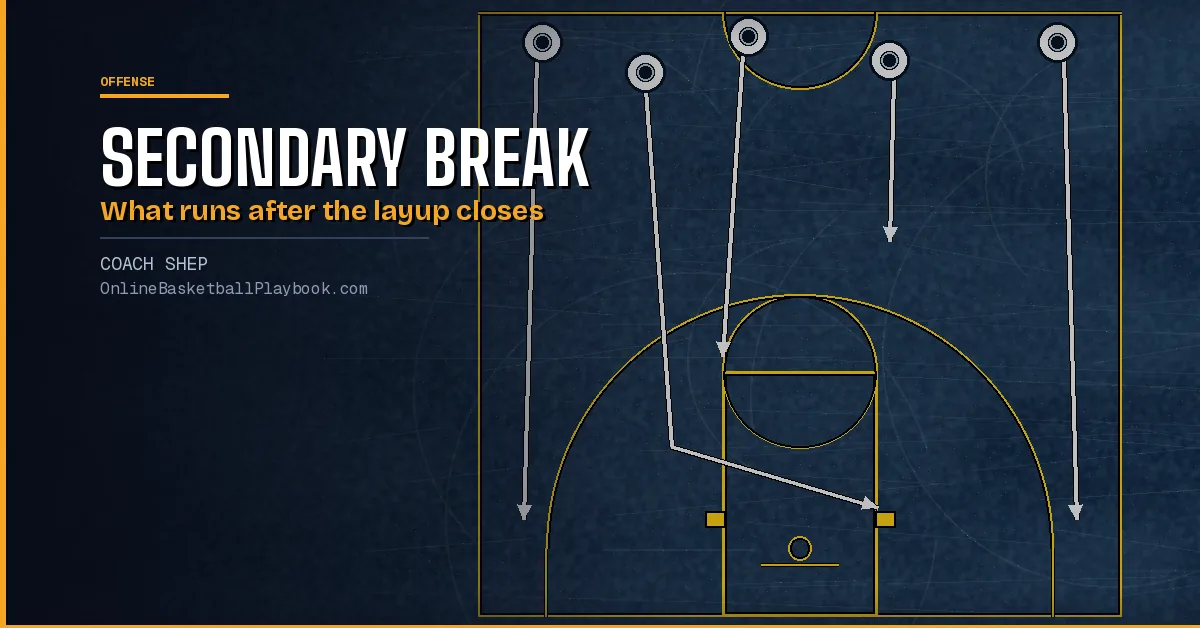
Secondary Break Basketball: Lanes, Options and Trailers
Secondary break basketball explained: where the primary break ends, the lanes, the numbered options, the trailer, after-make looks and where it flows next.