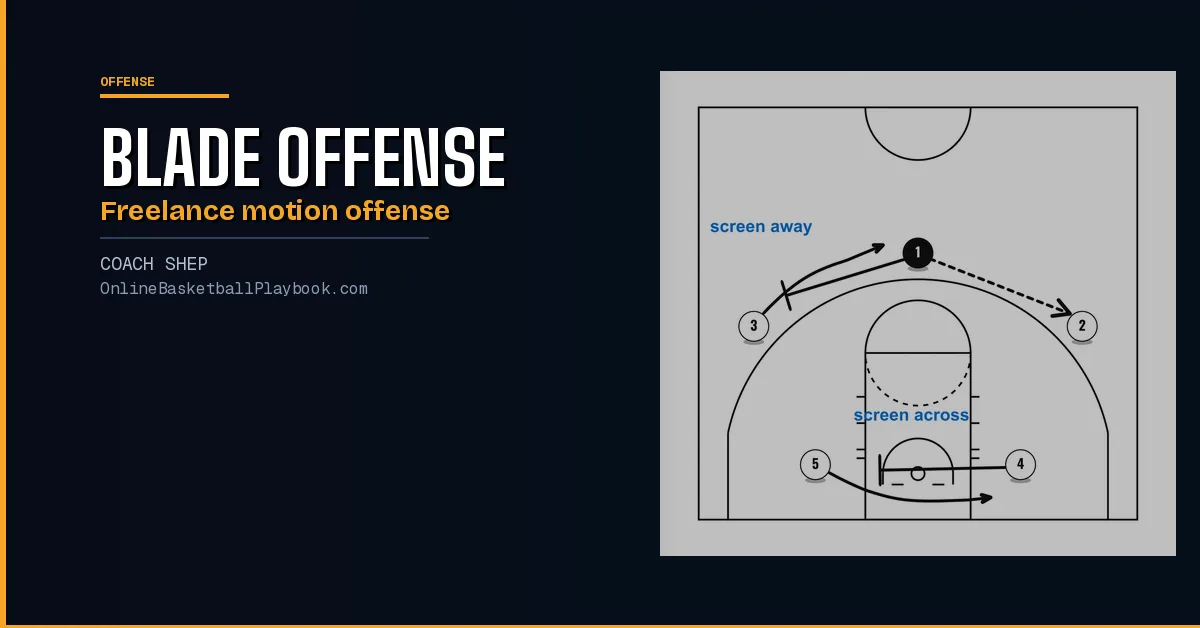
The Blade offense in basketball is a freelance motion that starts in a 3-out, 2-in alignment and runs on one rule. Each time the ball moves, both players one pass from it go set a screen away from it. Nobody is a guard or a forward. Every player ends up at all five spots, and the offense keeps going as long as those five spots keep being filled.
This guide covers the set, the rule over three passes, why the Blade fits both a youth team and a varsity team, and the two options to add once the defense has seen the base. The wider family of rule-based offenses is on motion offense basketball.
What the Blade Offense Is
Mike Krzyzewski built one of the great careers in college coaching on a simple base offense, 3-out, 2-in motion, with its spacing. Duke layered its own detailed structure on top of the basic motion. The Blade goes the other way and strips the motion down to a single screening rule that any team can run.
Like Krzyzewski's motion, the Blade starts with screens away from the ball when the first pass goes to a wing. The difference is that the whole offense turns on that one screen-away rule. It is a freelance structured offense. Players are free to move on their own, provided all five floor spots stay filled.
The name comes from the screens. After every pass, two players slash down to set picks. More on the coach behind Duke's offense is on Coach K's coaching philosophy.
One rule, five interchangeable players and a floor that stays filled: that is the whole offense.
The Set and the One Rule
The Blade always starts in a 3-out, 2-in alignment. One player holds the ball at the top of the key, one stands on each wing, and the last two line up along the baseline. No spot belongs to a guard or a forward, because all five players will pass through all five positions.
The rule starts on the first pass:
- The player at the top of the key passes to a wing.
- Two players are now one pass away from the ball: the passer, and the baseline player on the ball side.
- Both of them screen away. The passer screens for the opposite wing. The ball-side baseline player screens across the lane for the weak-side baseline player.

The wing who catches the pass always looks to attack. The screen across the lane is the same action taught on cross screen basketball, and the passer's screen for the far wing is a standard away screen. Footwork and angles for both are on setting screens in basketball.
Keep Screening: The Next Passes
The Blade does not stop after one screen. Players keep screening whenever they are one pass away, pass after pass, until the defense gets tired of being screened. That is when an open shot or a driving lane shows up.

On the second pass the ball goes from the wing down to the baseline player on that side. Screens follow on both sides of the floor. The passer screens and the player at the top of the key comes over to fill the wing. On the weak side, the baseline player screens up for the wing, who cuts down to the baseline. Every spot is still filled, but different players now stand in them.

Follow 4 through the three diagrams. He starts on the left side of the baseline, screens across the lane, screens up from the right side of the baseline, and three passes later he is at the top of the key with the ball moving around him. Every player in the Blade must be at ease with the ball in any spot. The player who catches always looks to attack. As the defense tires of fighting screens, the offense gets dribble penetration or a cut to the rim for an easy basket.
In its purest form the Blade is a motion offense that allows freelance movement, as long as all five positions keep being replaced. Players who want to drill the reads before running them live can start with drills to teach motion offense.
Fill the five spots, screen when you are one pass away, and attack every catch.
Why the Blade Works at Every Level
The Blade is meant to sit between two problems. Too much structure turns players into robots. Too little structure turns the floor into chaos. A few simple movements to follow give players a better feel for the game.
Some youth coaches try complex set plays, some try isolation plays, and some run no plays at all. Young players need some structure without having to think about every step. One view holds up the flex as too much for young players: they keep cutting baseline off screens even when they may have been open on the baseline without a cut. Too many moving parts crowd a young player's head. The Blade gives a youth team one rule and lets players learn the flow of the game instead of just memorizing plays. The pattern-against-rules question is weighed in full on flex offense vs motion offense, and more on running a young team is on coaching youth basketball.
A high school varsity team can use the Blade to simplify its offense at times. As players mature, add moves off the screens so they read where the defense is and move with it:
- the curl cut
- the slip cut
- backdoor cuts
- flare-outs
- screen refusals
With those reads in place, players play off the flow of the game instead of a string of set plays. Each cut is taught on cutting in basketball, and the backdoor reads are on backdoor triggers.
Start with the rule alone, and add the reads as players mature.
Option One: Curl or Slip
A defense that knows what is coming has an easier time stopping it. After the defense has seen the base Blade several times, a couple of easy movements off it keep the defense on its heels and help players learn to read the defense and go after its weak spots. The setup does not change. The first pass still goes to a wing, and that pass is still the signal for the two players one pass away to screen away.

In the base Blade the far wing runs off the screen and comes to the top of the key to replace the point guard. Because the Blade keeps the floor spread, a defense that cheats to the top of the key, expecting that replacement, opens a lane for the wing to curl around the screen or slip it and cut hard to the hoop. The wing reads the defense and picks one.
The ball handler on the wing has to watch closely and not assume the movement will be the same every time. These changes from the base are what keep the defense honest.
When the defense cheats to the top of the key, the curl and slip lanes open.
Option Two: The Fist Double Screen
The second option is called. The point guard holds up a fist to tell his teammates that a double screen is coming on the pass, in place of the standard screen away.

The pass goes to the wing as usual. Then the passer and the weak-side baseline player set the double screen together, and the far wing uses it to flare to the corner. The flare is covered in full on flare screen basketball.

The ball handler on the wing then penetrates to the middle. The double screen and the drive together create three chances for an open shot:
- the shooter who flared to the corner
- a screener slipping to the basket
- the player back on the wing where the play began
The reads for the driver are on teaching dribble penetration reads, and the passing work behind them is on drive and kick drills.
Do not let players jump to the new movements too soon. Let the defense think the base Blade is all it will see, and the lanes will open. When a team needs a called set instead of a read, basketball quick hitters has 25 of them sorted by action and formation.
Hide the option inside the base, and run it only after the defense has settled into guarding the base.
The Blade and Other 3-Out 2-In Motion
The Blade shares its set with other 3-out, 2-in motion offenses. The version on 3 out 2 in basketball offense keeps its two posts across the lane from each other and gives each pass its own set of actions, a high-low counter and drive rules for the posts. The Blade uses one rule for every pass and rotates every player through every spot, posts included. That guide warns against passing and screening away every time and asks players to mix the actions. The Blade keeps the screen away as its one rule and adds the curl, slip and fist reads once the defense has seen the base.
A team that wants all five players outside the arc can look at 5-out motion offense. Teams that want two posts who stay inside have the standard 3-out, 2-in.
Questions Coaches Ask
What is the Blade offense in basketball?
A freelance motion offense that starts in a 3-out, 2-in alignment. On every pass, both players one pass from the ball go screen away from it, and players keep refilling the five spots. There are no set guard or forward positions.
Why is it called the Blade?
After every pass, two players slash down to set picks.
Who screens in the Blade offense?
Whoever stands one pass from the ball. On the first pass to a wing, that is the passer and the baseline player on the ball side. The passer screens for the opposite wing and the baseline player screens across the lane.
Is the Blade offense good for youth basketball?
Yes. It gives young players enough structure to play without memorizing plays or thinking about every move, and it works well at all age levels, including high school varsity.
How do you add options to the Blade?
After the defense has seen the base several times, let the far wing curl or slip the screen away, and give the point guard a fist call for a double screen that sends the far wing to the corner on a flare. Add them slowly so the defense still thinks it is seeing the base.
Every diagram on this page uses the symbols on how to read a basketball play diagram. The Blade is one of the offenses on basketball offense.
Get the next coaching guide in your inbox
One email when a new guide or diagram set goes up. Free.
Want the printable playbook packs?
Playbook packs: zone attack, press break, press defense, out of bounds, quick hitters, practice plans and the youth turnover cure, each a printable PDF. Or draw your own version free in PlayDraw.
See the playbook packsBack to Motion Offense and every Offense page.
Keep Building
Related breakdowns
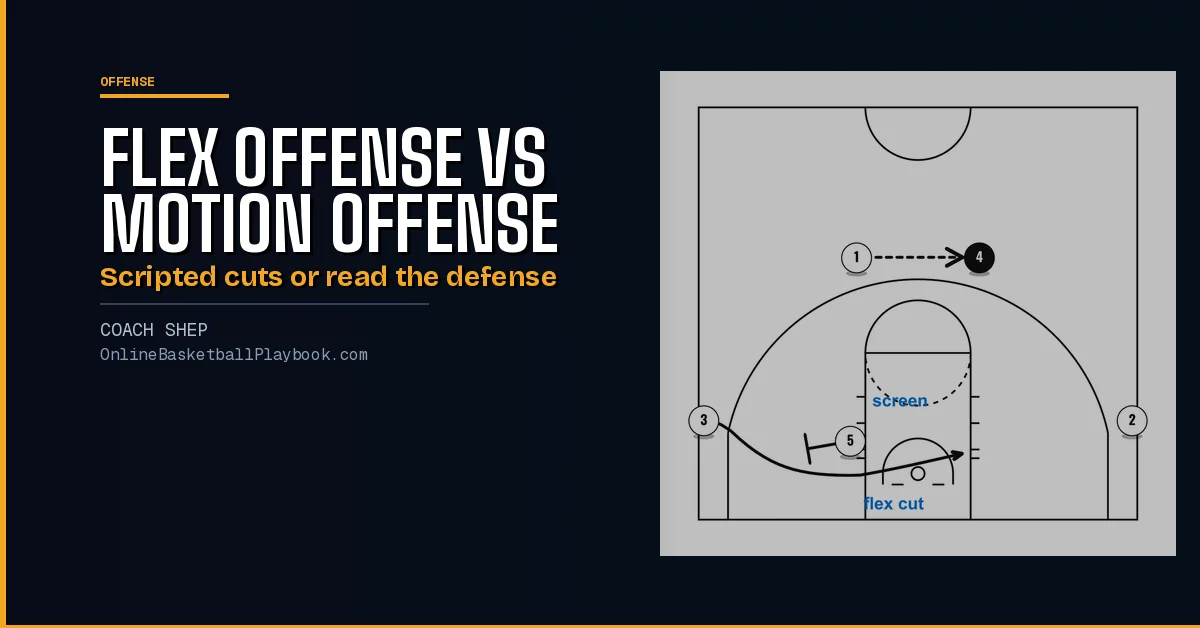
Flex Offense vs Motion Offense: Pattern or Rules
The flex scripts the cuts and repeats them side to side. Motion gives players rules and lets the defense decide the cut. Both drawn at the same moments.
Basketball Offense Questions: Presses, Motion and Systems
Basketball offense questions coaches ask, answered short: breaking every press, motion, 5 out, Princeton, flex and triangle, and the pick and roll.
Motion Offense vs Switching, Sagging and Pressure Defenses
Motion offense adjustments vs switching, sagging and pressure: flare and skip vs deep help, attack mismatches, fill behind the drive and pressure releases.