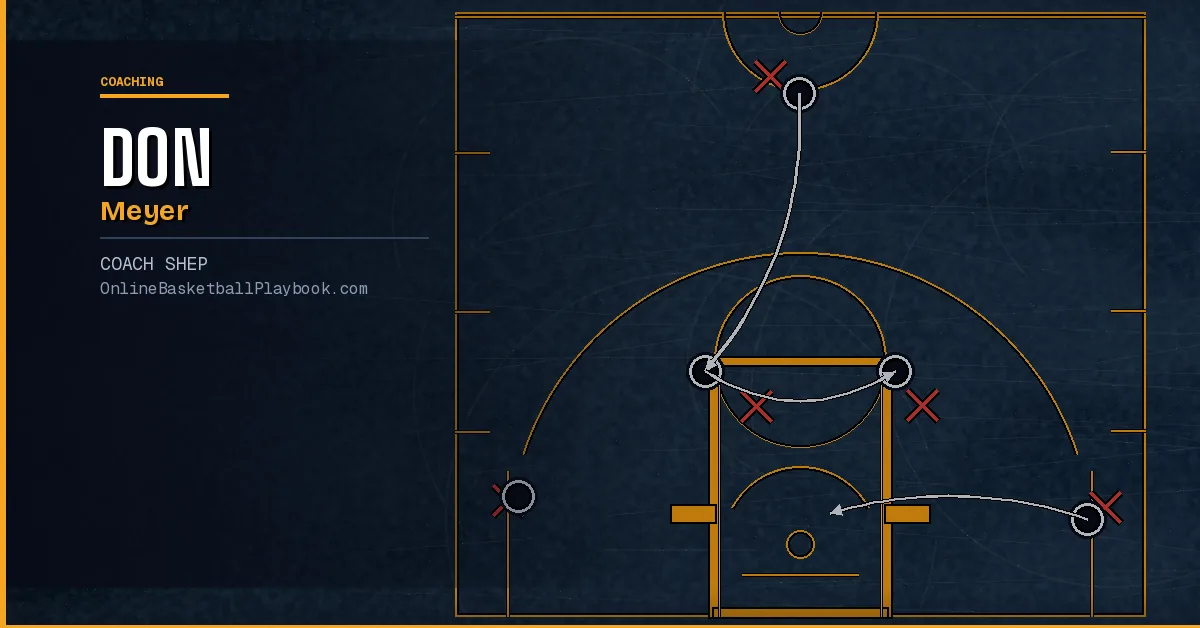
The cycle of the game in basketball is Don Meyer's method for teaching a single possession as a chain of connected parts. Defense, rebounding and offense stop being separate units. His Northern State cycle numbers six phases, from defensive coverage to offensive board coverage, and together they make one possession. The coach behind the chain is on Don Meyer, and the two phases that live on the glass build on basketball rebounding fundamentals and transition defense.
Cycle of the Game in Basketball: The Six Phases
Read in order, a possession runs through six phases like this.
| Phase | Label | What goes under it |
|---|---|---|
| 1 | Defensive coverage | Concentration, communication and consistency. Transition and talk, ball pressure, rotation, wing denial |
| 2 | Shot pressure | Pressure on every shot |
| 3 | BOPCRO | Block out, pursue, chin the rebound, outlet |
| 4 | Sureness | Triple threat with a pass fake and shot fake, rim then post then action, cutting and screening, cut and space, drive and space, balls in the rack |
| 5 | Shot discipline | The 4's and 3's, who, where, when and how, an inside-out approach, second shots |
| 6 | Offensive board coverage | Slice of the pie, guard penetration, rebound presence |
A staff can use the six names to say where a possession broke and to design drills that run the full loop.
Another chain covers only the offensive half. It runs press offense, rotation and transition, then spacing, then sureness, then putting the ball in the lane to collapse the defense, then shot selection, then filling the rebound spots.
Rebounding takes two of the six phases. Meyer's priority pyramid ranks team first, rebounding second, defense third and offense fourth. He also says rebounding is the only skill played on both ends of the floor, and he wants rebounds charted on both ends so the staff can see whether players value possession.
Learn the six names in order and any possession has a place where it broke.
Phases 1 and 2: Defensive Coverage and Shot Pressure
Meyer opens the cycle with the words concentration, communication and consistency. Beside the first phase he lists stance (sit into the game), vision, position, talk, anticipation and technique. Under it sit transition and talk, ball pressure and jump to the ball, rotation with a baseline trap and cover down, wing denial on and up the line with a hand in the lane, and keeping the ball off the top of the key with the head in the passing lane.
Meyer adds the working rules for the phase.
- Help from outside the lane. Meyer wants quick help to ensure early recovery, and he wants the help to come from outside the lane rather than inside it. See help defense principles.
- Jump to the ball. The most dangerous player on the floor is the one who just passed, so every pass is a jump to the ball.
- Ball pressure. Pressure the ball as much as possible without fouling or allowing penetration. A 6-inch zone early in the year gets players too close on purpose, which builds constant ball pressure.
- Quickness. Meyer's line is that a player gets quicker through positioning, anticipation and technique, so quickness can always improve.
- Rotation cues. Help the helper and go where your help came from.
Shot pressure is the second phase. Meyer's shot-pressure rule is to pressure every shot, with the proper hand on layups and the front hand on jump shots, and no short-arming. His man-to-man close-out teaching adds the close-out.
- Sprint half the distance, then break down.
- Close out short, with a bigger gap of 6 to 8 feet.
- Weight back.
- Hands up. The body takes away the shot and the position takes away the drive.
- Contest every shot. Put the biceps by the ear.
Three close-out drills build the habit.
- Five-spot version. Ten players split five on the arc and five in the paint, and the defense closes out on the offense. Wing players loop their close-outs, and every close-out ends with a pass fake to teach jumping to the ball.
- One-shooter version. Two balls, one shooter and three closers. The closers try to block the shot, and the shooter never shot fakes until one gets blocked.
- Rotating shooter version. The passer passes out to the shooter and then closes out while the shooter shoots. The closer becomes the next shooter and the first shooter goes to the end of the close-out line.
More technique is on closeout and recover, and the team habits behind these two phases are on how to build a defensive identity.
Phase 3: BOPCRO
BOPCRO is Meyer's rebounding sequence for every shot.
- Four-step version. Block out, pursue, chin the rebound, outlet.
- Five-step version. Block out, pursue, chin the ball, rebound, outlet.
The five-step version comes with two pieces of technique. The chinit pulls the ball to the chin with the elbows out and wide, which makes the body big and protects the ball. The 2-and-2 rule means two feet and two hands, so a rebounder jumps off both feet and rebounds with both hands. Full block-out technique is on box out basketball.
On a defensive rebound Meyer wants the post posted up in four seconds or less.
The rebound gets drilled together with what follows it.
- Cutthroat rebounding. Three on three or four on four with three groups rotating. The coach controls the shot. A stop leads to BOPCRO and then straight into offense.
- Crash and sprint. Three on three where the three offensive players crash the boards, score and sprint back toward half court. The first 3 steps are the most vital, and then the player finds the ball.
- Shot, outlet and run. The coach shoots, the defense rebounds, then outlets and runs. A second version has the defense rotate to block out before the outlet.
- Cover down. Coaches stand on the baseline 8 feet from the basket with a dummy, and the defense covers down from high to low in 3 steps. The first goal is to steal the pass and the second is to block out.
Drill sets are on rebounding drills. Rep the rebound together with the play that follows it.
Phase 4: Sureness With the Ball
Sureness is Meyer's word for the fourth phase. It goes with talking the offense and balls in the rack.
- Triple threat to drive-and-space list. Triple threat with a pass fake and shot fake, rim then post then action on the wing, rim then post then post then action at the top of the key, cutting and screening, dribble up to fill the top of the key, dribble at an overplay for a loop or backcut, lane game, cut and space, drive and space.
- Catch, bounce pass and hand version. The offense-only chain lists three sureness habits: catching in a triple threat, bounce passes, and passing from outside hand to outside hand.
- Ten-pass 3-on-3 version. A team must complete 10 passes in a row.
- Pivot, rip and pass version. Dick Bennett's sureness drills include pivot and rip in 1-on-0 and 1-on-1, plus three-player passing games, monkey in the middle among them.
- Flow version. A Princeton-offense teaching line says that when a team loses its flow, it should return to sureness with urgency.
A few reads and habits of Meyer's offense sit inside this phase.
- Rim, post, action. Every catch reads the rim first, then the post, then the action.
- Top of the key twice. Put the ball at the top of the key twice before going inside. Meyer labels these top-down feeds and calls a top-down feed the toughest pass to guard.
- Side changes. Move the ball to the other side twice before taking a perimeter shot, except with an excellent shooter.
The full set of motion principles is on motion offense.
Balls in the rack puts a price on the turnover.
- One ball out per turnover. The rack holds a set number of balls, and each turnover takes one out. When the balls run out the team suffers a consequence.
- Two balls and a consequence. The rack holds two balls and three team turnovers bring a consequence. Meyer says he borrowed the idea from another head coach.
Ball security drills and the turnover types they fix are on how to protect the ball. Whatever version you run, the team should feel every turnover.
Phase 5: Shot Discipline and the 4's and 3's
Meyer wants 4's and 3's, and the 4's and 3's head his list under shot discipline. The scale grades every shot with a number.
- Layup, jumper, okay shot version. 4 is an open layup, 3 is an open jumper, 2 is an okay shot for a good shooter, 1 is a bad shot and 0 is a turnover.
- Layup, power shot, free throw version. Layups, power shots and free throws score a 4. A wide-open shot for a shooter scores a 3. A two-point jumper with a defender's hand in the face is a 2. A 1 is an arc shot, or a pull-up two over a hand in the face.
- Paint version. 4 points for a shot in the paint, 3 for a wide-open shot, 2 for an okay shot and nothing for a bad shot. This version grades scrimmage shots.
Meyer also puts the third bad shot on the staff. A single bad shot is only that. Two make a bad player and three make a bad coach.
The rest of this phase is questions and habits.
- Who, where, when, how. The four questions for any shot.
- Inside-out approach. No perimeter lapses and an inside presence.
- Second shots. Meyer pairs the 1st, 2nd and 3rd with 30, 60 and 80 percent.
Grading shots is covered on basketball shot selection and how to teach shot selection. Pick one scale, say the number out loud and keep using it.
Phase 6: Offensive Board Coverage and Floor Balance
Meyer treats every shot as a pass, and each shot triggers offensive board coverage. Two parts sit under the phase, plus rebound presence.
- Slice of the pie. The posts roll to the weak side, with 2-on-1 weak-side rebounding and the wings going to the elbow on a three from the top of the key.
- Guard penetration. The other two guards are the fullback and the halfback.
In Meyer's view the best post move is a big man spinning to the weak-side rebound. A ball-side post must always get to the weak side on a shot. Offensive rebounding tools include the tip up to keep the ball alive and the tip out. The garbage moves are the overhead finish, chin and score, chin with a fake and score, and chin and pass out for the three. Offensive rebounding is built out on offensive rebounding basketball.
The fullback, halfback and tailbacks are also the transition and talk rule in phase 1. In phase 6, when a guard penetrates, the other two guards are the fullback and the halfback, and the tailbacks belong to the board-coverage teaching.
- Three tailbacks version. The fullback drops back deep and is designated. The halfback goes to half court and looks to stop the outlet. Three tailbacks go to the offensive glass. Meyer adjusts the numbers against one opponent to two tailbacks, one halfback and two fullbacks.
- Two fullbacks version. Two fullbacks at the half line stop the ball and give up no layups or uncontested threes. Three tailbacks crash the boards and then get back.
- Two halfbacks version. Once a player penetrates the arc he is a rebounder, and the tailbacks rebound and sprint back. If player 1 penetrates, players 2 and 3 are halfbacks. If player 2 penetrates, players 1 and 3 are halfbacks.
- Shooter as halfback version. The shooter can never be the fullback. He can be the halfback and should be when he shoots a three. If the shooter penetrates the arc, the other two guards are back. An offensive rebound with no clear next step goes out to the fullback.
Whatever numbers you choose, every player should know his role on every shot.
Training the Whole Cycle in Practice
Practice lines from Meyer and others all aim at running the chain whole.
- Compress the game. Play ten two-basket games in place of one twenty-basket game, so small units compete at full intensity and make game-speed decisions.
- Make practice like games. Build in loose balls, jump balls, save situations, and baseline and sideline out-of-bounds plays.
- Transition defense in every drill. Settle on a transition-defense philosophy that suits your style and carry it into shooting drills, breakdown drills, 5-on-0 work and scrimmages. In Meyer's perimeter shooting drill players shoot and move to lines and never go to rebound, so managers rebound.
- Finish drills at the next phase. The other side of the same idea: close an offensive drill with transition defense, and close a defensive drill with an offensive conversion.
- Two emphases per practice, maximum.
Correction follows the same short pattern.
- Praise, prompt, leave. Name one thing going well and why, name one thing to do better, then leave the players to fix it.
- Instant replay correction. Let the player see the mistake, dummy the possession by replaying it, and say do it right this time.
Practice plans built on these ideas are on basketball practice structure and how to incorporate game situations into practice, and competitive formats are on competitive basketball drills. Hand the possession from one drill to the next and the cycle trains itself.
Pitfalls Meyer Warns About
- Rushing the install. Meyer says teaching can never be too slow. His classic mistake is moving to scrimmage before players have absorbed the skill.
- Too many rules. Meyer, citing Tarkanian, warns that more ways to defend one move means more thinking and slower feet. On defense, keep it simple and aggressive.
- A phase missing from practice. A phase that is absent from practice will be absent from games.
- Fundamentals as punishment. Meyer never assigns fundamentals as punishment, since it damages the player's relationship with the skill.
- Complacency after success. His image: more planes are lost on the trip home from a successful mission than in the battle itself, because everyone relaxes.
Short cues, few rules and full-speed reps keep all six phases alive. Halftime and timeout talks are on halftime adjustments and coaching communication, and the program side of Meyer's pyramid is on basketball team culture.
Questions Coaches Ask
What is the cycle of the game in basketball?
It is Don Meyer's chain of six numbered phases for one possession: defensive coverage, shot pressure, BOPCRO, sureness, shot discipline and offensive board coverage.
What does BOPCRO stand for in basketball?
Block out, pursue, chin the rebound and outlet in Meyer's teaching. A five-step version spells it block out, pursue, chin the ball, rebound, outlet. More is on box out basketball.
What is sureness in basketball?
Meyer's word for the fourth phase, tied to balls in the rack. It covers triple threat with pass and shot fakes, rim then post then action, and cutting and screening.
What are 4's and 3's in basketball?
The shot-quality numbers Meyer wants his team to take. In his scale a 4 is an open layup, a 3 is an open jumper, a 2 is an okay shot, a 1 is a bad shot and a 0 is a turnover.
What are fullback, halfback and tailback in basketball?
Meyer's floor-balance roles on a shot. The fullback drops back deep, the halfback goes to half court to stop the outlet and the tailbacks go to the offensive glass.
Get the next coaching guide in your inbox
One email when a new guide or diagram set goes up. Free.
Want the printable playbook packs?
Playbook packs: zone attack, press break, press defense, out of bounds, quick hitters, practice plans and the youth turnover cure, each a printable PDF. Or draw your own version free in PlayDraw.
See the playbook packsMore Guides
- Long-Term Athlete Development Basketball: Stages by Age
- How to Disguise Your Basketball Offense and Defense
Back to Coaching and Program and every Coaching page.
Keep Building
Related breakdowns
Basketball Style of Play: One System Across Four Phases
Basketball style of play: how early offense, halfcourt spacing, zone attack, transition defense and a help scheme fit as one connected system for your team.
Basketball Season Planning: The Four Phases of the Year
Basketball season planning: plan backward from March, the four phases of the year, the post-season review, summer plans, preseason install and the in-season week.