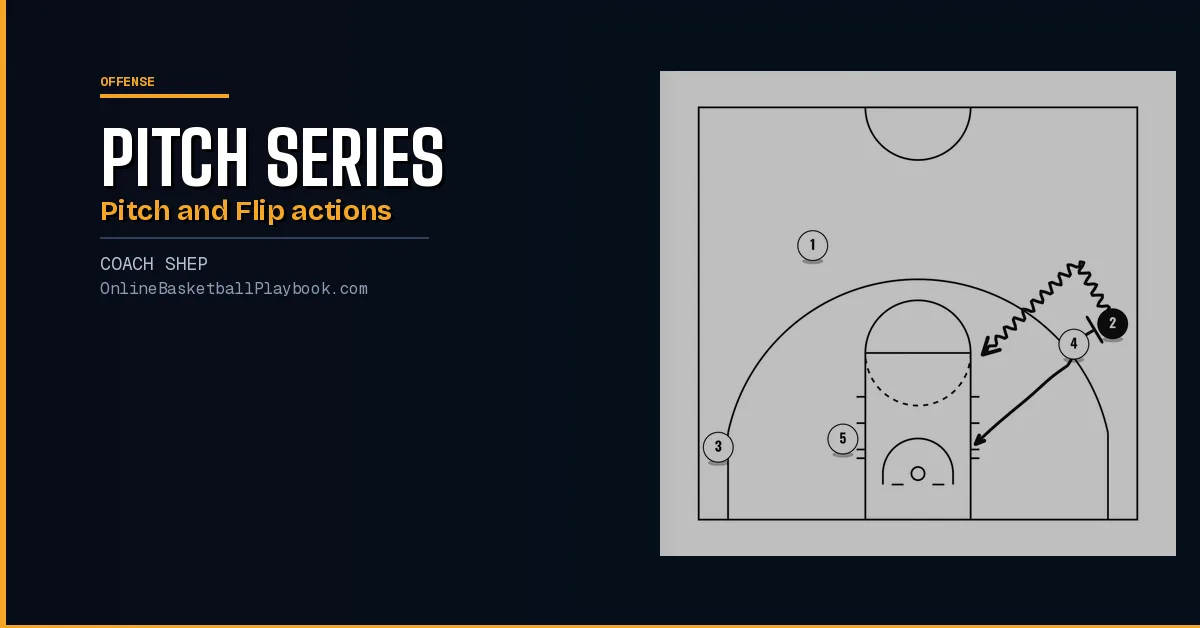
The Hoiberg Pitch Series is a family of early offense calls credited to Fred Hoiberg. Every call starts one of two ways. In a Pitch call the point guard dribbles toward the middle and pitches the ball back to the trailing 4. In a Flip call the point guard dribbles at the wing and flips or hands it to him. From those two starts come thirteen named actions: seven Pitch calls and six Flip calls.
What makes it a series is how many endings come off one start. The 4 who catches the pitch can set a side ball screen, slip it, dribble at a wing for a backdoor, drive it himself or throw it back for a big man's ball screen. The wider picture of the first seconds of a possession is on early offense basketball.
What the Hoiberg Pitch Series Is
The series is a list of calls, not a read system. Each name has two parts. The first word gives the start: Pitch for the 1/4 dribble pitch, Flip for the 1/2 dribble flip. The second word gives the finish: Get, Dive, Split, Chase, One, Mix Angle, Mix Orlando, Drag, Stop, Sonics or Jersey. The numbers read as passer and receiver, so 1/4 means the 1 to the 4 and 2/4 means the 2 to the 4.
The pieces are familiar ones. There are pitches and dribble hand-offs, side, drag and angle ball screens, slips, a backdoor, a down screen and a back screen lob. The pick and roll is the most common finish, and a guard who knows the screener's options on roll, pop and slip will recognize most of what the 4 and the 5 do here.
The Floor and the 1/4 Dribble Pitch
Every Pitch call starts from the same floor. The 1 brings the ball up on the left side. The 4 starts in the middle at half court, to the 1's right. The corners hold the 2 on the left and the 3 on the right, and the 5 waits on the right block.
The 1 heads for the top of the key on the dribble, and the 4 comes in behind him for the pitch. That short pass is the pitch. In most of the calls the 1 then spaces away to the right side, which leaves the 4 alone with the ball on the left half of the floor.

The pitch is the trigger. Every Pitch call on this page begins with this exact start.
Pitch Get, Pitch Dive and Pitch Split
These three calls share their first move. After the pitch, the 2 comes up out of the left corner to the left wing. The 4 throws ahead to him, then chases the pass to screen for the 2's dribble as the 1 moves away to the right. What the 4 does when he gets there is the call.
Pitch Get
The 4 sets a side ball screen for the 2 on the left wing. The 2 comes off it toward the left elbow and the 4 rolls to the rim.

Pitch Dive
Same start, but the 4 never sets the screen. He slips it and dives to the rim, and the 2 hits him for a layup.

Pitch Split
The 4 slips the ball screen again, and this time the 5 comes up the court from the right block toward the ball.

Once the 5 arrives, he ball-screens for the 2 on the left wing. The 2 takes it toward the left elbow, the 5 rolls to the rim and the 4 comes back out from the left block to the left wing.

Get, Dive and Split look the same for the first two passes. The difference is the call. The 4 screens in Get, slips in Dive, and slips as the 5 comes up in Split. The screener's side of these choices is covered on pick and roll reads.
Pitch Chase and Pitch One
In these two calls the 4 keeps the ball after the pitch instead of throwing ahead.
Pitch Chase
The 4 dribbles right at the 2 to set up a backdoor. The 2 takes a step up out of the left corner, then goes backdoor along the baseline for the 4's pass. The 5 lifts from the right block to the right elbow.

More ways to signal and time a backdoor are on backdoor triggers.
Pitch One
The shortest call in the series. After the pitch, the 4 drives it down the left lane line.

Pitch Mix Angle and Pitch Mix Orlando
In both Mix calls the ball goes back. The 4 catches the pitch and throws back to the 1, and the 5 comes up from the right block to screen.
Pitch Mix Angle
The 4 returns the ball to the 1 in the right slot. The 5 runs up and sets him an elbow-angle ball screen. The 5 rolls hard to the basket and the 4 fills in behind the ball.

Pitch Mix Orlando
Mix Orlando adds a hand-off before the ball screen. The 4 throws back to the 1, and the 1 dribbles at the 3, who comes up out of the right corner, for a dribble hand-off. The 5 runs up to screen for him. The 3 takes the 5's screen and the 5 rolls hard to the basket, while the 1 shakes up behind. On the weak side the 4 screens down for the 2.

Mix Orlando keeps all five players busy at once: a hand-off and a pick and roll on the right side, and a down screen on the left.
The 1/2 Dribble Flip
The Flip calls start from the same floor with a different first move. The 2 comes up out of the left corner. The 1 dribbles at him and flips it to him on the left wing. In Flip Get, Flip Stop and Flip Sonics the 2 then dribbles it at the 4, who has trailed up the floor, pitches it to him above the arc and, in Get and Sonics, spaces away to the right slot.

Flip Mix Angle and Flip Jersey use the same idea with a hand-off in place of the pitch: a 1/2 hand-off, then a 2/4 hand-off. In every Flip call except Flip Drag, the ball travels 1, then 2, then 4 before the call starts.
Flip Drag, Flip Get and Flip Stop
Flip Drag
After the flip, the 4 runs straight into a drag ball screen for the 2. The 2 comes off it toward the middle, the 4 rolls to the rim and the 1 shakes behind.

Other two-screen and trailer versions of this action are on double drag screen basketball.
Flip Get
The 2 drives the ball at the 4, pitches it to him and spaces away. The 4 takes a dribble and throws ahead to the 1, who is on the left wing after the flip. Then the 4 sets a side ball screen and the 1 dribbles off it. The 1 heads for the left elbow and the 4 rolls to the rim.

Flip Get is Pitch Get with the ball moved one more time first. The side ball screen is the same, and the 1 is the one using it.
Flip Stop
The 2 drives at the 4 and pitches to him. The 4 stops behind him for the shot.

Flip Sonics
Flip Sonics starts like Flip Get. The 2 takes it at the 4, pitches and spaces away, and the 4 takes a dribble and throws ahead to the 1. The 4 takes a step as if to sprint into a ball screen for the 1. Instead he turns and screens away for the 2. The 2 comes off that screen toward the ball and the 1 passes to him.

Flip Mix Angle and Flip Jersey
Flip Mix Angle
It opens with a 1/2 hand-off, the 1 bringing it to the 2. The 2 then brings it to the 4 for the 2/4 hand-off and spaces away. The 4 takes one dribble as if he is going to pitch it and sprint into a ball screen for the 1. Instead he throws back to the 2. On the airtime of that pass, the 5 leaves the right block and sprints up to screen for the 2.

Flip Mix Angle and Pitch Mix Angle end the same way. The ball comes back to a guard on the right side and the 5 arrives to screen for him.
Flip Jersey
The 1 brings it to the 2 for the 1/2 hand-off while the 3 empties the backside.

Then comes the 2/4 hand-off. The 5 sets a back screen, the 2 runs off it to the rim, and the 4 looks to throw the lob over the top.

All Thirteen Calls at a Glance
| Call | Start | What happens next |
|---|---|---|
| Pitch Get | 1/4 dribble pitch | 4 throws ahead to 2 and sets a side ball screen for him |
| Pitch Dive | 1/4 dribble pitch | 4 throws ahead, slips the screen and dives for a layup |
| Pitch Split | 1/4 dribble pitch | 4 slips, and 5 comes up the court |
| Pitch Chase | 1/4 dribble pitch | 4 dribbles right at 2, who goes backdoor |
| Pitch One | 1/4 dribble pitch | 4 drives it down the lane line |
| Pitch Mix Angle | 1/4 dribble pitch | 4 throws back to 1, 5 sets an elbow-angle ball screen and rolls, 4 fills behind |
| Pitch Mix Orlando | 1/4 dribble pitch | 4 throws back to 1, 1 hands off to 3, 5 ball-screens for 3 and rolls, 4 screens down for 2 |
| Flip Drag | 1/2 dribble flip | 4 sprints into a drag screen for 2 and rolls to the rim, 1 shakes behind |
| Flip Get | 1/2 dribble flip, then 2 pitches to 4 | 4 throws ahead to 1 and sets a side ball screen for him |
| Flip Stop | 1/2 dribble flip, then 2 pitches to 4 | 4 stops behind the dribbler for a shot |
| Flip Sonics | 1/2 dribble flip, then 2 pitches to 4 | 4 throws ahead to 1, fakes the ball screen and screens away for 2 |
| Flip Mix Angle | 1/2 hand-off, then 2/4 hand-off | 4 fakes the pitch, throws back to 2, 5 ball-screens for 2 |
| Flip Jersey | 1/2 hand-off, then 2/4 hand-off | 3 clears the backside, 5 back-screens for 2, 4 looks for the lob |
Every row starts from one of two moves, so the table reads as one series, not thirteen separate plays.
Where the Series Fits
Every call starts from the floor a team has as it brings the ball up: the 2 and the 3 in the corners, the 5 on the right block and the 4 trailing the 1. How teams fill those spots on the break is covered on fast break and transition offense and on secondary break basketball.
Dribble drive motion offense and the drive and space offense run on gap drives and the reads that follow them. Every Pitch and Flip call is a set sequence of pitches, hand-offs and screens. The named calls a dribble drive team adds to its reads are on dribble drive named plays.
The closest relative on this site is pistol action, another early action that starts with a pitch on one side of the floor. Pistol usually pitches ahead to the wing. The Pitch Series pitches back to the trailing big and lets him start the action.
Questions Coaches Ask
What is the Hoiberg Pitch Series?
A set of early offense calls credited to Fred Hoiberg. Seven Pitch calls start with the point guard pitching the ball back to the trailing 4, and six Flip calls start with the point guard flipping it to the wing.
What does 1/4 dribble pitch mean?
The 1 drives toward the top of the key, then pitches the ball back to the 4, who trails in behind him. The numbers are passer and receiver.
What is the difference between Pitch Get and Pitch Dive?
Both start with the pitch and a throw ahead to the 2 on the wing. In Pitch Get the 4 sets a side ball screen for the 2. In Pitch Dive he slips it and dives to the rim for a layup.
What is a drag screen in the Flip series?
In Flip Drag the 4 runs straight into a ball screen for the 2 right after the flip, rolls to the rim, and the 1 shakes behind.
How does Flip Jersey get a lob?
After the 1/2 and 2/4 hand-offs, the 3 has cleared the backside, the 5 back-screens for the 2, the 2 runs to the rim and the 4 looks to lob it over the top.
Every diagram on this page uses the symbols on how to read a basketball play diagram. The series is one of the first actions covered on early offense basketball, and its pieces sit with the rest of basketball offense.
Get the next coaching guide in your inbox
One email when a new guide or diagram set goes up. Free.
Want the printable playbook packs?
Playbook packs: zone attack, press break, press defense, out of bounds, quick hitters, practice plans and the youth turnover cure, each a printable PDF. Or draw your own version free in PlayDraw.
See the playbook packsBack to Early Offense in Basketball and every Offense page.
Keep Building
Related breakdowns
Memphis Basketball Plays: 2006 Dribble Drive Motion Sets
Memphis basketball plays from the 2006 dribble drive motion: the loop cut, Drop, Quick, X, Swing and Pop sets drawn frame by frame.
Dribble Drive Motion Offense: Spacing, Reads and Install
The dribble drive motion offense explained: 4-out 1-in spacing, the Drop, Drag and Rack zones, the read off a drive, shot diet, weak spots and the install.
Dribble Drive Named Plays: Drop, Quick, Pop and Corner Sets
Dribble drive named plays, each drawn: Drop, Drag, Quick and Pop calls, a corner ball screen set, one entry with four finishes, the numbering and when to call one.