Shooting confidence in basketball comes from watching your own shots drop. That sounds simple, but it sets the whole plan. To see a lot of makes, a player has to make a lot of shots, and to make a lot of shots he has to take a lot of them, in practice and in a certain way. This guide covers the belief a shooter holds, the three habits that build it, what to do in the second after a miss and how a shooter gets passers and screeners to believe in his shot as much as he does.
The mechanics of the shot itself are on basketball shooting form, and full workouts are on how to build a shooter.
Where Shooting Confidence in Basketball Comes From
A player gains confidence by watching his own shot drop. Most people in the game know that. Few actually build their practice around it. Successful repetitions reinforce certainty, so the work that builds confidence is the work that produces makes.
Two things follow from that:
- Start close. Shooters begin their practices near the basket, where the ball goes in again and again.
- Stay in range. Shooters rarely shoot from beyond their range, and they rarely take shots with little chance of going in.
Confidence also takes a lot of work, and the way the work is done matters even more than the amount. How to judge a good shot from a bad one in games is on basketball shot selection, and the order in which a young shooter adds range is on basketball shooting development.
The Zone and the Shooter's Mindset
One former NBA marksman ranks confidence as the key piece of how a shooter thinks. In his account it peaks when a shooter gets hot, or goes into the zone. The subconscious mind takes over, the ball seems to shoot itself, and the shooter may not even remember letting it go. The basket looks bigger and the defense seems to disappear.
The same shooter describes how great shooters see the game:
- They rank the jump shot above everything else in the game and value offense above defense, because the team that scores more points wins.
- They expect success and cannot see why anyone would doubt them.
- In his view a shooter has to shoot. If a coach wants a different action, the answer is to take the shooter out of the game. A shooter with no confidence, he says, is no longer a shooter.
The way to the zone, in his account, runs through the habits below: makes from close range, shots inside the player's range and a belief that does not move after misses.
The Next Shot Goes In
The core of this mindset fits in five words: the next shot goes in. A young shooter should build enough trust in his shot to hold that belief even when everyone else in the gym seems to have reached the opposite conclusion.
- After ten straight misses, the shooter should still firmly believe the next one is going in.
- With the coach angry and the whole crowd booing, he must still believe the next shot goes in.
The mental toughness guide covers how players reset after mistakes in general. This is the shooter's version of it.
Three Habits That Build Confidence
For a player who gets so frustrated after a miss that it hurts his next shot, there are three things a shooter must do. Confidence may be the most important thing in shooting, and these habits are how it gets built.
| Habit | What the player does | Why it builds confidence |
|---|---|---|
| 1. Perfects first | Opens every practice or shooting session with lots of shots right near the basket | Grooves the form and lets the player watch his own shot drop over and over |
| 2. A written record | Records what he plans to do and what he actually did | Improvement shows up in writing in front of him |
| 3. See it and say it | Pictures the ball going in and repeats a positive statement to himself while he shoots | Builds the player up |
1. Perfects
Every session starts the same way: many shots close to the rim. The comparison is a golfer who begins his practice by making 100 putts from 3 feet. A timed perfects routine with five spots is on how to build a shooter, and the form progression close to the rim is on basketball shooting form.
2. Record what you plan and what you do
A player cannot know what he wants to do next without knowing what he did. The record turns practice into a constant game against himself. If he is even a little committed, he will improve, and he will see it in black and white.
Take a college shooter who, the summer before his sophomore year, shot 300 threes a day and wrote every session down. He made 71 percent. Leafing through his workbook one day, he decided he could really shoot it and that he should pull the trigger whenever he was open.
Ready-made charts and logs are on individual basketball workout plan, and charting in games is on basketball shot chart.
3. Visualize and talk to yourself
This is the hard part. The shooter has to see his shots going in. While he shoots, he tells himself over and over that he is a great shooter and that everything he shoots goes in. In practice he says it seriously. Build yourself up, talk to yourself and see the ball going in.
Visualization and cue words at the free throw line are on free throw shooting.
After a Miss: No Emotion
There is one thing a shooter cannot do: show negative emotion after a miss. That covers a big show of disappointment, complaining, pouting or anything like it.
A player who reacts with emotion has, in effect, missed one more shot, because he just lived the miss again with feeling, and that tends to stay in the mind. The reverse can also be true.
Show no emotion on misses or on makes, and in practice pair that calm with the positive self-talk above. It is hard to explain and even harder to get people to believe.
Handling a Miss: The Versions Side by Side
Two ways to handle a miss, each asking the shooter to do something different in the moment.
| Version | What the shooter does after a miss | What it guards against |
|---|---|---|
| Next shot goes in | Holds a firm belief that the next shot is going in, through ten misses, an angry coach or a booing crowd | Conclusions that may seem obvious to everyone else in the gym |
| No emotion, positive self-talk | Shows no reaction to a miss or a make and keeps repeating a positive statement about his shooting | Reliving the miss with emotion, which counts as missing one more shot |
A third reset, picturing the next shot going in right after a miss and leaving the analysis for film, is on basketball shooting form as part of its confidence ladder.
Selling Your Shot to Teammates
Confidence is not only private. Lou Hudson, one of the finest jump shooters the NBA has seen, gave a shooter ideas on selling his belief in himself to teammates, fans and coaches. Working out one on one with that shooter, he spent a lot of time on new ways to create more chances to shoot, and he advised him to:
- Befriend the passers.
- Befriend the screeners.
- Befriend the other scorers.
Everyone had to believe in the shooter and his ability to make shots. Hudson used his own career as the example. He convinced Pete Maravich to pass him the ball, Walt Bellamy to look for him out on the perimeter and Jim Washington to set screens for him. Each of those relationships was built on Hudson's jump shot.
That shooter says his confidence and efficiency both grew after those workouts. The actions that free a shooter are on basketball shooting off screens. Building belief across a whole team is on how to use practice time to build team confidence.
Putting the Habits Together
Put together, the habits above shape every shooting session. Perfects come first, at the start of the session.
- Perfects. Lots of makes right at the basket to groove form and see the ball go in.
- Volume inside your range. Shoot a lot, from spots where the shot has a real chance of going in.
- Plan it and write it down. Write down what you plan to do and what you actually did, so the progress shows in writing.
- Self-talk and pictures. See each shot going in and keep repeating the positive statement.
- No reaction. No emotion on a miss or a make.
Scored shooting drills that add pressure on top of this are on basketball shooting drills, and a summer plan is on developing your shot in the off-season.
Questions Coaches Ask
How do you build shooting confidence in basketball?
By watching your own shots drop, so you need a lot of makes. Start every session with perfects close to the rim, stay inside your range, keep a written record of what you planned and what you did, and picture the ball going in while you talk to yourself in positive terms.
How do I stop getting frustrated after missing a shot?
Show no negative emotion after a miss. Reacting with disappointment or complaining is like missing the shot a second time, because you live it again with feeling. Stay neutral on misses and makes, and in practice keep repeating a positive statement about your shooting.
What should a shooter believe after a run of misses?
That the next shot goes in. Confidence comes from makes, so start close to the basket where the ball goes in, avoid low-percentage shots and hold that belief even after ten misses in a row.
What are perfects in basketball shooting?
Many shots taken right near the basket at the start of every practice or shooting session. They groove the form and let the shooter watch the ball drop again and again.
Does self-talk help shooting?
It is one of the three habits that build confidence. While shooting, the player sees the ball going in and tells himself, seriously and over and over, that he is a great shooter and that everything he shoots goes in.
Why should a shooter keep a shooting log?
So he knows what he did and can plan what to do next, and so improvement shows up in writing. Leafing through his log one day, one college shooter, who made 71 percent of 300 threes a day one summer, decided he should shoot whenever he was open.
Get the next coaching guide in your inbox
One email when a new guide or diagram set goes up. Free.
Want the printable playbook packs?
Playbook packs: zone attack, press break, press defense, out of bounds, quick hitters, practice plans and the youth turnover cure, each a printable PDF. Or draw your own version free in PlayDraw.
See the playbook packsRelated Guides
- Doubling the Post in Basketball: When, Who and How to Rotate
- Coaching Undersized Basketball Teams: How Small Teams Win
- How to Defend a Great Player in Basketball: Van Gundy's Plan
- Coach and Referee Communication: Rules of Conduct for Coaches
Back to Basketball Shooting Form and every Player Development page.
Keep Building
Related breakdowns
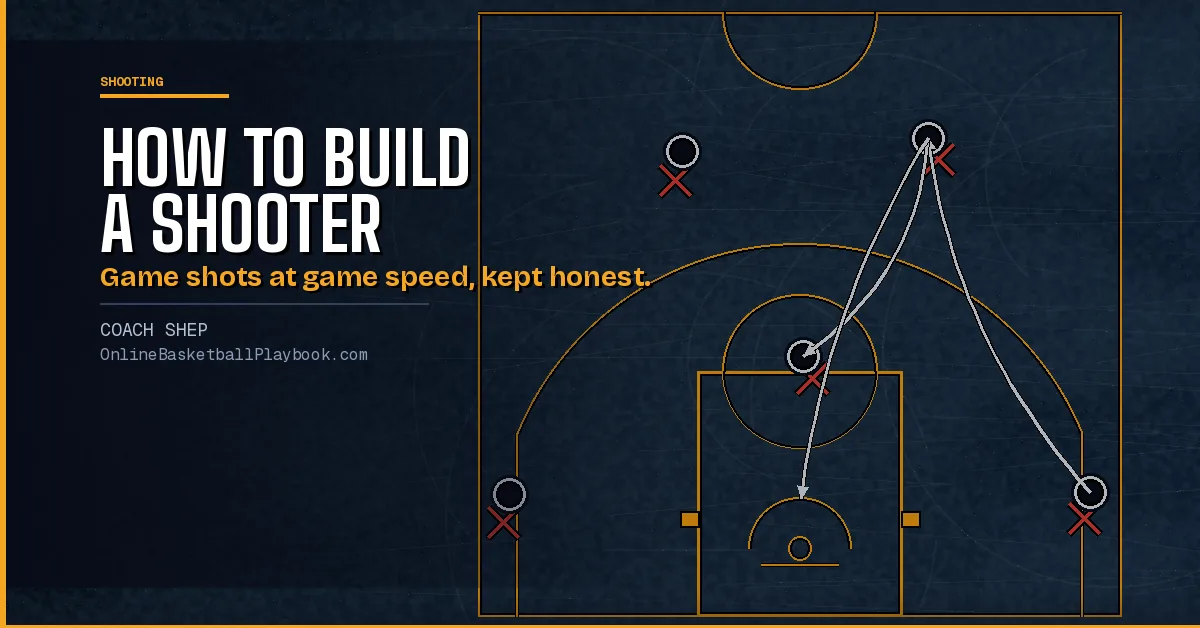
How to Build a Shooter: Individual Shooting Workouts That Actually Work
Game shots, game speed, a score on every rep, here's how to structure individual shooting workouts that turn gym time into real shooting ability.
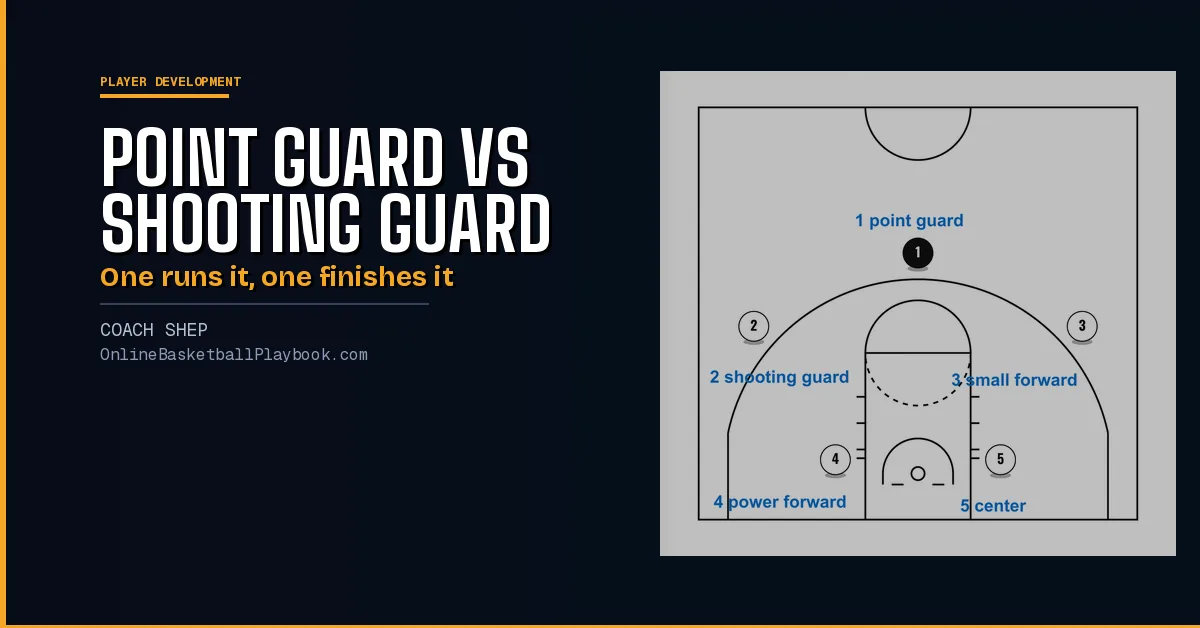
Point Guard vs Shooting Guard: Roles, Skills and Reads
The 1 runs the offense with the ball and the 2 scores without it. Here are both jobs side by side, on offense, on defense, in the break and by type.
Basketball Shooting Questions: Form, Layups and Footwork
Basketball shooting questions answered short: shooting form, hand placement, range, fixing misses, the layup, the reverse layup, steps and footwork.