How to defend a great player in basketball, as Jeff Van Gundy teaches it, starts before any double team. The first job is to take away his easy points. After that he gives a set of tools: a full face guard, a soft run that pries the ball loose from a great point guard, two ways to help when your man-to-man cannot hold a star wing, and a plan for a great post. Each one follows, then his transition defense, his out-of-bounds rules and the team habits that sit under all of it.
How to Defend a Great Player in Basketball: Take Away His Easy Points
Van Gundy puts one job ahead of every scheme. Before anything else, he strips away the star's easy points. He names five:
- Layups. Limit the shots at the rim.
- Free throws. Limit his trips to the line.
- Transition opportunities. Limit his chances in transition.
- Second shots. Limit second shots off misses.
- The open three. Limit the uncontested look from behind the arc.
Getting back is covered in transition defense, finishing the possession with a block out in box out in basketball, and taking away the open three without giving up the drive in closeout technique. How a staff writes the star into a scout is on the basketball scouting report, and how the whole plan fits together is on building a defensive game plan.
Should You Double Team the Best Player?
Van Gundy's test for a double is simple. Do not double a player just to keep him from scoring 30 against you. He calls that ego. Double him only when you judge that it is your team's best route to a win.
He also warns against the line "make someone else beat us." A double means giving other players open, uncontested shots. He names the core problem with any double team: the long closeouts that follow open up plenty of driving lanes.
One rule covers every double, wherever it comes from, and one covers post doubles:
- Zone the rest of the floor. Behind every double, in the post or anywhere else, the other defenders play zone.
- Know when to leave. On a post double, the doubler leaves on the shot, the pass or a back dribble.
How the help side moves behind a double is on how to coach defensive rotations and help defense principles.
Face Guarding the Star
Van Gundy rates a body-to-body face guard on the star as incredibly impactful. He says there is just something about a defender planted nose to nose that throws a player off. The full set of man-to-man positions it grows out of is on man-to-man defense, and the offense's side of it, getting the ball to a star who is being denied, is on late-game plays when they deny your best player.
A Soft Run at a Great Point Guard
Against a great point guard, Van Gundy sends a second defender at him so the ball leaves his hands. It is not built as a true double team.
- Who runs. X4, who guards the 4 man, makes the run.
- Where. Near the sideline and near half court, as close to both as he can get.
- How. As slowly and as softly as possible. Van Gundy says so much of defense is an illusion. The only goal is to make the point guard give up the ball and force the trailing big to make a decision.
- No rotation. X2 does not rotate onto the 4 man. He only stunts at him until X4 gets back into the play.
- When to leave it. When the ball is starting to be picked up, or, if it is run in the backcourt, when the point guard retreats with his dribble to stretch the double out.
- After the run. How you guard the point guard next depends on your personnel and on whether the plan is to deny him the ball for the entire possession. At minimum, deny him one more pass.
Full trapping schemes are on trapping in basketball.
When Your Man-to-Man Cannot Contain a Star Wing
Van Gundy asks what to do when your man-to-man is not good enough to contain the other team's best player. He gives two answers for a star on the wing, plus a late-quarter version.
| Version | When | What the defense does |
|---|---|---|
| Post plant with a box trap | On the star wing's catch | Your post defender plants right at the near-side block. The other three defenders play zone everywhere else. The waiting big traps in the box on any drive from the wing. |
| Top-side double on the wing isolation | When the star isolates on the wing | The nearest defender from the top doubles the wing. |
| Weak-hand double vs a 1-4 look | When the offense lines up 1-4 late in a quarter | The ball defender pushes the handler to his weak hand, and the outside defender doubles. |
Rotating behind the top-side double
The big question with the double from the top is whether the 5 man is part of your rotation or you rotate through him.
| Version | Who covers the open man |
|---|---|
| 5 in the rotation | The 5 man rotates out to cover the 2. |
| Rotate through the 5 | The 2 goes through the 5 man to take the corner. |
Van Gundy's choice is the second one, rotating through the 5. A full picture of how rotations run on the help side is on how to coach defensive rotations. When a team builds a whole defense around one scorer instead, the junk defenses are on what is a box and 1.
Defending a Great Post Player
Van Gundy's rules for a great post player start with the front and end with the double.
- Do not fear the lob over the front. He calls it the most overrated play in basketball. The offense rarely completes it, and a high-low pass that reaches the post without first hitting the backboard is rarer still.
- How to front. Sit right on the post's front leg and push him back.
- Lob help. The nearest defender comes, thinking steal or seal: steal the pass, or seal himself and brace to take the charge.
- Where the double comes from. On a post catch, the doubler is the defender nearest the elbow, never the man guarding the passer.
- When the double leaves. On the shot, the pass or the back dribble.
- Behind the double. The other defenders play zone, as they do behind every double.
He also describes one post double he calls great. It comes from the opposite baseline. On the catch, the post's own defender jumps to the high side, toward the middle, and the opposite big runs to the post's baseline side.
Every other front, three-quarter and behind choice, with more lob help and digs, is on post defense in basketball.
Transition Defense: Taking Away the Run-Out
Transition chances are one of the five easy points on Van Gundy's list, and transition defense is one of the three things he holds most personal as a coach. He says the best transition defense is a good offense, one that takes care of the ball, gets high-percentage shots and earns free throws.
- Two to the glass, three back. He sends two to the glass and three back. He says you cannot play two back in a tandem because of the transition three and the way every team sends its wings to the corner.
- Leave on the shooting motion. His players do not wait for the shot to go up. They head back as the shooting motion starts.
- Matching up. After a make, each player picks up his own man, and he calls players who cannot do that dogs. On misses, they match to someone of similar size.
- A trailing defensive big. He runs back and makes contact.
- The trailer's defender. Sprint ahead of the ball and load to the ball.
He adds that transition offense and transition defense both depend on the same two things: the intelligence of your perimeter players and the hard work of your bigs. In his view the common thread in teams that pressure a defense in transition is not the great point guard. It is a big who sprints rim to rim, since that squeezes the defense together. In his example the running big pulls X2 toward the paint, which opens a skip pass for an open three on the right wing.
5 vs. 4 Scramble
- White attacks Blue 5 on 4. Blue's fifth player waits under the opposite rim.
- Blue guards the ball, and everyone else guards two.
- Blue then attacks 5 on 5, with its post already at the rim.
- White attacks back 5 on 5 to finish. That is three possessions in all.
Variation: the missing player can also be a corner perimeter player. More get-back drills are on transition defense drills.
Out-of-Bounds Defense
Van Gundy's baseline out-of-bounds rules start with the dead ball.
- Contact. Everyone has contact with his man. No wandering or stumbling around while the ball is dead.
- Through screens. Get your shoulders and head below the screener's hips going through any screen.
- Guarding a shooter. Van Gundy does not want a small helping off a shooter's body. A defender on a shooter should be wary of helping, because a shooter who just set a screen is likely about to come off another one.
Shoulder jump on the inbounder
| Version | Start | Jump | Finish |
|---|---|---|---|
| Baseline | On the slap of the ball, the inbounder's defender sits on his inside shoulder to take away the quick basket cut. | He jumps to the outside shoulder for a second. | He jumps back to the inside shoulder. |
| Sideline | The inbounder's defender first takes away the quick pass to the post. | He jumps over to the inbounder's top shoulder. | He jumps back to his first spot. |
The reason he gives for the baseline jump: in his count, 90% of all baseline inbounds go to the weak side. Full coverages are on how to defend baseline out of bounds plays and how to defend sideline out of bounds plays, and screen coverages in general are on defending screens in basketball.
The Habits Under the Plan
Van Gundy frames the tools above with a few standards for the whole team.
- What wins. Defense, rebounding and inside-out offense.
- Know how you lose. Have a philosophy for winning, and know just as well what will make you lose.
- Teaching. Teaching, for him, means getting players to do things they would rather not do so they can reach what they want. It is a constant fight. Do not lower your standards, and push players to be perfect practice players.
- Confrontation. A coach cannot be afraid of it. The point is not to pick fights. It is being willing to call a player out on something you judge important.
- Talk. Players' on-court communication should be early, loud and continuous. Say it three times.
- Soft, stupid and selfish. A player can be only one of them.
- Who you can coach. Know which players you are able to coach.
- The coach's own confidence. It is as fragile as the players' confidence. Keep evaluating yourself, but hold a core philosophy that failure cannot shake.
Four stats Van Gundy watches
| Stat | What it measures |
|---|---|
| True field goal percentage | Shooting percentage: PTS / (2 x (FGA + 0.44 x FTA)), with threes weighted in |
| Turnover differential | Turnovers forced against turnovers committed |
| Rebounding percentage | The share of missed shots your team gets |
| Made free throws | Your made free throws should top the opponent's attempts |
That formula is the one behind the true shooting percentage calculator, and the rest of the box score is on the basketball statistics guide.
Van Gundy also asks each coach to name his own three things, the parts of the game that matter most to him beyond wins and losses. His three: conditioning, transition defense and blocking out. Give him a fourth and he adds screening.
Questions Coaches Ask
How do you defend a great basketball player?
Start by stripping away his easy points: open threes, second shots, run-outs, trips to the line and layups. Then pick your tools, such as a face guard or a soft run that makes him give up the ball. Double him only when that gives your team its best chance to win.
Should you double team the other team's best player?
Only when you judge it to be your best route to a win, not to keep him from scoring 30. A double gives other players open shots and, through long closeouts, driving lanes. The other defenders play zone behind it.
What is face guarding in basketball?
Guarding a player body to body, nose to nose. Van Gundy calls a total face guard on a star incredibly impactful because it throws players off.
How do you stop a great point guard?
One way is a soft run from the 4 man's defender, near the sideline and half court, so the point guard gives the ball up. It is not a true double, and no one rotates. Afterward, deny the point guard at least one more pass.
Where should a post double team come from?
In Van Gundy's rules, from the defender nearest the elbow rather than the passer's defender. He also likes a double from the opposite baseline, with the post defender jumping to the high side. The doubler leaves on the shot, the pass or a back dribble.
Should you front a great post player?
Van Gundy fronts by sitting on the post's front leg and pushing him back, and he says not to fear the lob over the top because the offense rarely completes it. The closest defender comes on a lob to steal it or take the charge.
Get the next coaching guide in your inbox
One email when a new guide or diagram set goes up. Free.
Want the printable playbook packs?
Playbook packs: zone attack, press break, press defense, out of bounds, quick hitters, practice plans and the youth turnover cure, each a printable PDF. Or draw your own version free in PlayDraw.
See the playbook packsRelated Guides
- Doubling the Post in Basketball: When, Who and How to Rotate
- Coaching Undersized Basketball Teams: How Small Teams Win
- Coach and Referee Communication: Rules of Conduct for Coaches
- Shooting Confidence in Basketball: Build a Shooter's Belief
Back to Basketball Defense and every Defense page.
Keep Building
Related breakdowns
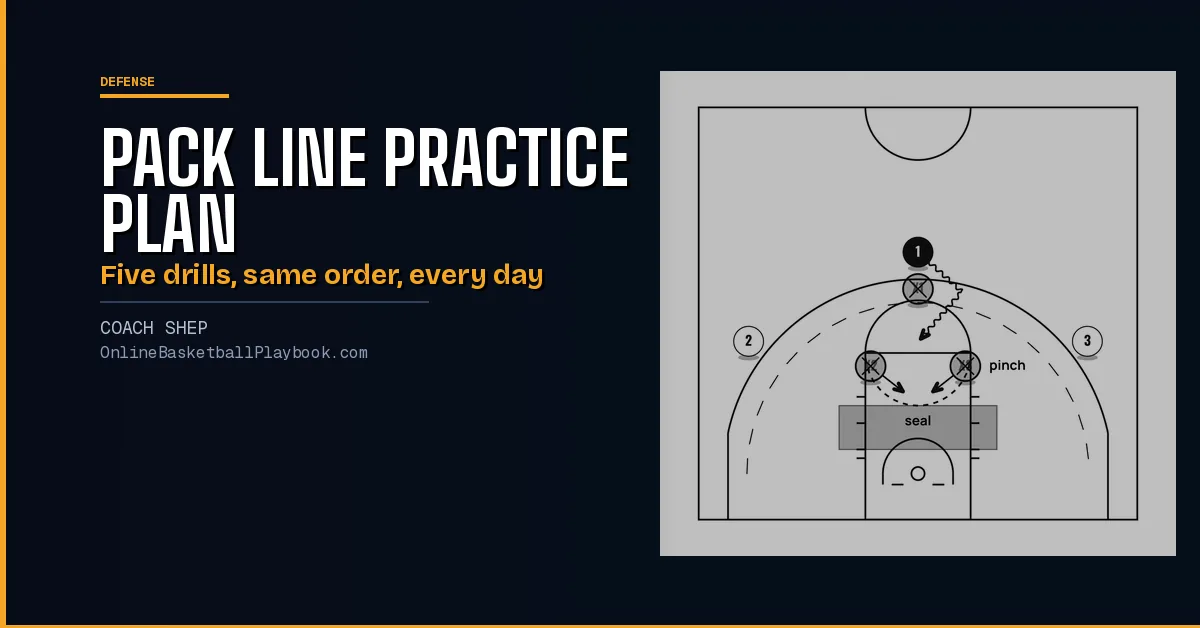
Pack Line Defense Practice Plan: Install Order and Daily Drills
A pack line defense practice plan: day one, five daily drills in order, a ten-minute shell, the install order and how to build each week around one leak.
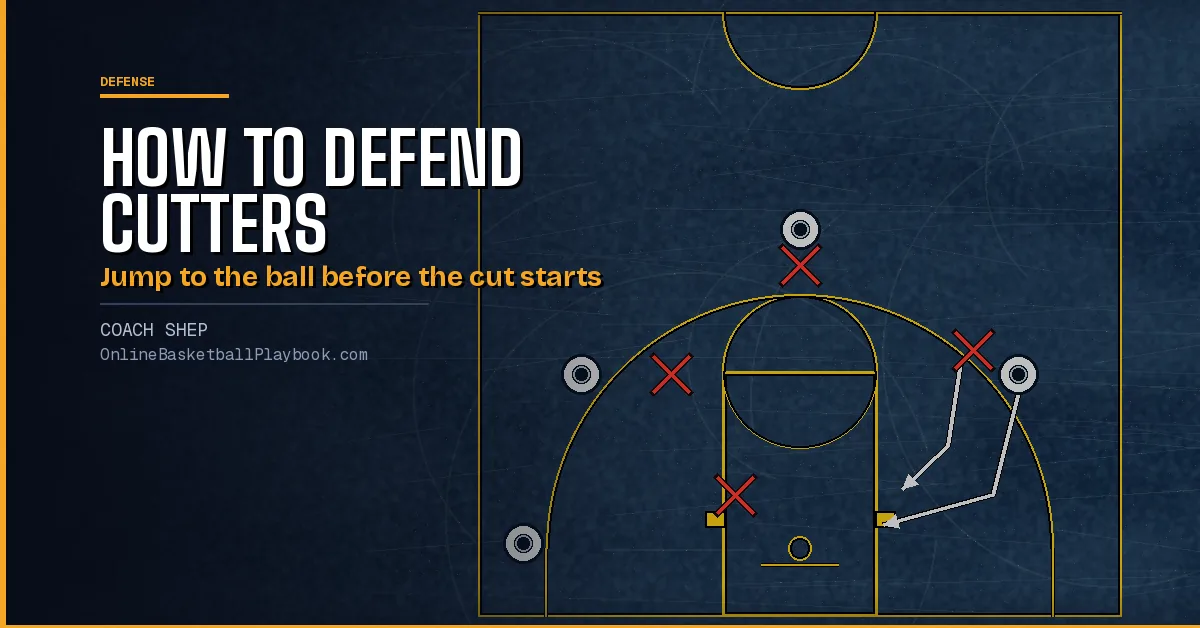
How to Defend Cutters in Basketball: Every Cut, Every Rule
How to defend cutters in basketball: jumping to the ball, the one-pass-away stance, bumping the cutter, the give and go, back cut, flash, curl and screen cuts.
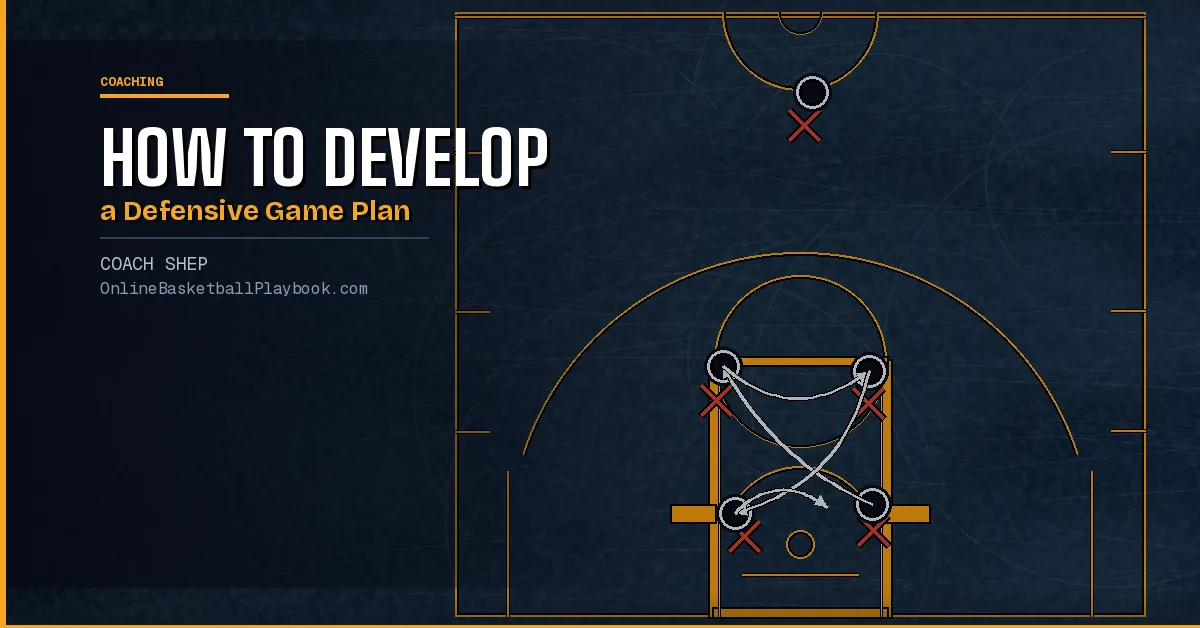
How to Develop and Implement a Defensive Game Plan
How to Develop and Implement a Defensive Game Plan