Doubling the post means sending a second defender at a post player who has the ball, usually so the post has to pass instead of score. Mike Neighbors puts the decision this way: once you choose to double, you are essentially telling your team that no defender can effectively contain that player one on one. This guide covers when to send the double, who sends it, how the doubler plays it, what the other three defenders do and when everyone gets out.
Single coverage of the post (fronting, three-quarter and playing behind) is on post defense, which also lists the common doublers and the trap angles.
Why Teams Double the Post
Neighbors focuses his double on containing a dominant post. He notes that there are certain times when doubling a post who turns the ball over can be a useful attack, but that is a separate plan. Graduation and injury led his staff to double a dominant post more than ever in one season, and it made them get better at something they had never taught, drilled or evaluated.
Steve Fisher lists ten reasons his post double worked:
- The opponent has to do something it has not practiced.
- It is hard to get ready for in a couple of days.
- It turns the post from a scorer into a passer, which forces bad shots and turnovers.
- It makes it an athletic game.
- It takes the offense out of its set play and makes it decide quickly.
- The possession usually ends in a perimeter jump shot.
- It is hard to scout, because the double comes from different angles.
- Players really like it.
- It keeps post players out of foul trouble.
- It builds reaction and communication, the total player.
Deciding whether to double at all, and whom, is part of the scout. The broader planning steps are on the basketball defensive game plan and basketball scouting report.
Set It Up Before the Catch
A double works better when the post catches away from his spot. Three versions of the setup:
| Version | Post defender before the catch |
|---|---|
| Push and wall up | Push the post as far from his post-up spot as possible. Neighbors says even 6 to 8 inches matters against the best post moves. Keep your body between him and the basket so he has no angle on the catch, and wall up actively knowing his go-to shoulder. |
| Big to big | The post defender plays three-quarter on the top shoulder and pushes the catch outside the post area box. |
| Wrap and slide behind | No entry is allowed above the free throw line extended. The guard has to dribble down and feed from lower. The post defender wraps to deny the high entry, puts an arm in the passing lane and uses an arm bar to push the post down the lane and hold him there. Once the ball is below that line, the defense sits on a midline, and the post defender slides behind and tries to move the post off the lane so he never catches it directly on the block. |
Fronting and three-quarter footwork in detail is on post defense.
Doubling the Post: When the Double Goes
Most versions send the double during the flight of the entry. Neighbors wants his doubler moving as soon as the post feed leaves the passer's hands, so he arrives with the ball. Some versions wait for a move.
| Version | Trigger |
|---|---|
| On the flight of the feed | The doubler moves on the air time of the entry and arrives on the catch. In the big-to-big version, the post defender also slides behind on the air time. |
| Entry or set dribble | The staff picks the trigger: the entry pass, or a certain dribble. |
| Show, dig, then blitz | The doubler first opens up to see ball and man, then digs (bluffs and recovers) so the post is unsure whether a double is coming. The blitz comes the moment the post makes a threatening move or puts a foot in the paint. |
| Trigger line | Against a guard who posts up, the double comes the moment he crosses a set line on his way in. |
Who Doubles: Six Choices by Personnel
Fisher's base rule sends the double from high opposite the post, and it does not matter whether that player is a guard or a forward. Neighbors suggests varying who doubles. A third approach picks a different doubler for each kind of opponent:
| Version | Use it against | Who doubles | Behind the double |
|---|---|---|---|
| Show, dig, blitz | A strong low-post scorer who hurts you backing down or inside the paint | The first defender inside the strong side elbow | The other three zone up, ready to rotate when the ball comes out |
| Off the non-shooter | A good scoring big plus a perimeter player who cannot shoot | The non-shooter's defender, on the entry or a dribble | Lock up the shooter and invite the kick-out to the non-shooter. One off-ball defender stunts at the ball and recovers instead of fully rotating. The doubler takes an angle to cut off the drive, then closes out to his man. |
| On the entry | A post who can hurt you from the block with a jump shot or by backing down | The first defender inside the strong side elbow, while the entry is in flight or on a set dribble | The others zone up and rotate |
| Big from the top | A smaller player posting when the opponent plays two traditional bigs | The defensive big on the top of the floor | When the ball comes out, the nearest perimeter defender decides. If the receiver is a skilled outside shooter, he rotates out and takes the ball while the big rotates behind. If not, he bluffs and recovers to his own man while the big recovers to his. |
| Off the cutter | An inexperienced big who may give the ball away | The defender on the baseline cutter | See below |
| Low man, baseline side | A big guard with no outside shot who likes to post up, also usable against a big | The low man on the back side, to the low side of the post | Encourage the pass back out, which gives time to rotate out of the double |
Off the cutter. On the post entry, the cutter's defender drops with his back to the baseline, where he can see everything. The baseline speed cut is called the toughest cut to guard. The post defender slides behind and angles his body to send the post up the lane line. As the cutter goes, his defender steps to him with an arm bar, makes contact and forces the cut to the middle where the help is. He stays with the cutter to the rim, then returns to trap from the baseline side.
Low man, baseline side. When the post-up guard crosses the trigger line, the big comes from the baseline side and the guard's own defender slides high and gets chest to chest, taking away his view of the middle.
The man-to-man shell these doubles sit in is on pack line defense.
The Doubler's Technique
- Anticipate. Fisher wants doublers reading from the midline while still seeing ball and man in case of a weak side flash, then coming quick and aggressive with the proper angle.
- Hard and high. Double hard, fast and with high hands. Get chest to chest and lock feet with your teammate.
- Stay glued. Neighbors' doubler sticks to the post like Velcro and shows both hands to the official.
- High side and low side. In the big-to-big version, the post defender slides behind, putting himself between the post and the rim, then moves to his low side with high hands, and cannot let him beat him baseline. The other big sprints into the high side with his hands up, coming hard so there is no quick pass out.
- Turn him middle. Fisher never lets the post spin baseline. Direct him to the middle so he turns into the doubler, and do not let him turn his shoulders far enough to spot shooters or cutters on the help side. Press into him with the chest and arms raised and keep harassing him.
- No split. The two trappers stay close together, leaving no gap to split. If he dips his shoulders and forces through, take the charge, which Fisher says is called nine times out of ten.
In the big-to-big version, the trap's job is making the offense uncomfortable and the pass out difficult, not stealing the ball. Fisher adds that a frustrated post will often try to shoot out of the double, a low percentage shot, so good board coverage is needed. Trap angles away from the post are on trapping in basketball.
Jobs Behind the Double
Three ways to assign the other three defenders:
| Version | The three off the trap |
|---|---|
| Rim, nail, shooter | One covers the rim, one covers the nail and one shades toward the best perimeter shooter. |
| Big to big | The defender on the nearest perimeter player plays tight and locks him up so there is no direct pass back out. The low man (in the second alignment he sinks to the rim) keeps everyone above him, is the helper on every dive cut, whether it comes from up top or the weak side, and he closes out to his man on a skip. The top defender sinks to about the elbow, where both players on top stay in his view. |
| Interceptor and goaltender | A top defender drops into the paint, splits the difference between the two players up top and reads the post's shoulders, eyes and feet. The weak side defender is the goaltender, reading cuts and staying open to see ball and man. If he turns and loses his man, the help side gives up easy cuts. The last defender drops about half a step, never gives up a ball side three and takes away an easy pass back out. |
In the show, dig, blitz version the others are no longer matched to a man. They zone up and get ready to rotate on the pass out of the post. Stealing the pass out is not the job of the defenders behind the double. They only need to be in a good spot to rotate, and can be aggressive only when they read the pass and are 100% sure of the steal. Keep every rotation in front. If the post wants to skip the ball, he has to throw a high-arcing pass with hang time, which gives the defense time to recover.
General help positions are on help defense principles.
Leaving the Trap and Rotating Out
The big-to-big version keeps both defenders in the trap until one of three things happens:
- A pass gets out.
- The post dribbles out of his scoring area. The doubler then recovers to his own man or spot and leaves the post defender to play him one on one. This is used when the post scores with his back to the basket but is not much of a dribbler or playmaker.
- He dribbles out and picks the ball up, which ends any threat of the post making a play.
Fisher leaves the dribble-out call to the staff before the game: if the post reverse-pivots and dribbles toward the sideline, either stay pressed into him with the double still on, or go back to your man. The costs of staying in the trap or leaving it are on post defense.
Once the pass comes out:
- Sprint out. Neighbors' doubler sprints out of the trap on the pass. Fisher's doubler sprints out and takes the next available man, with no concern about guards and forwards matching up. If you do not sprint out, you give up open threes. A doubler who stops to look loses one or two important seconds.
- First pass. Fisher's interceptor usually takes the first pass out with a good closeout and steers the ball to the outside. In the show, dig, blitz version the nearest defender closes out, hands high.
- Read and talk. Read, react, shoot the gap and communicate. Players sprint to ball and help spots. The big-to-big version says returning to your own man is best, though players sometimes have to rotate and end up cross matched.
- Get back to the big. In the show, dig, blitz version the doubler opens up as the ball goes out and reads where to recover. He should be back within the third pass, which lets the other big hold his man and limits the mismatch. If that big had to rotate out to the perimeter, the doubler must recover to front the post.
Rotation rules for every kind of help are on how to coach defensive rotations, and closeout technique is on closeout and recover.
Situations and Adjustments
Neighbors notes you can vary the trap by changing who doubles, and can take the double off completely if a post starts to anticipate it. Fisher's game situations:
- Skip pass while they screen the interceptor. The goaltender covers out on the skip, and the interceptor and the doubler each recover to an open man. If the next pass goes to a post now guarded by a guard, double him too.
- Two guards tight on the ball side. Players have a hard time seeing two offensive players on the same side below the free throw line extended. The top side player has to get both feet into the paint, try to keep the ball and both players in view, and intercept the pass out. Everyone else talks and rotates after it.
- First man from the midline. Whoever gets there first from the midline doubles. If the goaltender doubles, the usual doubler drops and the interceptor stays the same. Some players read faster and double better, so Fisher's teams sometimes ran a segment or a whole game this way, and found it a very effective double, especially with a veteran team whose players know each other's movements.
- A great shooter on the help side. Two answers: do not double from that shooter, which is hard and needs special preparation, or double from him while everyone else favors him so he gets no good look. Several times his staff put a colored jersey on one player in practice and had the others react to him.
- High-low. Deny the ball to the elbow and work so the low post is the easier look. Either the high post defender doubles (posts usually love the chance, and it is hard to see out of a double by two posts), or the help side doubles, the goaltender rotates and a top defender drops into the elbow area as the interceptor and takes the first pass out.
- A big who passes well. Fisher's staff has had times when the doubled player was a non-scoring big who hurt them with passes. The second-half fix was to stop doubling him while still doubling everyone else.
Drills to Teach the Post Double
Neighbors drills the double in his normal shell defense sessions and again when scouting specific actions before games. Fisher works it out of a 4 on 4 shell with a post and a post defender added, from the first day through the season. The post goes block to block working to get open, the perimeter players may exchange or cut, and players rotate through every spot. His breakdowns:
- 2 on 2, The Double. The post defender bumps, slides behind and turns the post into the doubler. The doubler sees ball and man and anticipates the entry. If he cheats, skip to his man for an open three. The doubler gets his feet together with the post defender and presses in so the post cannot turn, with hands up and the right angle. On the pass out, sprint to the line of the ball.
- Post defense 1 on 1, entry by dribble or pass. Meet the post at the foul line extended, bump him off the lane and slide behind, then feed the post and play it live 1 on 1. Keep the ball out of the elbow area. When the guard dribbles down, bump and slide behind and move him off the lane on the catch.
- 3 on 3 double closeout. The interceptor reads the post's eyes, shoulders and feet and shoots the gap on the pass out. The doubler presses in, doubles, hunts a deflection, then sprints back to the line of the ball. If he is slow, swing the ball for the open shot.
Start stationary so players can feel their way around, talk, rotate and get used to the adjustments. After a couple of days, let the post move from midpost to midpost. More team drills are on drills to teach help and rotation and defensive breakdown drills.
The Same Idea on Ball Screens
Fisher doubles ball screens and handoffs for the same reasons: take teams out of their sets and make them decide on the fly. The screener's defender calls the screen early, then steps up and out showing his numbers, hands on hips. The off-ball defender nearest the screen becomes the interceptor. The other two split the gaps among the remaining three, reading the dribbler. A good double pushes the dribbler toward half court and often forces an off-balance pass. No splits and no fouls. Against a screener who steps out and will not roll, do not run at him. You may jab and retreat, a call made before the game or at half time. Guard-guard screens are usually switched. On a slip, the screener's defender feels him go and tells everyone. Hard traps on the ball screen are on blitz and trap ball screens.
Questions Coaches Ask
When should you double team the post?
Neighbors says a double sends a message to your team: no defender can effectively contain that post one on one. Fisher also doubles to take teams out of their sets and keep post players out of foul trouble. Pick the trigger in advance: the flight of the entry, a set dribble, or a threatening move or a foot in the paint.
Who should double the post?
Fisher doubles from high opposite the post. Other versions send the other big, the first defender inside the strong side elbow, the defender on a non-shooter or the low man on the back side. Neighbors notes that changing the doubler adds another element to the attack.
Should you double the post on the pass or on the catch?
Move on the pass so you arrive on the catch. Neighbors' doubler leaves on the air time of the feed. The show, dig, blitz version waits for a threatening move or a foot in the paint.
What do the other defenders do when you double the post?
In one version, cover the rim, the nail and the best shooter. Another uses an interceptor in the paint and a goaltender on the weak side. A third zones up and rotates on the pass out, keeping rotations in front.
How do you rotate out of a post double?
On the pass, the doubler sprints out and picks up the next available man. The nearest defender closes out on the first pass with high hands, and players may end up cross matched.
How do you practice doubling the post?
Add a post and a post defender to the shell drill, then break it down: 2 on 2 for the doubler, 1 on 1 post defense, and a 3 on 3 double closeout.
Get the next coaching guide in your inbox
One email when a new guide or diagram set goes up. Free.
Want the printable playbook packs?
Playbook packs: zone attack, press break, press defense, out of bounds, quick hitters, practice plans and the youth turnover cure, each a printable PDF. Or draw your own version free in PlayDraw.
See the playbook packsRelated Guides
- Coaching Undersized Basketball Teams: How Small Teams Win
- How to Defend a Great Player in Basketball: Van Gundy's Plan
- Coach and Referee Communication: Rules of Conduct for Coaches
- Shooting Confidence in Basketball: Build a Shooter's Belief
Back to Basketball Defense and every Defense page.
Keep Building
Related breakdowns
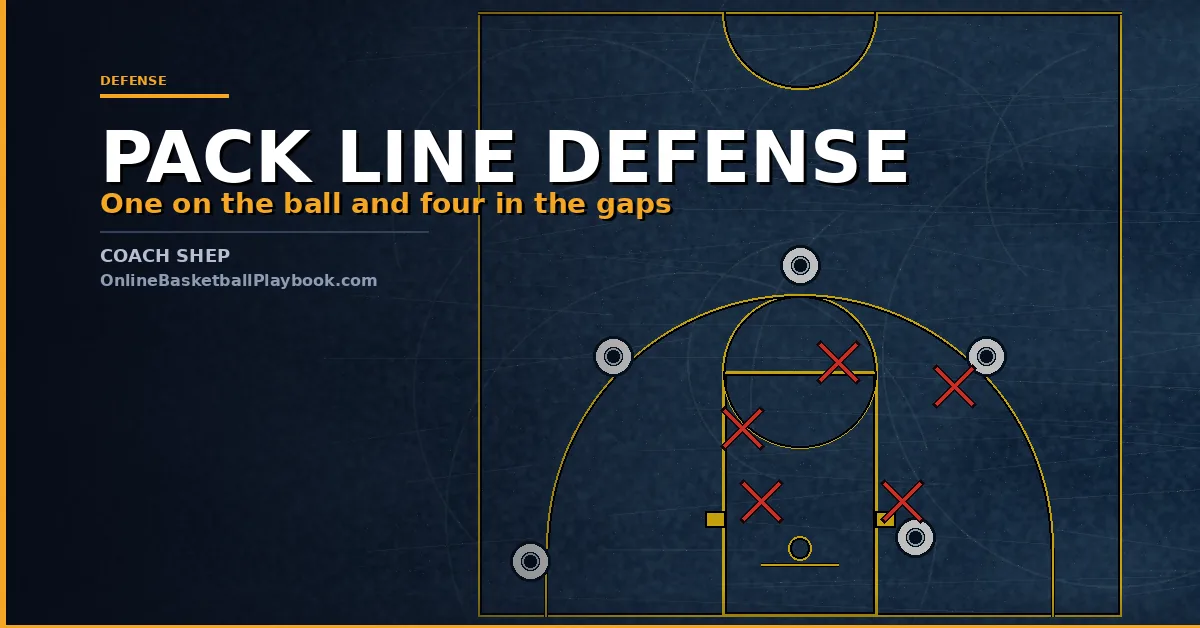
Pack Line Defense: Rules, Post Coverage and How to Install It
Pack line defense as coaches run it: where the line sits, on-ball and gap rules, post doubles, screens, dead balls, the costs and an install order.
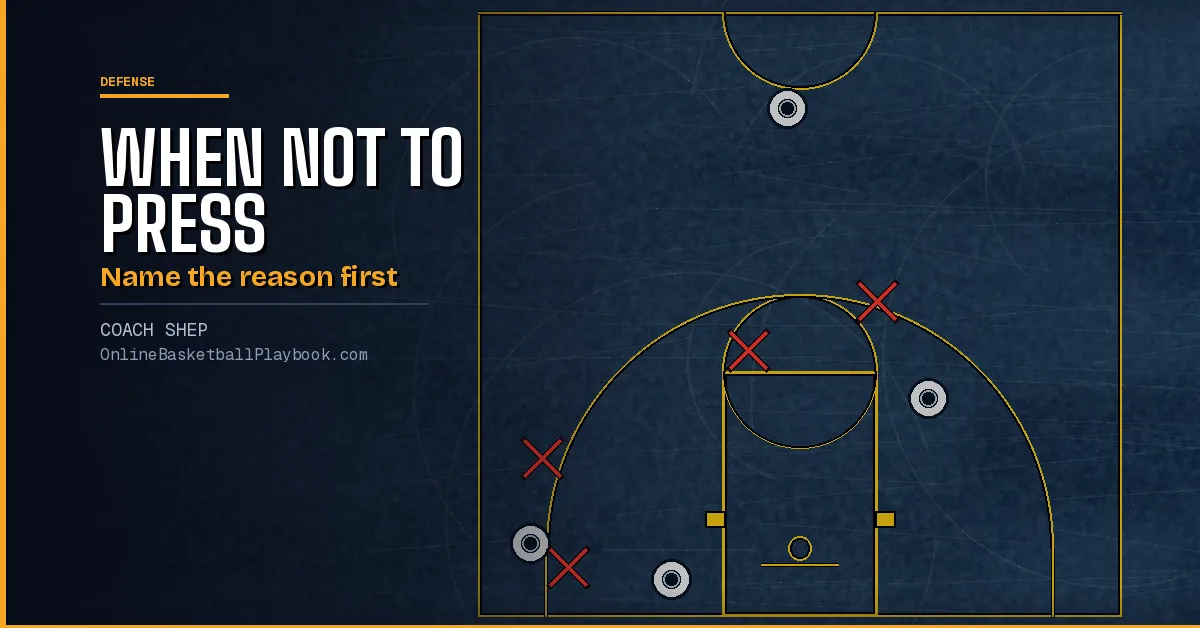
When Not to Press: Bad Reasons, Thin Benches, Poised Guards
When not to press in basketball: the bad reasons, the roster you need first, the opponents who beat it, the moments to drop it and the youth limits.
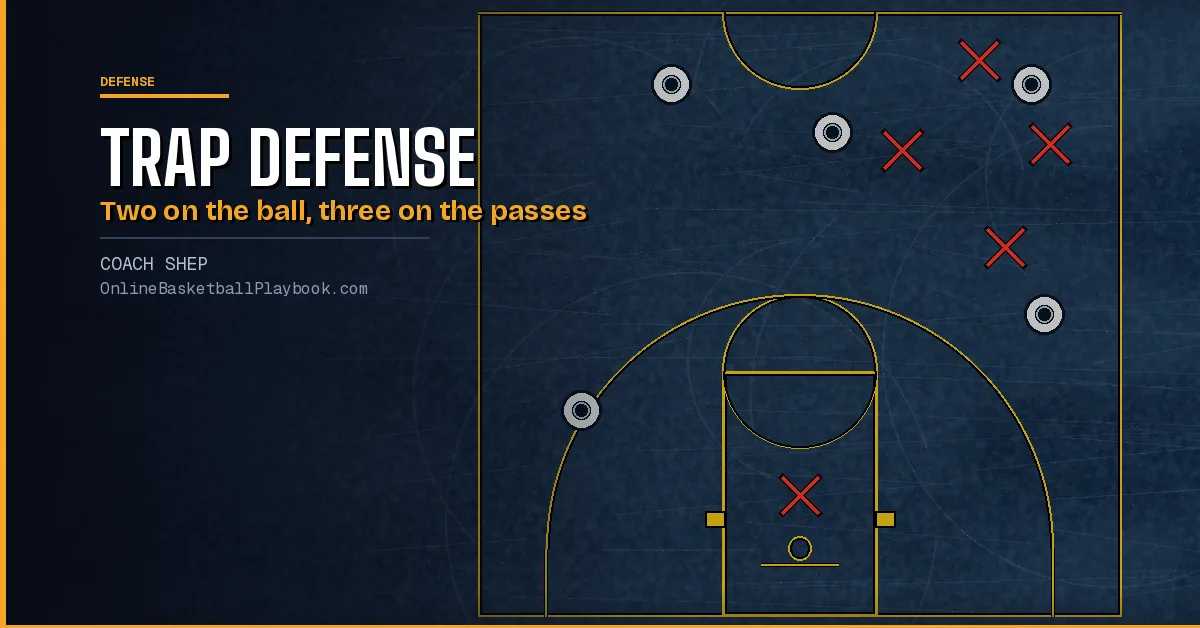
Trap Defense Basketball: When, Where and Who to Trap
Trap defense basketball explained: how two trappers close, when to spring the trap, the spots on the floor, the interceptors and goaltender, and every version.