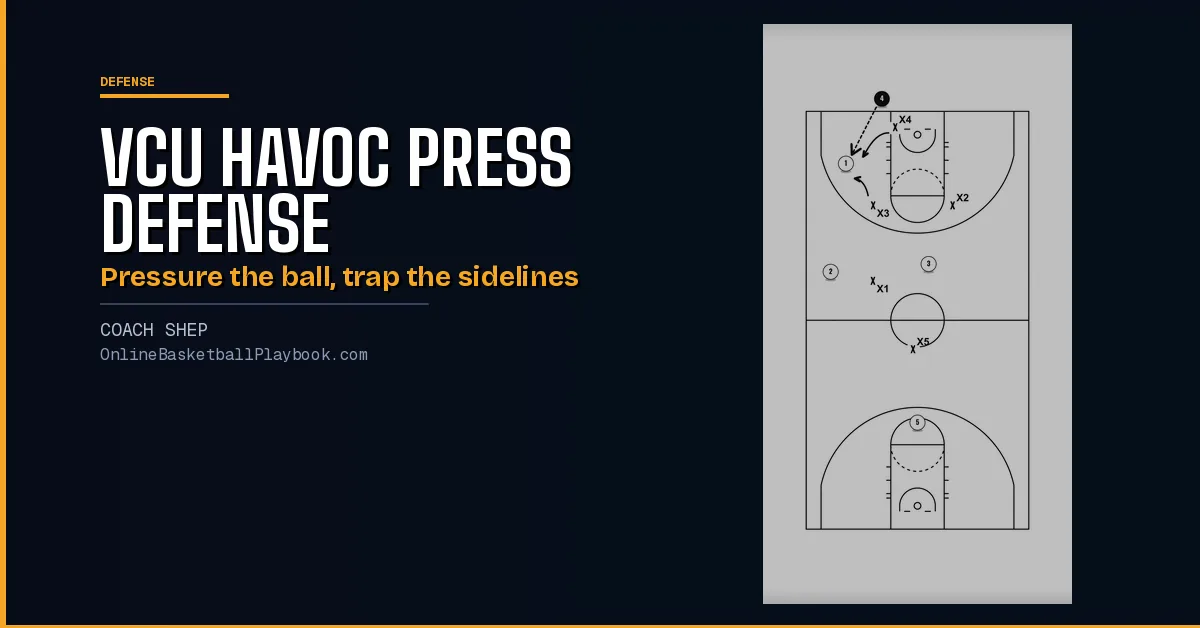
The VCU Havoc press defense is the full-court pressure Shaka Smart's VCU teams played. Smart calls Havoc a mentality first: the way his teams practice and the way they approach a game. As a style of play he breaks it into five areas, and full-court pressure defense is the first of them. The other four: pressure in the half court, a transition offense that wants a score or a good look inside the first 5 to 6 seconds, getting into the paint against a set defense, and going hard to the offensive glass.
The general case for pressing and the other press families are on full court press defense. This guide stays on what VCU did.
What the VCU Havoc Press Is
Smart describes two types of pressure defense and says VCU used both. In the first, every defender is matched up: heavy pressure on the ball, denial off it, physical play, no cuts and no passing lanes, and no trap. In the second, the defense traps. The two are very different, but in his view they go together.
One reason to mix them is surprise. A trap the offense knows is coming is easier to attack, and a trap it expects that never arrives can get the ball handler to pass too early or pick up his dribble in a bad spot. Most good teams break the press, Smart says, so the pressure has to keep coming. He also wants instinctive players who do not wait to be told when to trap. They just go trap.
Smart wants his team to be the more aggressive of the two. Looking back on one season, he could not find many games where VCU was the more aggressive team and lost. The man-to-man side of full-court pressure is covered in depth on full court man to man pressure.
Why VCU Presses
These are VCU's goals for the press, as Smart explains them:
- Turnovers. Smart disagrees with Billy Donovan's view that you will not turn good teams over. VCU charted it and found it turned over the best and the middle teams in its league at about the same rate.
- Quick or bad shots. Smart treats a quick or bad shot as almost as good as a turnover.
- Offense for yourself. A team can be a poor shooting team and still be a great pressing team.
- Tempo, flow and discomfort. Force the pace, break up the other team's offense and make it do things it does not practice, such as the 4 man bringing the ball up. With only a couple of days to get ready, opponents find it hard to prepare for.
- Fatigue. The question is not whether a player reaches fatigue but what he does there. Smart asks who will get tired first and, more important, who will recover fastest. VCU worked year round with its strength coach and tested every player's VO2 max one summer.
- Depth. VCU recruited so players 6 through 11 could play real minutes, and Smart asks his bench whose 6 through 11 is better. VCU also asks it as whose 6 through 10 is better. Smart's ideal pressing team has no great players and everyone is close to interchangeable.
- Style. It is exciting for fans, for players and for recruiting. It takes some control away from the coach, Smart says, but it takes the same control from the other coach.
VCU also names identity and brand as a goal. Whether your roster fits the style is the question on when not to press.
What a Havoc Pressing Team Emphasizes
Smart and VCU name the same emphases:
- Energy. Five players flying around. Two cautions: fouling negates hustle, and even a deep team's energy swings from day to day, so the coach reads whether his players have it tonight and may back off a little if not.
- Communication. "Talking makes you quicker."
- Transitions. To Smart a transition is any move from one thing to another. VCU also names getting into the press quickly.
- Deflections. Be first to the floor. Pressure on the ball matters a great deal, because without it good traps are hard to create.
- Stunting. A stunt is a fake with the foot and the hand.
- Back pressure. When the trap gets beaten, keep running. Pressure from behind, get a hand on the ball and get below it.
- Outnumbered and fix-it situations. VCU practices them every day.
- Defending more than one position. VCU splits it into the front and the back of the press, and Smart loves players who can guard several positions.
VCU adds taking away the obvious pass and pressuring the ball, especially in man to man. Whatever the alignment, these habits come first.
Where and When to Trap
Smart divides the court into three areas with the lane lines. The middle area is the middle tunnel, and VCU does not want to trap there, though there are exceptions. His ideal trap has three parts: a ball handler out of control, who then cannot see the second defender coming, a location out of the middle, and the closer to the sideline the better. VCU names the same three reads for when to trap: the ball handler's control, surprise and location on the court.

Smart draws a hard line between good and bad traps. A good trap, he says, usually brings a good result. A bad trap does the defense a disservice 9 times out of 10, and the defense had better get back. In his words, "Bad traps will kill you."
Not every trap needs two men. Smart's 1 man trap is a matchup call: one defender's pressure alone forces the ball handler into a poor decision, with no second defender brought to the ball. More on trap timing and placement for any press is on trapping in basketball.
Trapping Fundamentals
Smart's trapping fundamentals, in his order:
- Close out to the trap. Run to it, close out, then close the gap so it is airtight and the ball handler has no room to breathe.
- When the ball handler pivots away from the pressure, take the space he gives up. Be greedy.
- Against a live dribble, leave him no escape. If he back dribbles to make space, close the gap again. Stay elastic: if he breaks up the sideline, go with him. Do not be stiff.
- No splits and no fouls. At VCU a trapper who gets split comes out of the game.
- Very active hands. Mirror the ball, and if it goes overhead, the hands go up with it.
- Force the obvious pass, which tells the interceptors where to go.
- If a foul is coming, make it with the lower body. Smart's view is that officials never call a lower-body foul.
- Interceptors think like trappers.
VCU's trapping rules come in four lines: never get split and never foul, use the lower body physically, on the obvious pass eyes and shoulders and be elastic, and on a penetrating pass the first 3 steps, then sprint back and fix it. Smart adds that VCU studies what each opponent does against the press, because most teams are predictable. Close the gap, mirror the ball and force the obvious pass on every trap.
The Fist and Double Fist
Smart calls VCU's main press Fist, a man-to-man press. Whoever guards the inbounder is the Madman, and his job is to go after the ball like one. VCU puts whoever's man is taking it out on the ball, though a coach could assign one player to the inbounder. He stands ten toes on the line, close enough that the inbounder could smell his breath, moves when the inbounder moves and gets his hands on the ball as often as he can. Smart notes that John Beilein asks for the same closeness in his 1-3-1.
Each of the other four puts a forearm, the hammer, into the ribs of his man on the inside shoulder and denies with the other arm. Smart's three areas to be great in:
- Pressure on the ball. Nothing works without it. VCU does not force the ball middle or sideline. Smart would rather see it go to the sideline, but the rule is not to get beaten either way.
- Position off the ball. Unless your man is the deepest player, stand one third of the distance from your man to the ball and see both. If your man moves, you move. If you need a step back to see him, take it.
- Stunt. If the ball is dribbled toward you, stunt at it with a foot and hand fake.
VCU's Double Fist press works from the same match-up. Everyone matches up and communicates right away, in the groups 4 and 5, 2 and 3, and 1. The Madman influences the ball to the ball side. Off the ball, defenders play the inside shoulder and arrive on the catch, and at one third of the distance they stunt. The press forces the ball into the alley and stunts to shrink the floor, and its trap on the turn and up follows a 3 stride rule.

When the offense clears out and leaves its guard alone at the top of the key, Double Fist traps the turn and corrals the dribble.

Two Ways to Trap: Trap the Turn and Force the Action
Smart describes two ways VCU traps. The first is trap the turn. As soon as X2 sees the back of 1's head, he goes to trap. X4 thinks like a trapper and becomes the interceptor. X5 cheats toward the easy pass, reading 1's hips and shoulders.

The second is force the action. Smart says many teams with a good guard clear everyone out and let him bring it. VCU's answer is to force the ball out of the middle. Its middle defender stunts and fakes at the guard until the guard passes the three-point line extended, then goes to trap. X3 and X4 are the interceptors, and X5 protects the basket.

Other ways to rotate behind a trap are on scramble press and match-up press.
The Diamond and Side Diamond
VCU also runs a Diamond press, with one plain job for each player:
- Madman: on the ball. Beat the passer to the ball, be active and angle yourself with the backboard.
- 3 man: the first player to one side of the inbounder. Play the inside shoulder, even with your man, do not deny the inbound pass and give up no sideline.
- 2 man: the first player to the other side. Close down from the free-throw line, give up no sideline and be the high interceptor.
- 1 man: get back, match up with the next player over the top on the ball side and be the sideline interceptor.
- 5 man: as deep as the deepest player, back to half court. Be the defender in a 2 on 1 and protect the rim. Nothing easy.

The Diamond's first teaching point is that you cannot get beaten up the sideline. Then corral and control the dribble, trap and rotate actively and deflect the pass back to the inbounder. The 2 and 3 men talk and can switch based on where the offense lines up. On a throwback to the inbounder, stunt, retreat and get ready to come again. Stay in the press until a deep pass penetrates it, then back tip, back pressure and sprint to the rim from the weak side. Talk, match up and fix it.

The Side Diamond turns the diamond onto the sideline. It traps once, then sprints out, whether the ball goes to the midline and back or on a short pass up the court. It keeps the ball from the middle, and the closer the ball gets to the frontcourt, the more it protects the middle. Its jobs:
- Madman: on the ball, angled more in the backcourt. Trap the first pass if it is within 3 strides.
- 2 man: face the ball and take away the inbounder.
- 3 man: face the ball and let no one get behind him.
- 1 man: the rover, a free safety who faces the ball and matches up as deep as the deepest if anyone gets behind him.
- 5 man: the enforcer. Cover the basket and come up with the back player if he flashes.

The full install of a diamond press, with its reversal and over-the-top rules, is on the 1-2-1-1 diamond press guide.
Fix-It and Outnumbered Situations
A trapping team will get beaten sometimes, so Smart says it also has to be good at fix-it situations. A fix-it situation is going from not matched up to matched up again. VCU's transition rules for fixing it are basket, ball and ball-side. Smart does not think teams at his level are good enough to get the ball over and exploit the mismatches that follow, and VCU tries to switch back later in the possession.
Once it is fixed, the pressure stays on. VCU may trap again in the half court, where a wing entry may be a trapping spot, or it may just pressure the ball and deny entries. The most important pass to deny is the first pass into the offense, and the team rule is no elbow catches. Smart accepts getting beaten backdoor now and then. His answer is heavy pressure on the ball so the backdoor pass, especially the first one, is hard to complete.
Smart calls play in outnumbered situations, 2 on 1 up to 5 on 4, critical and says VCU works on them every day. VCU's Butler Transition drill puts the defense outnumbered in transition and asks it to hold the fort for 7 seconds.

VCU also runs Smart's favorite fix-it drill when it traps ball screens in the half court, where players must scramble. Out of the trap, exactly one defender goes to the ball, never two and never none. More recovery work is on transition defense basketball.
Havoc Press Drills
Smart says VCU runs one trapping drill and one pressing or rotation drill every day. Beyond that, the press is taught through 5 on 5 play. These are drills VCU uses for it.
Full-court 1 on 1. From the first day of practice, every player on the team plays full-court 1 on 1. The defender straddles the offensive player's hip with his forearm, the hammer, on the hip so he cannot get beaten deep.
5 on 5 press work. Players circle on the floor and a coach makes a layup. The defense must talk and set up Fist. The Madman puts immediate pressure on the ball, the defender on the outlet does not allow a catch with a full head of steam, and everyone moves into one-third position.
Circle Trap. Two versions:
- Four on four with interceptors. X1 and X2 trap the ball and X3 and X4 become the interceptors. The drill trains trapping fundamentals and the interceptors' reads.
- Three on three game. The offense catches and holds the ball for a two count. It has no dribble and cannot move off the ball. The two closest defenders trap, and as the ball moves the trappers and the interceptor change. Smart keeps extra balls handy for deflections and runs it for a minute. A defense doing a great job, he says, gets 6 to 9 steals and deflections in that minute.

Trap Transition. A guard starts with the ball in the trap. He holds it for 2 seconds, then he can pass out. From there it is live, and the defense sprints back in transition and fixes it. It trains back tips, back pressure, talking and fixing it.

Triangle Fast Break. 1 starts with the ball and X1 and X2 chase him to back tip. 1 cannot pass until he reaches half court. Once he throws it ahead, it is 4 on 4 live. Same goals as Trap Transition.
444. Three teams of 4. When a team scores, it presses until half court, looking for a steal and another score. It trains getting into the press quickly and conditioning.
1 on 1 building to 4 on 4. Builds pressure on the ball, stunts, traps and the habit of keeping the ball where the defense wants it.
More press drills, sorted by skill, are on full court press defense drills. Whatever drills you pick, run a trapping drill and a rotation drill every day.
The Culture Behind Havoc
Smart's starting point is that players should know what the program does down to the smallest detail and hear it again and again, with praise when they follow the plan and sometimes correction when they do not.
Give them the answers to the test. Players should know beforehand what they will be tested on, on and off the floor. VCU's incoming freshmen get an orientation twice a week, a meal or a meeting with someone from inside or outside the program, and before summer ends each one has heard from every coach on the staff.
Every day we... Smart asks coaches at every level to finish that sentence. VCU's answer was transitions, from offense to defense and from one drill to the next, with the goal of being the best team in the country at it. After a drill players get a short water break, then huddle by team or by position.
Five core values. VCU's are:
- Appreciation: every opportunity is a gift. VCU watches each player's appreciation to entitlement ratio, and Smart calls appreciation the foundation.
- Enthusiasm: for the process, not only after a big win or a 10-0 run. Smart picks this one as the value most unique to VCU.
- Competitiveness: VCU defines it as going after greatness aggressively.
- Team-ship: fully committing to align with the team. VCU looks for players who can get over themselves.
- Accountability: responsible for the team and for yourself.
Three kinds of accountability. Coach to player is the first, and every program has it. Players holding themselves to a standard is the second. Players holding players accountable is the third, and it is the one VCU emphasizes most. Smart does not think a team can be great with only the first. More on building it is on basketball accountability.
Expose hypocrisy. Smart says the coach's job is to call out any gap between what the program says it is about and what it does, whether the gap comes from a player, an assistant or the head coach. The wider work of setting standards is on basketball team culture and how to build a defensive identity.
Questions Coaches Ask
What is the VCU Havoc defense?
Havoc is the name VCU under Shaka Smart gave its style, and full-court pressure is the first of its five areas. The press mixes matched-up pressure with no trap and trapping pressure, with fix-it rules for when it gets beaten.
Is Havoc a man-to-man press or a zone press?
Smart calls VCU's main press, Fist, man to man. VCU also runs the Double Fist, which matches up on the inbound, and the Diamond and Side Diamond alignments, where each defender has a set job.
Did VCU press after every miss?
No. Smart says VCU usually pressed off a miss only after a missed free throw, a set situation.
Every diagram on this page uses the symbols on how to read a basketball play diagram. More press systems are on best full-court press, the disguised press defense and how to build a pressing team.
Get the next coaching guide in your inbox
One email when a new guide or diagram set goes up. Free.
Want the printable playbook packs?
Playbook packs: zone attack, press break, press defense, out of bounds, quick hitters, practice plans and the youth turnover cure, each a printable PDF. Or draw your own version free in PlayDraw.
See the playbook packsBack to Best Full-Court Press and every Defense page.
Keep Building
Related breakdowns
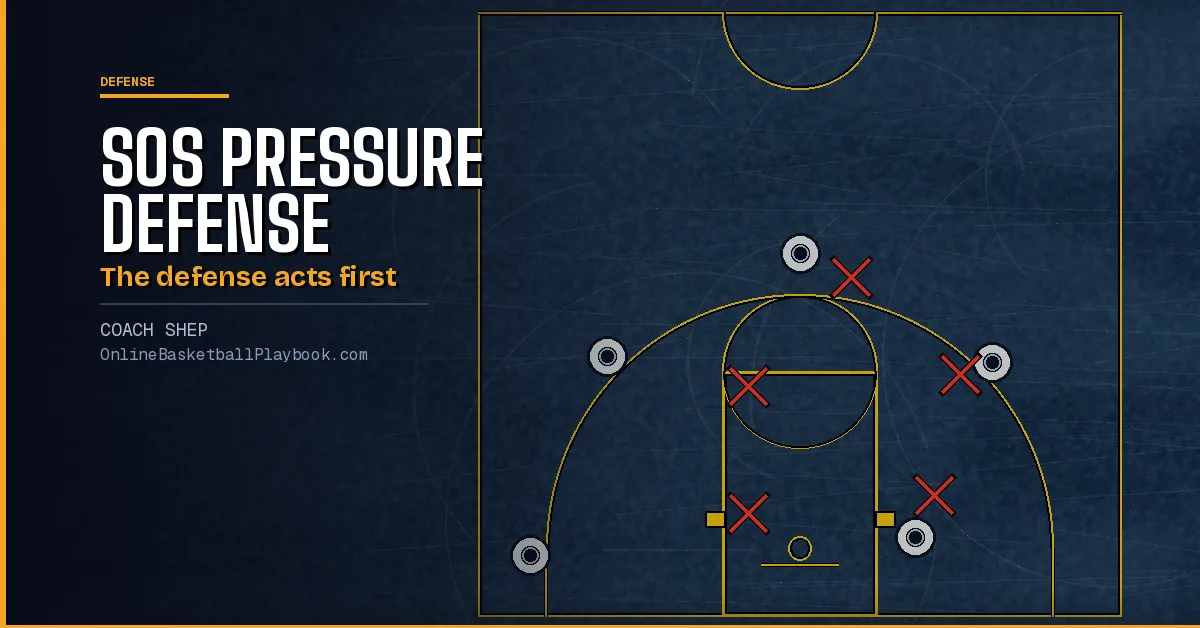
Pressure Defense Basketball: The SOS Man-to-Man System
Pressure defense basketball through the SOS system: on-ball, deny and help rules, checkpoints, switching, traps, the presses it grows into, and its costs.
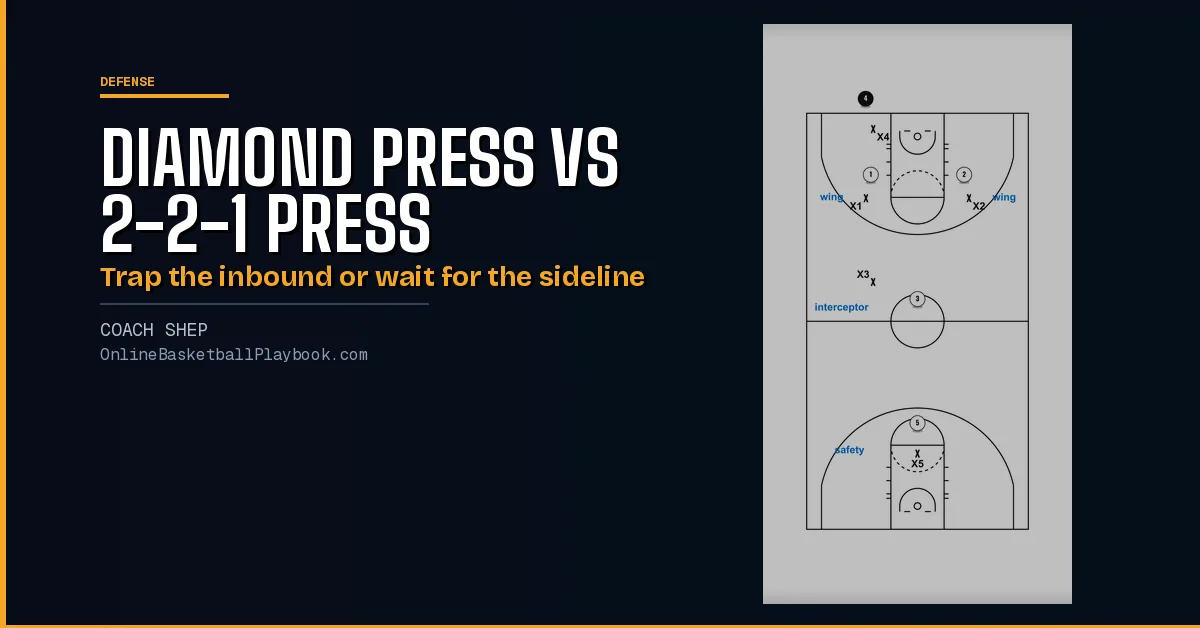
Diamond Press vs 2-2-1 Press: Full-Court Presses Compared
Diamond press vs 2-2-1 press drawn at the same moments: the set, the first trap, the reversal and the break, with the roster and the score that fit each one.
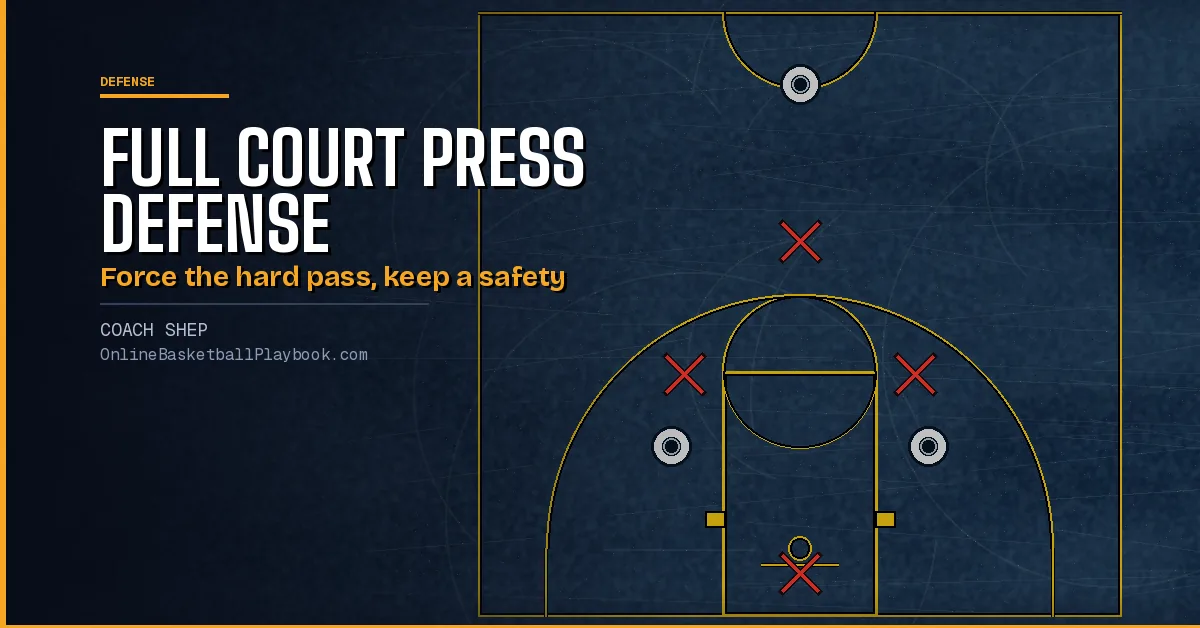
Full Court Press Defense: Types, Rules and How to Install It
Full court press defense pressures the ball for 94 feet. See the press families, shared rules, trap mechanics, the cost, the install order and drills.