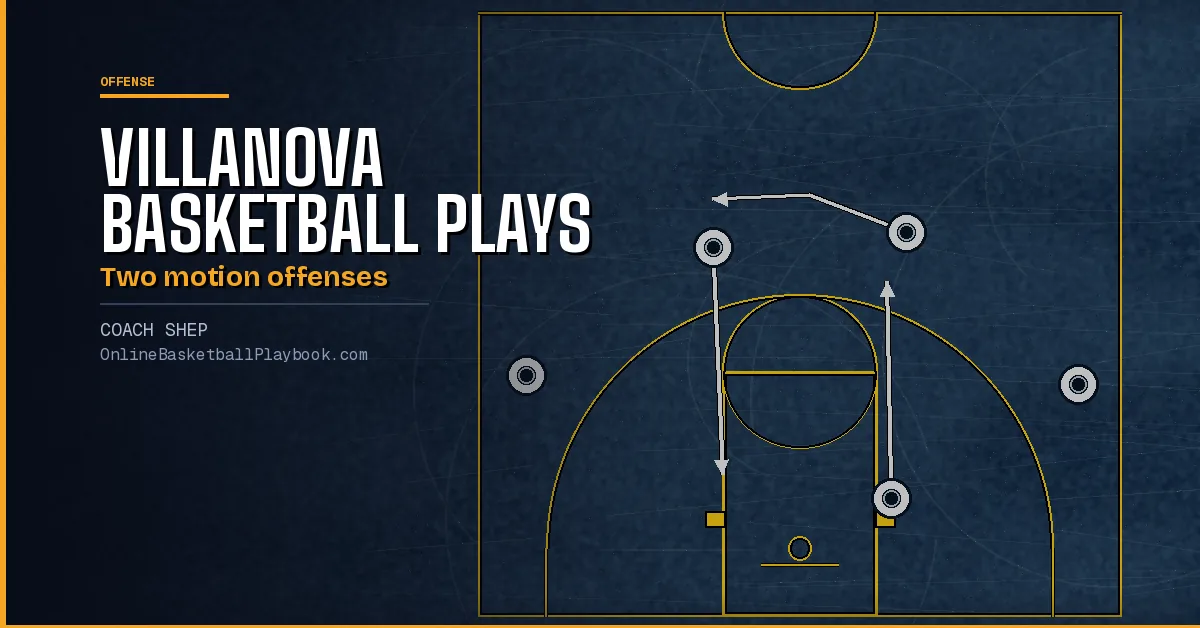
Villanova basketball plays on this page come from two different Villanova programs, and they are kept apart. The first group is the men's 4-out motion offense of Jay Wright: three guards and two forwards, with the forwards always high and low on opposite sides. The second group is the women's motion offense of Harry Perretta: five out, the ball on top, and a numbered menu of cuts that can be called out loud. This page draws 11 actions across 19 frames, and the text under each frame names where all five players go.
Villanova Basketball Plays at a Glance
The first four rows are the men's 4-out rules: the high-low spacing, the slot screen, and the two guard screens. The next six rows are Perretta's starting spots and his five numbered cuts, one frame each. The last row walks one full 25 call, two curl cuts and then back and flare screens, in eight frames. Perretta's two numbered options, the pick and roll with the 4 and 5 and the dribble hand-off, have no diagrams to transcribe, so they are described in the questions below but not drawn. For the rest of Wright's program, see the Jay Wright Villanova system.
| Play | Family | Frames | What it does |
|---|---|---|---|
| Hi-Lo Opposite | Men's: Jay Wright's 4-Out Motion Rules | 1 | The forwards always sit one high and one low on opposite sides. When one cuts down, the other comes up, and a guard fills the slot that opened. |
| Slot Screen and Basket Cut | Men's: Jay Wright's 4-Out Motion Rules | 2 | A forward screens a guard at the slot, the guard basket cuts, the other forward slides across, and the guards then refill the open spots. |
| Guard Down Screen | Men's: Jay Wright's 4-Out Motion Rules | 1 | Guards screen only for guards. With 1 and 3 on the same side, 3 screens down for 1, and 5 can add a second screen at the slot. |
| Guard Flare Screen | Men's: Jay Wright's 4-Out Motion Rules | 1 | The same spots, but 1 sets a flare screen for 3, and the ball goes to 5 for a skip pass to 3 or a pass into 4. |
| Initial Alignment | Women's: Harry Perretta's Numbered Cuts | 1 | Five out, with the ball in the middle of the floor so both sides can start action. |
| #1 Basket Cut | Women's: Harry Perretta's Numbered Cuts | 1 | Pass and basket cut, then fill an open spot on the far side while the others rotate behind. |
| #2 Curl Cut | Women's: Harry Perretta's Numbered Cuts | 1 | The passer screens away for the wing, who curls tight around the screen to the rim and then clears to the far corner. |
| #3 Backdoor Cut | Women's: Harry Perretta's Numbered Cuts | 1 | The passer screens away, but the cutter goes backdoor to the rim, and the screener comes back to the top of the key. |
| #4 Slip | Women's: Harry Perretta's Numbered Cuts | 1 | The passer goes to screen for the wing but slips to the rim before contact, while the wing replaces him at the top of the key. |
| #5 Back Screen or Flare Screen | Women's: Harry Perretta's Numbered Cuts | 1 | A wing screens for the passer. Drawn here as a flare: the passer fades to the wing and the screener comes back to the top of the key. |
| A 25 Call | Women's: Calling a 25 in Perretta's Motion | 8 | The first number names the cut after the first two passes, the second number names every cut after that: two curls, then back and flare screens. |
How to Read These Diagrams
Every play is drawn frame by frame, one diagram for each frame of the original, and the text under each diagram says where every player starts and where he goes. The basket is at the bottom of each diagram. Sides are named as a player sees them facing the basket, so the left wing is on the right side of the picture. A solid arrow is a cut, a dashed arrow is a pass, a wavy line is a dribble and a line ending in a short bar is a screen. The diagram guide covers the symbols in full. No offensive player starts a frame standing in the lane. Where a source frame had someone there, he is drawn on the nearest lane line or block.
Get the next coaching guide in your inbox
One email when a new guide or diagram set goes up. Free.
Men's: Jay Wright's 4-Out Motion Rules
Hi-Lo Opposite
The forwards always sit one high and one low on opposite sides. When one cuts down, the other comes up, and a guard fills the slot that opened.

Frame 1. 3 and 2 are guards on the wings, 1 is the third guard and 4 and 5 are the forwards. 1 has the ball in the left slot, 4 is in the right slot, 5 at the left mid-post, 3 on the left wing and 2 on the right wing. 4 cuts down to the right mid-post, so 5 moves up from the left mid-post to the left slot to keep the forwards high and low on opposite sides. 1 dribbles across to fill the right slot that 4 left.
Slot Screen and Basket Cut
A forward screens a guard at the slot, the guard basket cuts, the other forward slides across, and the guards then refill the open spots.

Frame 1. 1 has the ball in the right slot, 5 is in the left slot, 4 at the right mid-post, 3 on the left wing and 2 on the right wing. 1 passes to 2. 5 comes across and screens for 1 at the right slot, and 1 basket cuts off the screen down the right side of the lane. 4 slides across from the right mid-post to the left mid-post, so the forwards stay high and low on opposite sides. 5 could set the same screen as a flare screen for 1 instead.

Frame 2. 1 did not get the ball on his cut. 2 has the ball on the right wing, 1 is low on the right side of the lane after his cut, 4 at the left mid-post, 5 in the right slot where he screened and 3 on the left wing. 1 cuts back out under the basket and fills the left wing, the spot 3 is leaving, and 3 moves up from the left wing to the left slot. Leave a spot, fill a spot.
Guard Down Screen
Guards screen only for guards. With 1 and 3 on the same side, 3 screens down for 1, and 5 can add a second screen at the slot.

Frame 1. 2 has the ball on the right wing, 1 is on the left wing, 3 in the left slot, 4 at the left mid-post and 5 in the right slot. With two guards on the left side, 3 screens down for 1. 5 comes over and screens just inside the left slot as well, which makes a staggered double screen. 1 runs off both screens, around the outside of them, and cuts down the middle to the rim, where 2 passes to him.
Guard Flare Screen
The same spots, but 1 sets a flare screen for 3, and the ball goes to 5 for a skip pass to 3 or a pass into 4.

Frame 1. 2 has the ball on the right wing, 1 is on the left wing, 3 in the left slot, 4 at the left mid-post and 5 in the right slot. 1 sets a flare screen for 3, and 3 fades off it to the left wing, outside 1 and closer to the baseline. 2 passes to 5 in the right slot, and 5 throws the skip pass to 3 for a three. The other option for 5 is a pass into 4 at the left mid-post.
Women's: Harry Perretta's Numbered Cuts
Initial Alignment
Five out, with the ball in the middle of the floor so both sides can start action.

Frame 1. Five out with no post. 1 has the ball at the top of the key, 3 is on the left wing, 2 on the right wing, 5 in the left corner and 4 in the right corner. The offense starts with the ball in the middle of the floor, so action can begin on either side.
#1 Basket Cut
Pass and basket cut, then fill an open spot on the far side while the others rotate behind.

Frame 1. 1 has the ball at the top of the key, 3 is on the left wing, 2 on the right wing, 5 in the left corner and 4 in the right corner. 1 passes to 2 and basket cuts straight to the rim, then keeps going under the basket and out to the left corner. 3 rotates from the left wing to the top of the key and 5 lifts from the left corner to the left wing. 4 stays in the right corner.
#2 Curl Cut
The passer screens away for the wing, who curls tight around the screen to the rim and then clears to the far corner.

Frame 1. 1 has the ball at the top of the key, 3 is on the left wing, 2 on the right wing, 5 in the left corner and 4 in the right corner. 1 passes to 2 and screens away for 3. 3 curls tight around the screen into the lane and cuts to the rim, then clears out to the left corner. 1 steps back out from his screen to the left slot, and 5 lifts from the left corner to the left wing.
#3 Backdoor Cut
The passer screens away, but the cutter goes backdoor to the rim, and the screener comes back to the top of the key.

Frame 1. 1 has the ball at the top of the key, 3 is on the left wing, 2 on the right wing, 5 in the left corner and 4 in the right corner. 1 passes to 3 and goes to screen away for 2. 2 cuts backdoor to the rim instead of using the screen, and clears out to the right corner. 1 comes back off his screen to the top of the key, and 4 lifts from the right corner to the right wing.
#4 Slip
The passer goes to screen for the wing but slips to the rim before contact, while the wing replaces him at the top of the key.

Frame 1. 1 has the ball at the top of the key, 3 is on the left wing, 2 on the right wing, 5 in the left corner and 4 in the right corner. 1 passes to 2 and goes to screen away for 3, but slips the screen and cuts to the rim, then clears out to the left corner. 3 rotates up from the left wing to the top of the key and 5 lifts from the left corner to the left wing.
#5 Back Screen or Flare Screen
A wing screens for the passer. Drawn here as a flare: the passer fades to the wing and the screener comes back to the top of the key.

Frame 1. 1 has the ball at the top of the key, 3 is on the left wing, 2 on the right wing, 5 in the left corner and 4 in the right corner. 1 passes to 2, and 3 comes in and screens for 1. 1 fades off the screen to the left wing, and 3 comes back off his screen to the top of the key, so the two trade places. 5 and 4 hold the corners.
Women's: Calling a 25 in Perretta's Motion
A 25 Call
The first number names the cut after the first two passes, the second number names every cut after that: two curls, then back and flare screens.

Frame 1. 1 has the ball at the top of the key, 3 is on the left wing, 2 on the right wing, 5 in the left corner and 4 in the right corner. 1 passes to 2 and screens away for 3, and 3 curls tight around the screen to the rim. That is the 2 of the call.

Frame 2. Between frames, 1 steps out from his screen to the left wing, a move with no arrow. 2 has the ball on the right wing, 3 is at the left block after his curl, 1 on the left wing, 5 in the left corner and 4 in the right corner. 3 clears out along the baseline to the left corner, 5 lifts from the left corner to the left wing and 1 moves up to the top of the key.

Frame 3. 2 has the ball on the right wing, 1 is at the top of the key, 5 on the left wing, 3 in the left corner and 4 in the right corner. 2 passes to 1 and screens down for 4, and 4 curls tight around the screen to the rim. That is the second curl cut, so the 2 of the call is done.

Frame 4. 1 has the ball at the top of the key, 4 is at the right block after his curl, 2 in the right corner, where he set the down screen, 5 on the left wing and 3 in the left corner. 4 clears out to the right corner and 2 comes up to the right wing. From here every cut comes off a back screen or a flare screen, the 5 of the call.

Frame 5. 1 has the ball at the top of the key, 5 is on the left wing, 2 on the right wing, 3 in the left corner and 4 in the right corner. 1 passes to 5, and 2 screens for 1. 1 fades off the screen to the right wing and 2 comes back off his screen to the top of the key, so the two trade places.

Frame 6. 5 has the ball on the left wing, 2 is at the top of the key, 1 on the right wing, 3 in the left corner and 4 in the right corner. 5 passes to 2. 3 comes up from the left corner and screens for 5 at the left wing, and 5 drops off the screen, outside it, to the left corner. 3 finishes the screen where 5 started, so the two trade places.

Frame 7. 2 has the ball at the top of the key, 1 is on the right wing, 3 on the left wing, 5 in the left corner and 4 in the right corner. 2 passes to 1, and 3 screens for 2. 2 fades off the screen to the left wing and 3 comes back off his screen to the top of the key, so the two trade places.

Frame 8. Where the call leaves the floor: 1 has the ball on the right wing, 3 is at the top of the key, 2 on the left wing, 5 in the left corner and 4 in the right corner. Five out again, so the next back screen or flare can start from either side.
Ideas That Repeat
- Both offenses refill the floor. Wright's rule is leave a spot, fill a spot, and Perretta's cutter always fills an open spot after a basket cut.
- In Wright's 4-out the forwards screen only for guards and only at the slots, and guards screen only for guards on the same side of the floor.
- The two forwards in the 4-out never sit on the same side. When one goes low, the other goes high.
- In Perretta's motion the first pass starts the action, and the cut that follows is the one the call names.
- A player who is overplayed one pass away from the ball cuts backdoor without being told.
- The flare screen shows up in both groups: Wright's guard flare for a skip-pass three, and Perretta's number 5.
The men's spacing is covered in 4 out 1 in offense and the women's five-out start in 5 out motion offense, with the general rules on motion offense basketball. The screens are in down screen basketball, flare screen basketball and back screen basketball, and the backdoor read in backdoor triggers. Perretta's two options tie into pick and roll and dribble hand-off. Villanova is one of the programs on the college basketball plays page under the Offense hub. Teach one rule at a time and rep it until the players make the cut without looking at the bench.
Questions Coaches Ask About Villanova Basketball Plays
What offense did Jay Wright run at Villanova?
A 4-out motion offense with three guards and two forwards. One forward is always on the perimeter at a slot and the other is at the mid-post on the opposite side, so the floor stays spaced.
What are the screening rules in Jay Wright's 4-out?
Forwards screen only for guards, and only at the slots. Guards screen only for other guards, which happens when two guards are on the same side: a down screen or a flare screen. Forwards never screen for each other.
What are the numbered cuts in Harry Perretta's motion offense?
1 is a basket cut, 2 a curl cut, 3 a backdoor cut, 4 a slip and 5 a back screen or flare screen. Two more numbers are options: 6 is a pick and roll with the 4 and 5, and 7 is a dribble hand-off.
What does a 25 call mean?
The first number is the cut used after the first two passes, here a curl. The second number is used for the rest of the possession, here back and flare screens.
What is an Option call in Perretta's motion?
Players can use any of the five cuts and two options. Perretta's staff strongly prefers bigs screening for smaller players and running hand-offs, so the 4 and 5 run a lot of the 6 and 7 options.
School profile: Villanova Wildcats on College Basketball Recruit.
Want the printable playbook packs?
Playbook packs: zone attack, press break, press defense, out of bounds, quick hitters, practice plans and the youth turnover cure, each a printable PDF. Or draw your own version free in PlayDraw.
See the playbook packsMore College Basketball Plays
- College Basketball Plays: Sets and Systems by Program
- Butler Basketball Plays: Brad Stevens Ball Screen Sets
- Gonzaga Basketball Plays: Flex Quick Hitters
- Kansas Basketball Plays: Bill Self 2-3 Zone Offense
- Michigan State Basketball Plays: Tom Izzo Sets
- Xavier Basketball Plays: Chris Mack Man Offense Sets
- Northern Kentucky Basketball Plays: AI, Delay and Strong Sets
- Pitt Basketball Plays: 1-4 High Sets and Ball Screens
- Davidson Basketball Plays: Motion Offense Rules and Actions
- Belmont Basketball Plays: Backdoor, Chicago, Chin and Nail Sets
- UConn Basketball Plays: 2023 Half-Court Sets Frame by Frame
- Duke Basketball Plays: Motion, Early Offense and Zone Ideas
- Michigan Basketball Plays: Beilein Chin and Shuffle Sets
- Florida Basketball Plays: Billy Donovan Spread Pick and Roll
- Wisconsin Basketball Plays: Bo Ryan Swing Offense Sets
- UCLA Basketball Plays: John Wooden High Post Options
- Memphis Basketball Plays: 2006 Dribble Drive Motion Sets
- West Virginia Basketball Plays: George King's Zone Press
- Seattle U Basketball Plays: The Chin Offense, Read by Read
- UConn Women's Basketball Plays: Auriemma's Strong and Elbow Sets
- BYU Basketball Plays: Mark Pope Pistol, Ricky and STS Sets
- Wichita State Basketball Plays: Shocker, 57 WU, 1-3-1 Special
- Virginia Basketball Plays: Blocker-Mover Sets, Frame by Frame
Back to College Basketball Plays and every Offense page.
Keep Building
Related breakdowns
Memphis Basketball Plays: 2006 Dribble Drive Motion Sets
Memphis basketball plays from the 2006 dribble drive motion: the loop cut, Drop, Quick, X, Swing and Pop sets drawn frame by frame.
Duke Basketball Plays: Motion, Early Offense and Zone Ideas
Duke basketball plays from its motion offense and early offense, plus motion ideas against a zone, drawn frame by frame with where every player goes.
Davidson Basketball Plays: Motion Offense Rules and Actions
Davidson basketball plays from its motion offense: the early offense, the Strong series, the three rules and the reversal actions, drawn frame by frame.