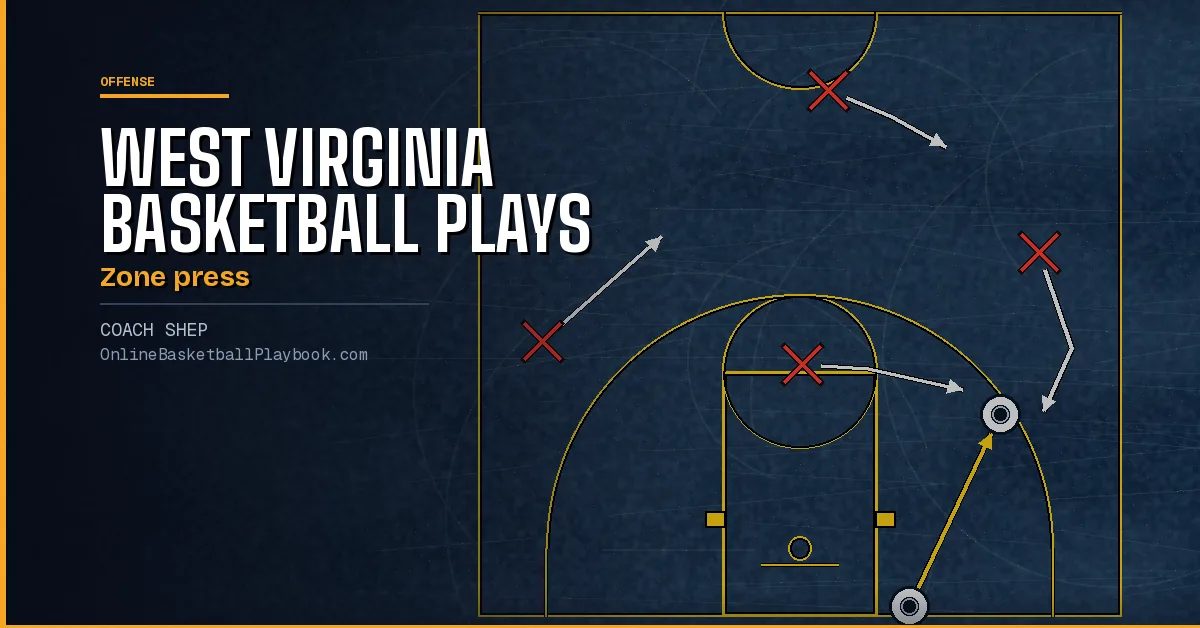
West Virginia basketball plays in this collection are not offensive sets. They are the zone press West Virginia ran when George King was the head coach, a press meant to speed the game up and rattle the other team, and one it often used to come from behind. The source is an old newspaper feature on the press and a set of eight numbered diagrams of its rotations. The idea is to double-team the ball again and again so the offense plays fast and out of control. This page groups those diagrams into 4 rotations across 8 frames. Every diagram is redrawn, and the text under it names where all five defenders are and where each one goes. Defenders are X1 to X5, and the offense is lettered A to E as in the original.
West Virginia Basketball Plays at a Glance
The first rotation is drawn in the back court, where the offense inbounds after a score. The other three are drawn past half court, at the end the offense attacks. The original diagrams of the first rotation cover the whole floor. These frames show one half court, so a defender in the other half is named in the text instead of drawn. The article also describes a half-court version, where the press pushes the ball handler into a corner near the 10-second line and the right-side guard and the middle man, playing just above the top of the key, look to pick off his pass. Its small diagram is too blurred to redraw with confidence, so it is described here in words only.
| Play | Family | Frames | What it does |
|---|---|---|---|
| The Inbounds Trap and the Return Pass | Trapping the Inbounds Pass | 2 | The press lines up after a score, lets the inbounds pass come in, traps the catch, then traps again when the ball goes back to the inbounder. |
| Up the Sideline to the Corner | Rotations Past Half Court | 3 | The ball gets past half court up one side. X5 stops it, the wing and the point take over the trap, and a pass to the corner brings the baseline man out to trap. |
| Ball in the Middle | Rotations Past Half Court | 1 | When the ball gets to the free-throw line, the point man and the middle man trap it and the other three fill the wings and the basket. |
| Wing Trap to Corner Trap | Rotations Past Half Court | 2 | The point man and the strong-side wing trap the ball on the wing. When it goes to the corner, the wing and the baseline man trap it there. |
How to Read These Diagrams
Every play is drawn frame by frame, one diagram for each frame of the original, and the text under each diagram says where every player starts and where he goes. The basket is at the bottom of each diagram. Sides are named as a player sees them facing the basket, so the left wing is on the right side of the picture. A solid arrow is a cut, a dashed arrow is a pass, a wavy line is a dribble and a line ending in a short bar is a screen. The diagram guide covers the symbols in full. No offensive player starts a frame standing in the lane. Where a source frame had someone there, he is drawn on the nearest lane line or block.
Get the next coaching guide in your inbox
One email when a new guide or diagram set goes up. Free.
Trapping the Inbounds Pass
The Inbounds Trap and the Return Pass
The press lines up after a score, lets the inbounds pass come in, traps the catch, then traps again when the ball goes back to the inbounder.

Frame 1. This picture shows the back court, the end where the offense inbounds after a score. The inbounds baseline is at the bottom, half court is the top line, and the offense brings the ball up toward the top of the picture, away from this basket. A takes the ball out of bounds just outside the lane and passes in to B, who catches it on the ball side at the three-point line, a little below the level of the free-throw line. The press wants that first catch in front of its first line. X1 starts at the free-throw line. X2 starts up the floor from B, near the sideline. Both come at the ball to trap B, X1 from the middle and X2 back down from above, on the sideline side. X3, the weak-side wing, starts on the far side of the floor and moves up the floor toward the middle to cover the weak side of this half. X4 starts at the center circle and moves toward the ball side to cut off a pass up that side. X5 is off this picture, deep in the other half of the court, where he guards the deep area and can be used to cut off the weak side at half court.

Frame 2. Same back court as frame 1, with the offense still bringing the ball up toward the top of the picture. Between frames, with no arrow drawn, B has moved up the floor near the sideline on the ball side. B has the ball there. A steps in from out of bounds into the lane, below the free-throw line, and B passes the ball back to him. The original picture does not draw this pass. Its note only says the ball went back to the inbounder, so the pass line here is drawn from that note. C waits on the far side of the floor near half court. X3 comes back across from the far side to stop A from moving up the floor, and X1 comes from low on the ball side to trap A with him, so X3 and X1 trap the ball in the lane just below the free-throw line. X2, low on the ball side near the sideline, gives up and runs back to the center circle. X4 drops back to half court and keeps going over it into the deep area in the other half, off this picture. X5, in the other half of the court, moves up to become the cut-off man at half court. He is off this picture.
Rotations Past Half Court
Up the Sideline to the Corner
The ball gets past half court up one side. X5 stops it, the wing and the point take over the trap, and a pass to the corner brings the baseline man out to trap.

Frame 1. Now the picture shows the other end, the front court the offense attacks. Half court is the top line and the offense brings the ball down toward the basket at the bottom. C has the ball just past half court on the left side of the floor. X5, the man who had come up to cut off at half court, is just below him and stops him from coming further. X3 and X1 run back from the trap in the back court. The picture starts them where they cross half court. X3, the strong-side wing, comes at C from above and inside to trap him with X5. X1 runs through the center circle and settles below and inside the ball, as the point man. X2 starts just above the free-throw line and hooks down into the right side of the lane, back to his weak-side wing spot. X4 starts high on the right side and runs down across the lane to the left side of the basket, low, where he becomes the man who roams the baseline.

Frame 2. Front court, the offense attacking the basket at the bottom. C still has the ball near the left sideline, a few feet past half court. X5 lets go of the ball and runs back toward the middle, to the left elbow area, his pivot spot. X1 and X3 take over the trap: X3 swings around under C into the spot X5 left, between C and the baseline, and X1 comes up from below and inside to trap from the middle of the floor. X2 steps out of the lane to the right side, level with the free-throw line, and X4 moves from low beside the lane out toward the left corner. Both are settling into their usual spots.

Frame 3. Front court, the offense attacking the basket at the bottom. C has passed down the left sideline to D, who has the ball low on the left side, toward the corner. C stays up near half court. Neither the pass nor D's move is drawn, and between frames X5 has dropped into the lane with no arrow. X4, the man who roams the baseline, comes out from low beside the lane to get between D and the baseline. X3, the strong-side wing, runs down the sideline from above D to trap him with X4. X1 lets go and runs back to his point spot, just above the free-throw line. X5 holds his pivot spot in the lane. Two short arrows show him sliding toward the ball or dropping toward the basket. X2, the weak-side wing, drops from the right side toward the right block, between the ball and the far corner.
Ball in the Middle
When the ball gets to the free-throw line, the point man and the middle man trap it and the other three fill the wings and the basket.

Frame 1. Front court, the offense attacking the basket at the bottom. E has the ball at the free-throw line. X1 traps him from above on the left side and X5 traps him from below, in the lane. X2 moves up from low on the right side to the right wing, level with the free-throw line. X3 moves up from low on the left side toward the left elbow, so both wings sit between the ball and the corners. X4 comes back from the left corner along the baseline to his deep spot under the basket.
Wing Trap to Corner Trap
The point man and the strong-side wing trap the ball on the wing. When it goes to the corner, the wing and the baseline man trap it there.

Frame 1. Front court, the offense attacking the basket at the bottom. B has the ball on the right wing. X1, the point man, comes from just above the free-throw line and X2, the strong-side wing, comes up from below B, and the two trap him. X5 holds his pivot spot in the lane and slides toward the right block. X3, the weak-side wing, drops from the left side to the left block to stay between the ball and the far corner. X4, who roams the baseline, starts in front of the basket and moves toward the right corner.

Frame 2. Front court, the offense attacking the basket at the bottom. B has passed to C in the right corner. That pass is not drawn. B stays on the right wing. X2 drops straight down the sideline from above C and X4 comes out along the baseline, and the two trap C. X1 goes back to the middle, to his point spot just above the free-throw line. X5 holds his pivot spot in the lane, sliding toward the right block. X3, the weak-side wing, drops from the left side to the left of the basket, between the ball and the far corner.
Ideas That Repeat
- Two men trap the ball in every one of the eight frames, and the pair changes as the ball moves.
- When the ball moves, a trapper who is not in the new trap lets go and runs to an open spot: the point, half court or the deep area.
- The weak-side wing drops to stay between the ball and the far corner. The diagrams say this in four of the eight frames.
- X4 roams the whole baseline. He comes out to trap when the ball goes to a corner and goes back under the basket when it comes to the middle.
- X5 starts deep, moves up to cut off at half court when the ball is reversed, and holds the pivot spot in the lane once the ball is past half court.
- A pass back to the inbounder gets trapped too, so a reversal does not get the offense out of trouble.
King put personnel first: the guard and cut-off spots need very quick players, and every man has to want to press, because one or two players who will not work break the whole thing down. He estimated West Virginia used the press only six or seven times that season. Its weak spot is a big man who catches behind the front line. Once the ball gets there, the press has lost its strength.
For modern versions of the same idea, see the 2-2-1 press, full court press defense, the best full court press and the Vance Walberg full court press. The trap itself is covered in trapping in basketball and half court trap defense. To build a team that can press, read how to build a pressing team and when not to press, and to see it from the other side, basketball press break. West Virginia is one of the programs on the college basketball plays page, and the press guides sit under the Defense hub.
Questions Coaches Ask About West Virginia Basketball Plays
What are the West Virginia basketball plays on this page?
The rotations of West Virginia's zone press under George King: the inbounds trap and the return pass, the trap up the sideline and into the corner, the trap on a ball in the middle, and the wing trap that turns into a corner trap.
How does the West Virginia zone press line up?
After a score, X1 and X2 attack the first catch, X3 drops back from the weak side, X4 starts at the center circle to cut off a pass up the ball side, and X5 plays deep in the other half.
What happens when the ball goes back to the inbounder?
X3 comes across to stop him and X1 traps with him. X2 runs back to the center circle, X4 drops deep and X5 moves up to cut off at half court.
Who traps when the ball goes to the corner?
The baseline man, X4, comes out to stop the ball and the strong-side wing traps with him. The point man goes back to the middle and the far wing drops between the ball and the far corner.
Did West Virginia press all game?
No. The article says West Virginia used it about six or seven times that season and presents it as a comeback weapon.
School profile: West Virginia Mountaineers on College Basketball Recruit.
Want the printable playbook packs?
Playbook packs: zone attack, press break, press defense, out of bounds, quick hitters, practice plans and the youth turnover cure, each a printable PDF. Or draw your own version free in PlayDraw.
See the playbook packsMore College Basketball Plays
- College Basketball Plays: Sets and Systems by Program
- Butler Basketball Plays: Brad Stevens Ball Screen Sets
- Gonzaga Basketball Plays: Flex Quick Hitters
- Kansas Basketball Plays: Bill Self 2-3 Zone Offense
- Michigan State Basketball Plays: Tom Izzo Sets
- Xavier Basketball Plays: Chris Mack Man Offense Sets
- Northern Kentucky Basketball Plays: AI, Delay and Strong Sets
- Pitt Basketball Plays: 1-4 High Sets and Ball Screens
- Davidson Basketball Plays: Motion Offense Rules and Actions
- Belmont Basketball Plays: Backdoor, Chicago, Chin and Nail Sets
- UConn Basketball Plays: 2023 Half-Court Sets Frame by Frame
- Duke Basketball Plays: Motion, Early Offense and Zone Ideas
- Michigan Basketball Plays: Beilein Chin and Shuffle Sets
- Florida Basketball Plays: Billy Donovan Spread Pick and Roll
- Wisconsin Basketball Plays: Bo Ryan Swing Offense Sets
- UCLA Basketball Plays: John Wooden High Post Options
- Memphis Basketball Plays: 2006 Dribble Drive Motion Sets
- Villanova Basketball Plays: Jay Wright 4-Out, Perretta Motion
- Seattle U Basketball Plays: The Chin Offense, Read by Read
- UConn Women's Basketball Plays: Auriemma's Strong and Elbow Sets
- BYU Basketball Plays: Mark Pope Pistol, Ricky and STS Sets
- Wichita State Basketball Plays: Shocker, 57 WU, 1-3-1 Special
- Virginia Basketball Plays: Blocker-Mover Sets, Frame by Frame
Back to College Basketball Plays and every Offense page.
Keep Building
Related breakdowns
Strategies for Coaching Against Zone Press Defenses
How to coach against zone press defenses: what the 1-2-1-1, 2-2-1, 2-1-2 and 1-3-1 take away, the spacing that beats them, how to break the trap and the drills.
Virginia Basketball Plays: Blocker-Mover Sets, Frame by Frame
Virginia basketball plays: the blocker-mover setup, its actions, four half-court sets, one full possession and two inbounds plays, drawn frame by frame.
Duke Basketball Plays: Motion, Early Offense and Zone Ideas
Duke basketball plays from its motion offense and early offense, plus motion ideas against a zone, drawn frame by frame with where every player goes.