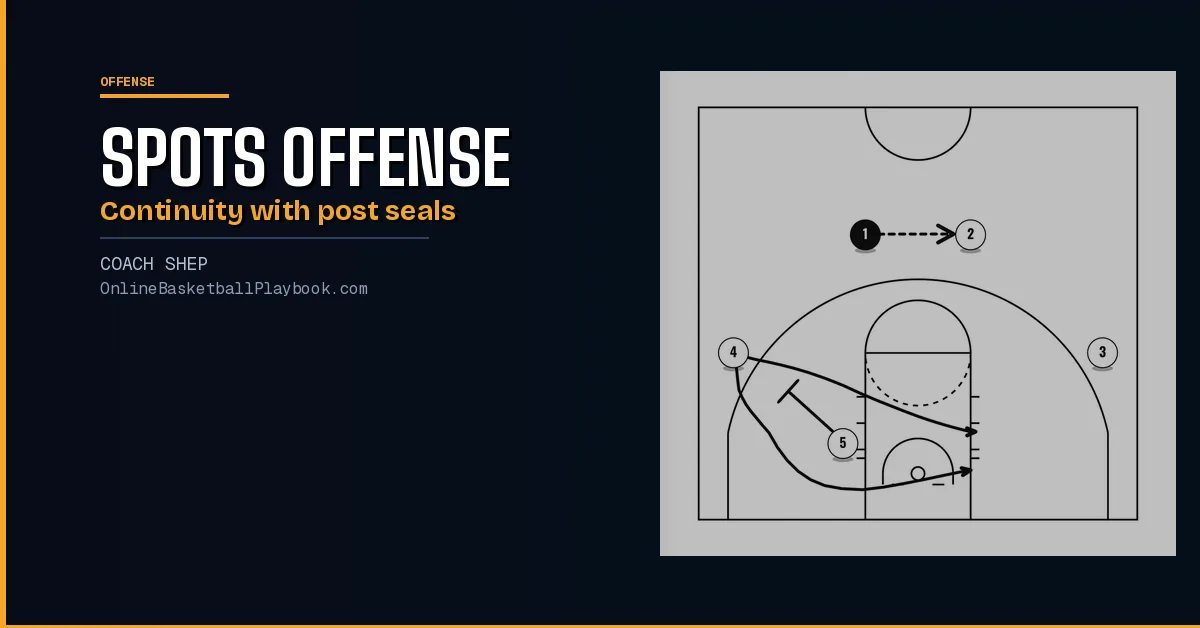
The Spots offense in basketball is a half-court continuity with two guards at the slots, two wings and one post on the ball side. Every pass triggers a set move, mainly a back screen for the wing on the side away from the ball, and the players refill the same five spots so the offense can run again. It is a driving and post-up offense: dribble penetration is a critical part of it, and the post is kept as isolated as possible.
How a continuity differs from motion is on continuity offense basketball.
The Set: Triangle Side and Open Side

The five spots:
- The two guards, 1 and 2. They stand at the slots, lane line extended, out beyond the arc.
- The two wings, 3 and 4. They stand on the wings.
- The post, 5. He starts on the block on the ball side.
The side with the ball is the triangle side: the guard, the wing and the post. Across from it is the open side. Spacing has to hold. Players stay high and wide, which gives the player with the ball room to operate, and the post is isolated as much as possible. How far apart the spots sit, and why gaps matter, is on what is spacing in basketball. Get the five spots right before teaching a single cut.
Spots Offense Basic Movement
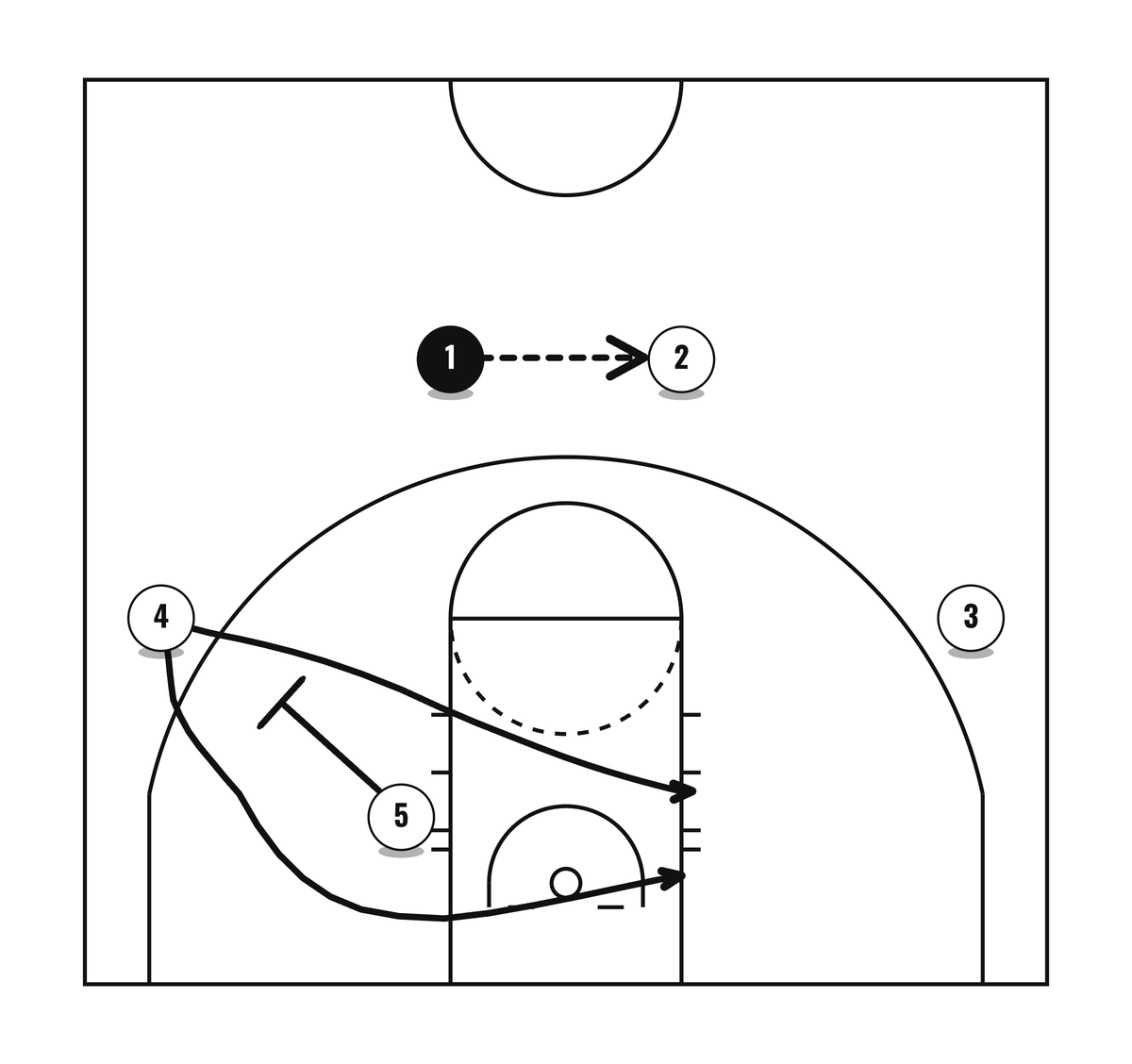
The guard to guard pass starts it. 1 passes to 2, and 5 back-screens for 4. The cutter can use either side of the screen, depending on how his defender plays it. He crosses the lane and becomes the post on the new ball side. Back screen footwork and angles are on back screen basketball.

The passer throws his hands up and widens out to the wing. The screener cuts up to take the guard spot the passer left and looks for a shot. The offense has reloaded into the same five spots, with the ball and the post now on the left side.

Reverse it again and the mirror image follows. The rules that keep it running:
- With no shot or drive available on the catch, hold it for a two count.
- Give the post a good look.
- Then move the ball on with the next pass so the movement never stops.
- Every catch must be a threat to score.
- Keep the spacing through every reversal.
The keys of the offense:
| Key | What it is |
|---|---|
| Passing key 1 | Lane line to lane line pass, the guard to guard pass above |
| Passing key 2 | Lane line to wing pass |
| Passing option 1 | High-low post feed |
| Passing option 2 | Wing post feed |
| Dribble key 1 | Baseline drive with a baseline drift |
| Dribble key 2 | Lane line drive into the middle seam |
Each one gets its own section below. Learn the guard to guard pass and the back screen first.
Post Seals and the Cut Up the Lane
Before the ball is passed, the post reads how he is played:
- Fronted: he seals.
- Played behind: he uses a leg whip.

The cutter off the back screen has a job beyond reaching the far block. He comes up the lane and looks to seal in the lane first. That gives the guard two places to feed him, in the lane or at the block. Post footwork once he catches is on basketball post moves, and the high-low feed is on high low offense basketball. Make the cutter seal on the way, every time.
The Lane to Wing Pass

When the guard passes to the wing on his own side instead of across to the other guard, the action changes. The post holds his post-up for a one count, then screens for the passer. The passer cuts off it and posts up. On the open side the other two players cut, exchange and space.

A second option off the same pass has the passer cut through the lane and out to the far wing while the other two rotate up behind him. The two options start with the same pass, so pick the one that fits your guards and rep it until the cut and the fills happen together.
Post Feeds and Getting Back In
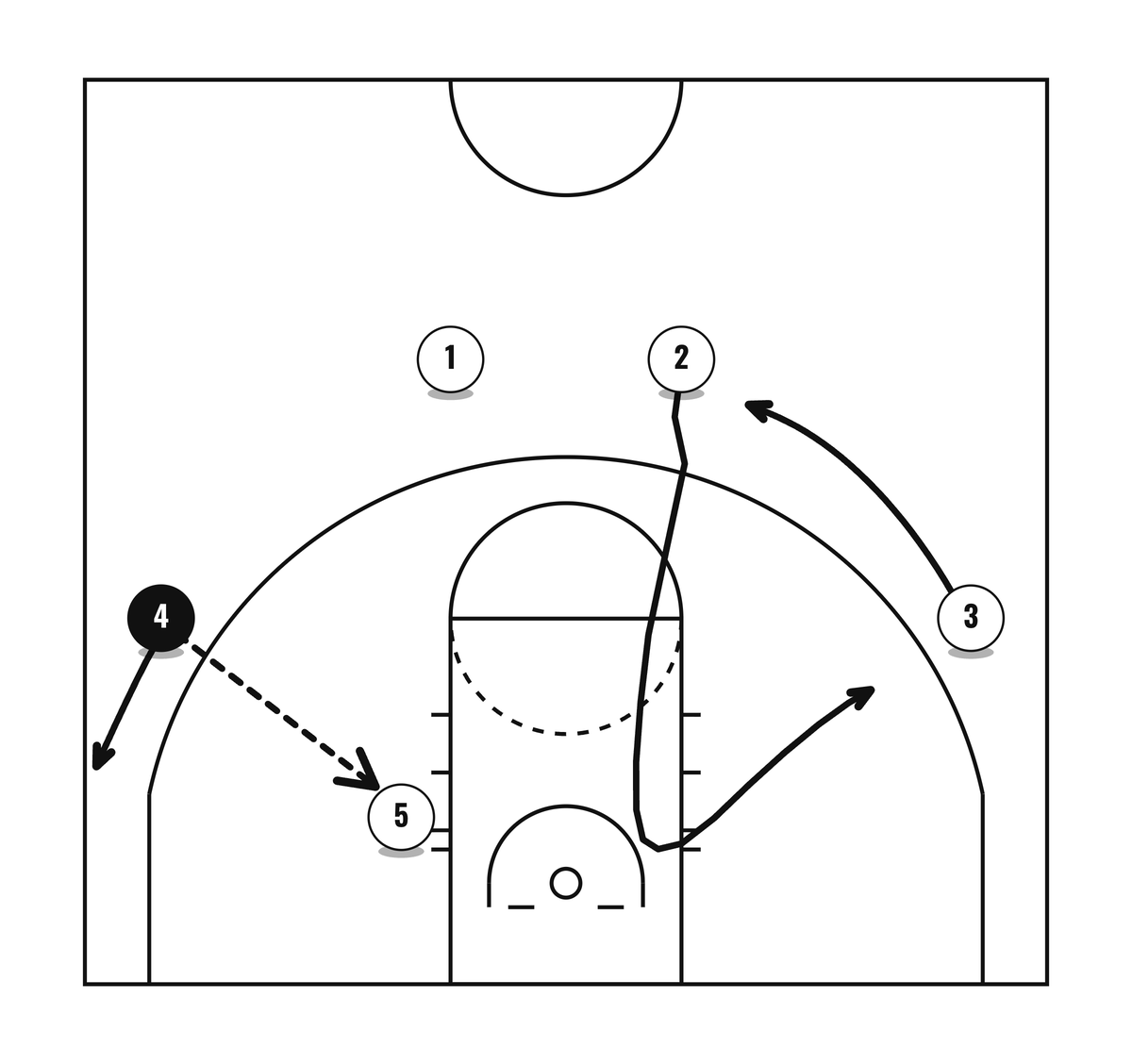
When the wing feeds the post, he relocates. The rest move around the post:
- 1 finds an open area and spots up.
- 2 dives into the gap between the block and the rim.
- 3 fills the left slot.

If the post passes out to the opposite guard and no shot comes, everyone goes back to the spots. From there it is the basic movement again: the ball is now at the left slot, so 5 back-screens for 4, 4 crosses to the left block, 1 widens to the right wing and 5 steps up to the right slot. When the post kicks it to the corner instead, the offense runs the lane to wing pass action from there: 5 screens near the right elbow, 1 cuts off him to the block, and 2 and 3 exchange on the open side. Wherever the ball comes out of the post, run the action that pass calls for.
Skip Passes
Any skip pass follows the same rule as if the ball had been passed there directly. A skip from the wing to the far guard gets the same back screen and cross as the guard to guard pass.

The guard to wing skip runs in two parts. First, the back screen and cross put 4 on the left block, 5 at the right slot and 1 on the right wing. Second, with 3 holding the ball on the left wing, 4 steps up and screens for 2 near the left elbow and 2 cuts off him toward the post. 5 cuts from the right slot to the right block and 1 fills the right slot.
The skip pass is stressed because of the spacing in the offense. The ball does the talking, and the spot where it lands sets the movement. Teach the skip as one more pass, not a special play.
Dribble Options

On a baseline drive from the wing, the post loops up the lane line, the far wing drifts baseline and the guard trails behind the driver.

On a middle drive from the slot, the post goes to the short corner, the far wing drifts baseline and the other guard fills the wing. Where the other players go on penetration in general is on teaching dribble penetration reads. Dribble penetration is a critical part of this offense, so drill both drives with all five players moving.
Counters and Pressure Releases
When the defense takes away the next pass, the Spots offense has answers that keep the spots intact.

Dive and fill. When the other guard is overplayed, he dives and the wing on his side fills his spot.

Dribble down. The guard dribbles at the wing, the wing cuts to the block and the post comes up to the guard's spot. The dive and fill and the dribble down can also be run together.
Dribble up. The wing has the ball and dribbles up toward the slot. The guard cuts down the lane line toward the post, the post steps out to the wing, and on the open side the guard and wing dive and fill.

Bust up by the post, flare. The post flashes high and the guard passes to him. The far wing sets a flare screen for the other guard. The passer bluffs a screen for his wing and comes back to the ball, and the wing cuts backdoor. Flare screen technique is on flare screen basketball, and other backdoor looks are on backdoor triggers.

Bust up by the post, slip. The post flashes and catches. The open side dives and fills. The passer screens for his wing, the wing runs off the top side of the post, and the screener slips to the rim. Both counters can also be used as an entry. Keep both ready for the possession that stalls.
Screen Reads
The cutter reads how the back screen is defended.

Bump cut. If the defense goes under, the cutter turns down the screen and bumps up to the slot. A team may also run a continuous bump cut to keep one chosen player in the post.

Switch, cut over. When the defenders switch the screen, the cutter continues his cut over it and the screener seals his man off.

Switch, cut under. On the switch, the cutter can also continue under the screen while the screener seals and flashes. Defensive switching itself is on switching defense basketball, and more screen work for the cutter is on drills to teach off-ball screens. Drill each read against a defender who plays it that way until the cutter reads it without a call.
Entries and After a Made Basket

Both entries begin with a dive and fill on the left side. The first is the dive and fill alone, as in the pressure release above. The second adds a screen by the right wing for the post, who comes off the block out to the wing. The pin down itself is on down screen basketball.

After a made basket, the post takes it out and inbounds to the point guard, who brings it up the middle. 2 and 3 run the sidelines, the inbounder runs the floor and 4 is already at the right block. Other half-court systems to compare are on motion offense basketball, 5 out motion offense, 4 out 1 in offense and swing offense. Start every possession from the same five spots and let the ball call the movement.
Questions Coaches Ask
What is the Spots offense in basketball?
A half-court continuity with two guards at the slots, two wings and a post on the ball side. A guard to guard pass brings a back screen for the far wing, who crosses to become the new post, and the screener replaces the passer at the slot.
What are the triangle side and the open side?
The triangle side is the side with the ball: the guard, the wing and the post. The open side is the side away from the ball.
How does the Spots offense handle a skip pass?
The same way it handles a direct pass. Wherever the ball lands decides the movement, so a skip brings the same back screen and cross as a pass made straight to that spot.
What does the cutter do when the defense switches the back screen?
He keeps cutting, over the screen or under it, while the screener seals his new defender. If the defense goes under the screen instead, the cutter turns it down and bumps up to the slot.
What if the defense denies the first pass?
Use a pressure release: the overplayed guard dives and the wing fills, the ball handler dribbles down or up, or the post flashes high to catch and start one of the post flash counters.
Every diagram on this page uses the symbols on how to read a basketball play diagram. The Spots offense is one of the systems on basketball offense.
Get the next coaching guide in your inbox
One email when a new guide or diagram set goes up. Free.
Want the printable playbook packs?
Playbook packs: zone attack, press break, press defense, out of bounds, quick hitters, practice plans and the youth turnover cure, each a printable PDF. Or draw your own version free in PlayDraw.
See the playbook packsBack to Continuity Offense and every Offense page.
Keep Building
Related breakdowns
Ball Screen Continuity Offense: Pick and Roll Rules and Reads
Ball screen continuity offense in full: the 4-out and two-big engines, reload rules, spacing, angles, reads, counters, Spain, Ram, double drag and zone sets.
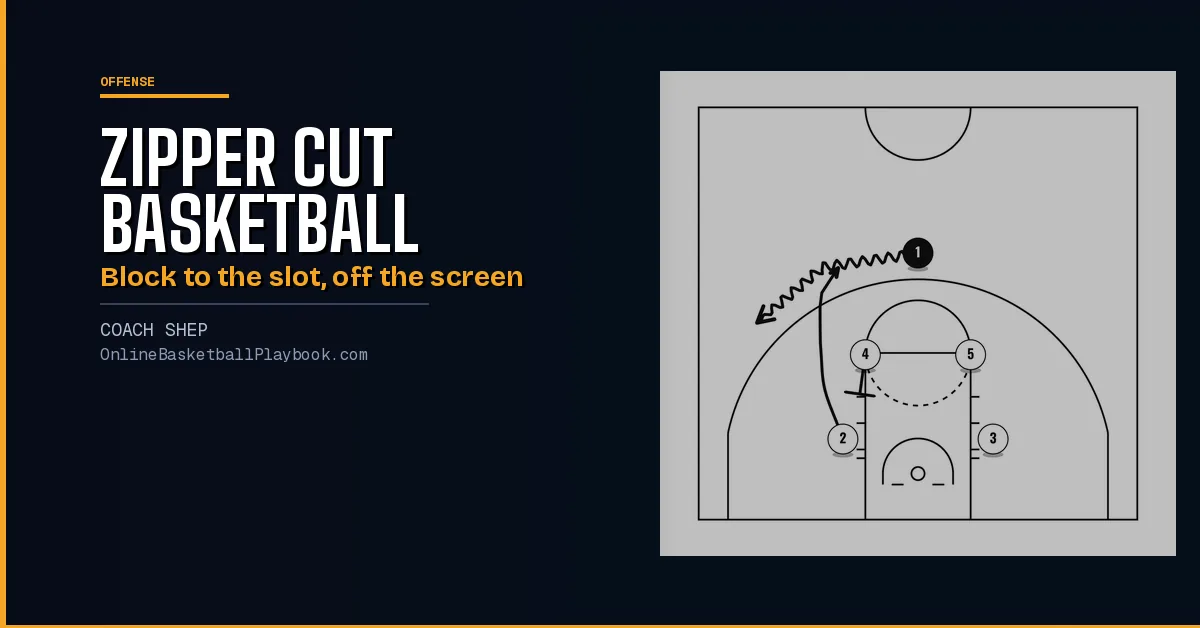
Zipper Cut Basketball: Zipper Screen, Action and Reads
Zipper cut basketball explained: the down screen that brings a player from the block to the top, where the screen goes, what the catch leads to and the reads.
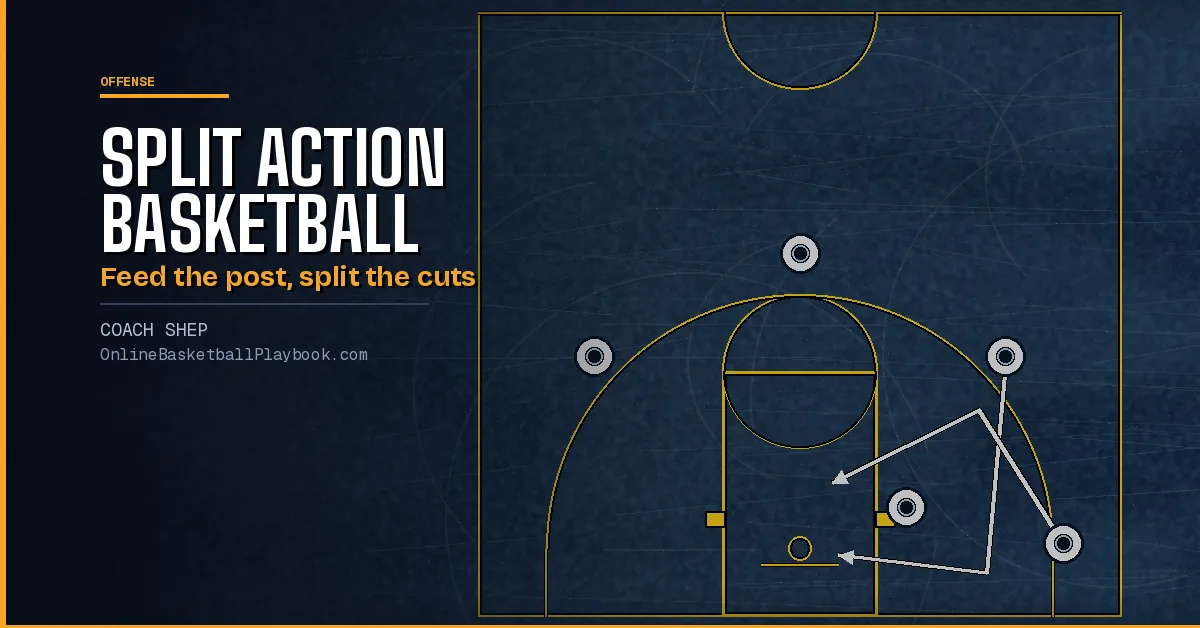
Split Action Basketball: Post Splits, Cuts and Reads
Split action basketball explained: the post feed and the two cutters, straight and reverse splits, the high post split, the reads and counters, and how to defend it.